AI at the Core · Section 6 · version 1.0, released 24 November 2026
6The university playbook
None of this requires training frontier models.6.1Build a stack, own what differentiates

Own what differentiates; rent or federate the rest.
Picture 65 of 100 · its page
- A university and its innovation campus are best served by building an AI research stack in layers.
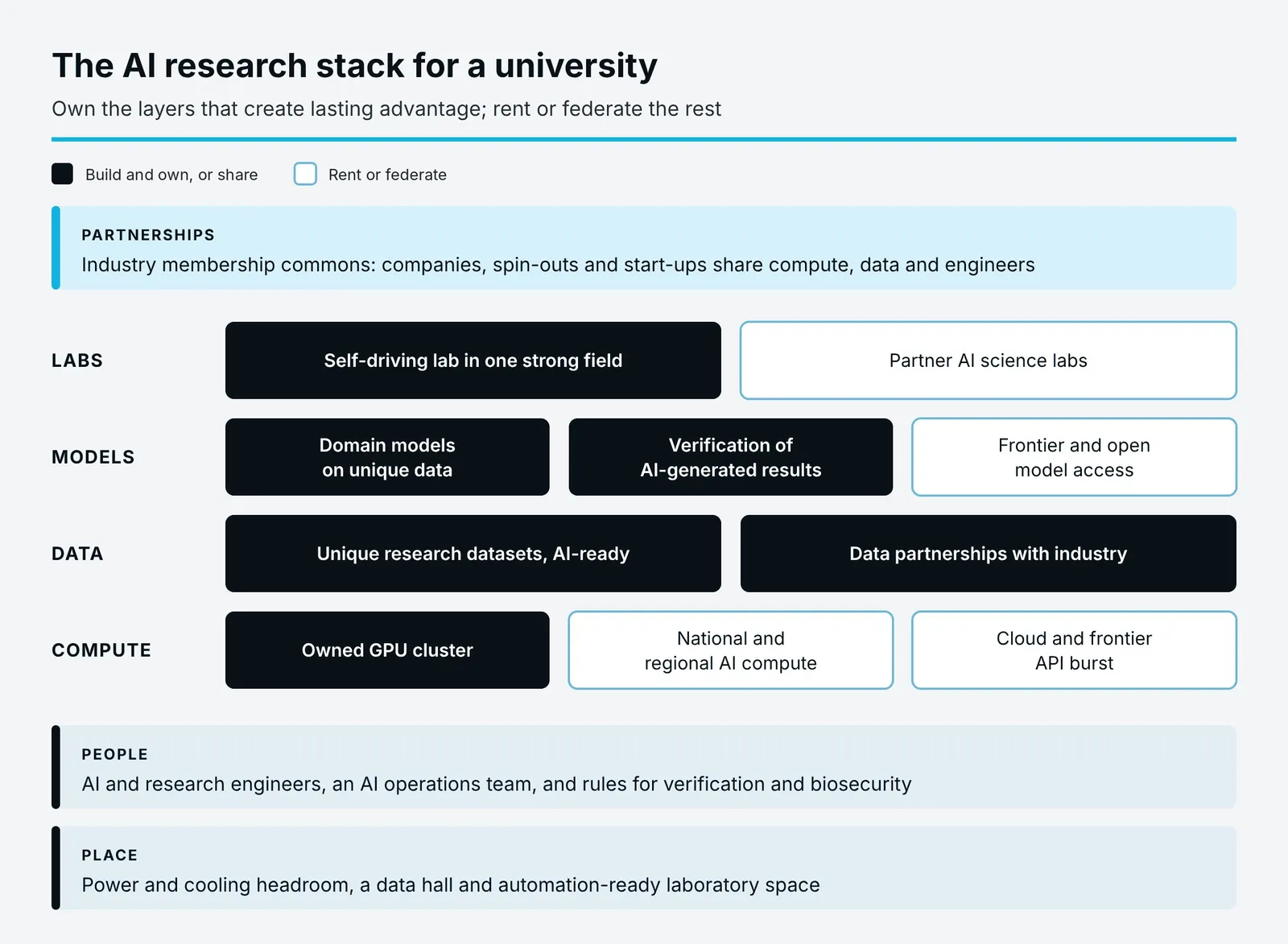
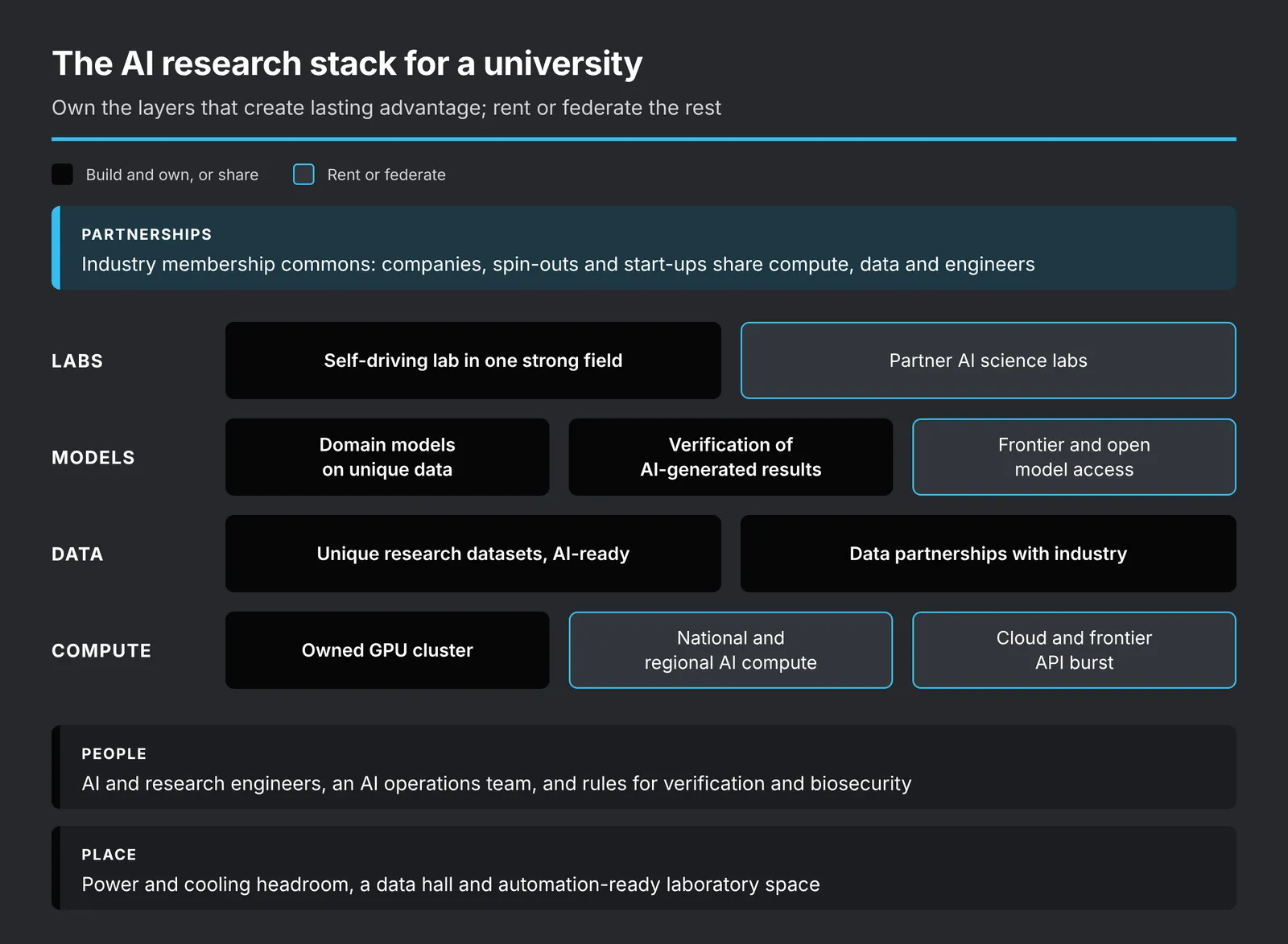
A university and its innovation campus should build an AI research stack in layers. It should own the layers that give lasting advantage and rent or federate the rest.
- Compute in three tiers. First, where measured workloads, sensitive data or services to industry justify it, an owned cluster for inference, fine-tuning, teaching and sensitive data, sized to that demand and planned to complement national systems. Princeton funded a 300-GPU cluster largely from its endowment. A regional university can start with 16 to 32 GPUs and grow towards about 64. Second, national and international machines for large runs. Third, one institution-wide agreement for frontier models, rather than many individual ones, covering confidentiality, no training on users' work, ownership of outputs and research priority. Most work can run under the education and academic agreements that Google, Microsoft, OpenAI and Anthropic already offer. Keep open models on the owned cluster for patient, partner-confidential and export-controlled data, and for continuity if a provider's models are withdrawn, and negotiate text-and-data-mining rights.
- Models as a shared service. A curated catalogue of open models and a small central team to adapt, deploy and evaluate them, with domain models in the two or three fields where the institution has distinctive data.
- Data as the differentiator. Access to capable general models is widely shared; distinctive data is not. Inventory what the university and its region uniquely hold, prepare it for AI use under proper governance, and build data partnerships with industry.
- A closed-loop laboratory. At least one self-driving laboratory, where AI designs experiments, robots run them and results inform the next experiments. Liverpool, Illinois and Toronto show that universities can build these, and low-cost platforms now make a pilot affordable.
- Verification and governance. Machine-checked results where possible, named expert review of what formal results claim, auditable records of agent work, and controls for provenance and biosecurity. Governance spans every layer and works best as one function. That function needs an accountable owner and a small group with authority to pause AI work when, for example, an agent acts beyond its permissions, sensitive data is exposed or a result raises dual-use concerns. Its remit covers agent permissions, ethics review, data protection, EU AI Act duties, dual-use screening and compute allocation.
- People. A career track for research software and AI engineers, with standing comparable to academic posts, an AI operations function, and doctoral training that teaches students to direct and check AI without losing the underlying skills.
- Place. Power and cooling headroom well beyond the first node (megawatts if the campus will host industry or national capacity), a data hall, and laboratory space designed for automation, planned with the institution's net-zero commitments in mind.
The emphasis differs by institution (full report, Section 6.2).
- Research-intensive universities should prioritise an owned cluster of meaningful scale, domain models in their strongest fields and a leading role in national programmes.
- Regional and technical universities should lead with distinctive regional and industry data, applied domain models, an operations team built from existing engineering staff, and a right-sized owned node, or a share in one hosted by a partner institution that already has the facilities to run it. Their strength is close relationships with industry, and the main risk is spreading resources too thin.
- Private and endowed universities can fund a cluster from endowment, but must plan for running costs and limits on private use of bond-financed facilities.
- Innovation campuses can make the stack a central part of their offer, and a good test is whether companies choose the campus for what it offers, not only for its buildings.
A university and its innovation campus are best served by building an AI research stack in layers. That means owning the parts that create lasting advantage (a right-sized compute cluster, data, domain models, a closed-loop laboratory, verification and people) and renting or federating the rest, without training frontier models of their own. Figure 1 summarises the structure.
6.2Different starting points

Different universities should own different things.
Picture 66 of 100 · its page
- Research-intensive universities
- Regional and technical universities
- Private and endowed universities
- Innovation campuses and science parks
The same layers apply to every institution, but the emphasis, and what it owns rather than shares, differs.
- Research-intensive universities should prioritise an owned cluster of meaningful scale, domain models in their strongest fields, verification capability and a leading role in national programmes. Their risk is relying on national compute and frontier-model access they do not control.
- Regional and technical universities, including US regional public universities, should prioritise distinctive regional and industry data, applied domain models, an operations team built from existing engineering staff, a right-sized owned node, and federated access for large runs. An institution that already has a data centre, cooling and operations staff can also host equipment on behalf of others, which is cheaper than each building its own. Their advantage is close industry relationships. Their risk is spreading too thin.
- Private and endowed universities, including many US research universities, can fund an owned cluster from endowment or philanthropy, as Princeton did202. They should prioritise distinctive data, domain models, an offer to industry and partnerships with national centres such as the Texas Advanced Computing Center for large runs. Since 2026, the wealthiest have paid a higher federal excise tax on endowment income237. Their advantage is flexibility over capital. Their constraints are recurring operating costs and limits on private use of facilities financed with tax-exempt bonds (Section 7.5).
- Innovation campuses and science parks can make the stack a central part of their offer to tenants: an industry membership commons, compute and engineering support, and space designed for automation, alongside the talent, networks and proximity to the university that already draw companies. A good test is whether companies choose the campus for what it offers beyond its buildings.
- Princeton University (2024) 'Princeton invests in new 300-GPU cluster for academic AI research', 15 March. Available at: https:/
/ ai. princeton. edu/ news/ 2024/ princeton- invests- new- 300- gpu- cluster- academic- ai- research (opens in a new tab) - Ropes & Gray (2025) 'Congress passes final tax package: key provisions for tax-exempt organizations', July. Available at: https:/
/ www. ropesgray. com/ en/ insights/ alerts/ 2025/ 07/ congress- passes- final- tax- package- key- provisions- for- tax- exempt- organizations (opens in a new tab)
6.3Questions for university leaders

Seven questions every university leader should be able to answer.
Picture 67 of 100 · its page
- Sections 6.4 to 6.10 take the layers of the stack in turn, Sections 6.11 and 6.12 cover intellectual property and governance, and Section 7 covers cost and phasing.
- Do we know what AI compute we have today, and who owns the plan for it?
- Where do we sit in national and international infrastructure: what will we host, what will we access, and what will we contribute?
- Is AI treated as a method across all our research, or as one theme among many?
- Where do we hold distinctive data or expertise, and do we have the rights to use it?
- How will we verify AI-generated research and govern its use, and who is accountable, with the authority to stop it?
- How will operating costs and refresh be met once capital grants are spent?
- Is our campus being designed for compute, data and automation, and for the companies that will want to use them?
Sections 6.4 to 6.10 take the layers of the stack in turn, Sections 6.11 and 6.12 cover intellectual property and governance, and Section 7 covers cost and phasing.
6.4Compute as core infrastructure

Plan compute in three tiers, like a library or a cleanroom.
Picture 68 of 100 · its page · 1 more for this section
- An owned cluster
- Federated national and international capacity
- Institution-wide access to frontier models.
Compute should be planned in the same way as a library or a cleanroom: shared across faculties, centrally funded and designed into the campus from the outset. I recommend three tiers.
- An owned cluster, where measured workloads, sensitive data or services to industry justify one, sized to that demand and sufficient for inference, fine-tuning, teaching and work on sensitive data that cannot leave the institution. It is best planned as an institutional or regional tier that complements national systems rather than replicating them. A node of 16 to 32 GPUs is a credible first phase: enough for inference on sensitive data, fine-tuning, teaching and small domain models, but not for sustained institution-wide demand, substantial training or a commercial compute offer. Smaller universities can start there and grow towards about 64 GPUs as measured use justifies it.
- Federated national and international capacity for large training runs, through programmes such as those in Tables 4 and 6.
- Institution-wide access to frontier models. What most researchers need day to day is affordable access to capable models on terms that protect their data and intellectual property. OpenAI and Anthropic now run academic programmes5154. Google offers its Gemini app to all Workspace for Education users at no charge, with conversations neither reviewed by people nor used to train models238, and universities such as Cambridge give staff and students Microsoft's Copilot Chat under their existing licence on similar terms239. A central agreement is preferable to many individual arrangements and gives the institution control over data terms: confidentiality, no training on users' work, ownership of outputs and protection of research priority. A university that already trusts a provider with its email and documents has a starting point, but terms on training, research IP and sensitive data still need checking separately. The route should follow the sensitivity of the data: education or enterprise agreements for most work, open models on the owned cluster for patient, partner-confidential and export-controlled data, and national or European providers, such as Mistral, where jurisdiction matters187. Access can also change overnight for reasons outside a university's control: in June 2026, a US government directive barring access by foreign nationals led Anthropic to suspend its two most capable models for all customers for about three weeks231. Open models on the owned cluster provide continuity in such cases.
A university's compute is better measured by the access its researchers have to computing, expertise and services than by the amount of hardware it owns.
- Anthropic (2026) Expanding support for scientists, 27 August. Available at: https:/
/ anthropic. com/ news/ expanding- support- for- scientists (opens in a new tab) - OpenAI (2026) 'Accelerating scientific discovery with ChatGPT for Academic Researchers', 29 July (updated 10 August). Available at: https:/
/ openai. com/ index/ chatgpt- for- academic- researchers/ (opens in a new tab) - Orrick (2026) 'Orrick advises Mistral in its €3B Series D funding round at €21B post-money valuation', 8 September. Available at: https:/
/ www. orrick. com/ en/ news/ 2026/ 09/ orrick- advises- mistral- in- its- 3b- series- d- at- 21b- post- money- valuation (opens in a new tab) - Anthropic (2026) 'Statement on the US government directive to suspend access to Fable 5 and Mythos 5', 12 June. Available at: https:/
/ www. anthropic. com/ news/ fable- mythos- access (opens in a new tab) - Google (2025) 'Gemini app now available with enterprise-grade data protections for all Google Workspace for Education users', 28 March. Available at: https:/
/ blog. google/ outreach- initiatives/ education/ gemini- enterprise- grade- data- protection (opens in a new tab) - University of Cambridge Information Services (2024) 'Copilot', IT Help and Support, 28 March. Available at: https:/
/ help. uis. cam. ac. uk/ node/ 15002 (opens in a new tab)
6.5Models as a shared service

Half of all articles are subscription-only, so AI tools mostly see their abstracts.
Picture 70 of 100 · its page
- Every researcher should have access to frontier models and a curated catalogue of open models, supported by a small central team able to fine-tune, deploy and evaluate them.
Every researcher should have access to frontier models and a curated catalogue of open models, supported by a small central team able to fine-tune, deploy and evaluate them. The institution should then choose two or three domains in which it holds distinctive data or expertise, and build domain-specific models there. Choosing where to build domain models first is not the same as deciding who uses the infrastructure: access should go to the work likely to create most benefit, broadly defined, across the institution. Section 3 suggests how to choose: favour fields with good data, a way to check results and industry partners able to act on them. For many universities with medical schools, hospitals or biobanks, the life sciences will be one of those domains. Such models become assets that industry partners will pay to use, on licence terms the institution sets (Section 6.11).
Models also need current literature. A model's built-in knowledge lags its release by months or more, so AI tools miss recent publications unless they retrieve them. When they search, they mostly see abstracts and open-access copies: in 2025, half of articles worldwide were subscription-only240. Universities should connect their AI tools to library subscriptions, preprint servers and their own publications, and negotiate text-and-data-mining rights with publishers. Copyright law helps: EU law allows research organisations to mine works they can lawfully access for scientific research241, and UK law allows mining for non-commercial research242.
- STM Association (2026) 'Uptake of open access', OA Dashboard. Available at: https:/
/ stm- assoc. org/ oa- dashboard/ oa- dashboard/ uptake- of- open- access/ (opens in a new tab) - Directive (EU) 2019/790 on copyright and related rights in the Digital Single Market, Article 3, 'Text and data mining for the purposes of scientific research'. Available at: https:/
/ eur- lex. europa. eu/ eli/ dir/ 2019/ 790/ oj (opens in a new tab) - Copyright, Designs and Patents Act 1988, section 29A, 'Copies for text and data analysis for non-commercial research'. Available at: https:/
/ www. legislation. gov. uk/ ukpga/ 1988/ 48/ section/ 29A (opens in a new tab)
6.6Data as the differentiator

Models are shared; distinctive data is not.
Picture 71 of 100 · its page
- Access to capable models is now widely shared and gives little lasting advantage, but the data each institution holds remains distinctive, so universities should inventory the datasets they and their regions uniquely hold, prepare them for AI use under proper governance, and establish data partnerships with industry.
Access to capable models is now widely shared and gives little lasting advantage, but the data each institution holds remains distinctive, so universities should inventory the datasets they and their regions uniquely hold, prepare them for AI use under proper governance, and establish data partnerships with industry. In October 2026, the US Department of Energy, Biohub, Google DeepMind, Isomorphic Labs and Meta committed about $1.3 billion of new money to AI-ready biological data, with the NIH coordinating existing datasets (Section 3.1)83. That is where they see the scarcity, and where a university of any size can lead internationally in a specialised area. Regional health data is one example: Northern Ireland has a single digital care record for every citizen who receives health and social care, and its Honest Broker Service gives researchers access to linked, de-identified health data in a trusted research environment243244.
- Biohub, US Department of Energy and National Institutes of Health (2026) 'International cross-sector collaboration commits nearly $2 billion to build foundational data for AI models to predict and treat disease', 7 October. Available at: https:/
/ www. newswise. com/ doescience/ international- cross- sector- collaboration- commits- nearly- 2- billion- to- build- foundational- data- for- ai- models- to- predict- and- treat- disease (opens in a new tab) - Digital Health and Care Northern Ireland (n.d.) 'encompass'. Available at: https:/
/ dhcni. hscni. net/ digital- portfolio/ encompass/ (opens in a new tab) - Health Data Research UK (n.d.) 'Northern Ireland Honest Broker Service (Northern Ireland Health and Social Care)'. Available at: https:/
/ www. hdruk. ac. uk/ organisations/ northern- ireland- honest- broker- service- northern- ireland- health- and- social- care/ (opens in a new tab)
6.7A closed-loop laboratory

A laboratory ran more than 11,000 steps with people only maintaining the hardware.
Picture 34 of 100 · its page · 2 more for this section
- At least one field in which experiments can be automated should host a self-driving laboratory, in which AI designs experiments, robotic systems run them and the results inform the next experiments.
At least one field in which experiments can be automated should host a self-driving laboratory, in which AI designs experiments, robotic systems run them and the results inform the next experiments. Liverpool, Illinois and Toronto show that universities can build these94123124. In November, Nature published AutoDNA, an automated laboratory at Shanghai Jiao Tong University in which AI agents ran more than 11,000 steps across more than 20 types of instrument to synthesise, transcribe, amplify and sequence nucleic acids, with people needed only to maintain the hardware and replenish reagents and labware3. The laboratory is also where the limit on speed-up will sit: Anthropic's researchers estimate that automating every step that needs no physical work could raise research output for a fixed budget 15 to 16-fold in fields with little physical work, but only 3 to 4-fold in bench sciences171. Such a laboratory generates proprietary data, attracts industry partners and trains staff for the laboratories of 2031.
- Wu, M. et al. (2026) 'An AI-native experimental laboratory for autonomous biomolecular operations', Nature, 4 November. Available at: https:/
/ www. nature. com/ articles/ s41586- 026- 11228- 6 (opens in a new tab) - University of Illinois News Bureau (2025) 'Self-driving lab: AI and automated biology combine to improve enzymes', 1 July. Available at: https:/
/ news. illinois. edu/ self- driving- lab- ai- and- automated- biology- combine- to- improve- enzymes/ (opens in a new tab) - Dai, T. et al. (2024) 'Autonomous mobile robots for exploratory synthetic chemistry', Nature, 635, 890–897. Available at: https:/
/ ideas. repec. org/ a/ nat/ nature/ v635y2024i8040d10. 1038_ s41586- 024- 08173- 7. html (opens in a new tab) - University of Toronto Engineering News (2023) 'Self-driving labs: $200-million federal grant powers AI-driven materials discovery…', 1 May. Available at: https:/
/ news. engineering. utoronto. ca/ self- driving- labs- 200- million- federal- grant- powers- ai- driven- materials- discovery- for- clean- energy- advanced- manufacturing- and- more/ (opens in a new tab) - Hermle, J., Jones, B., Althoff, L. et al. (2026) 'AI for scientific discovery: how researchers use Claude', Anthropic, 5 November. Available at: https:/
/ www. anthropic. com/ research/ how- researchers- use- claude (opens in a new tab)
6.8Verification, governance and people

Hardware is the easy part; people are the hard part.
Picture 73 of 100 · its page
- Verification sets the pace of AI-driven research (Section 2.2), and Anthropic's study of how researchers use Claude warns that more output could overwhelm scientists' capacity to check it171.
Verification sets the pace of AI-driven research (Section 2.2), and Anthropic's study of how researchers use Claude warns that more output could overwhelm scientists' capacity to check it171. Universities should therefore build the capability to check AI-generated results in the ways Section 5.2 describes: machine-checked proofs where possible, with named expert review of what they claim, calibrated estimates of uncertainty, auditable records of agent work, and reporting standards53155177. They should also agree standards for provenance, authorship and dual-use and biosecurity risk, including nucleic acid synthesis screening, which US policy proposes to require of federally funded institutions100. Access to the most capable models increasingly depends on such controls (Section 3.1)5999. Section 6.12 sets out how to hold these together as a single governance function.
Hardware is the easier part. I recommend that universities:
- Kallel, M. and El Louadi, M. (2026) 'Verification abundance, adjudication scarcity: what happens to mathematical knowledge when proof checking becomes free', arXiv preprint 2608.28997, 29 August. Available at: https:/
/ arxiv. org/ pdf/ 2608. 28997 (opens in a new tab) - Axios (2026) 'OpenAI launches new AI model for life sciences research', 16 April. Available at: https:/
/ axios. com/ 2026/ 04/ 16/ openai- models- life- sciences- drugs (opens in a new tab) - Anthropic (2025) 'Activating ASL-3 protections', 22 May. Available at: https:/
/ www. anthropic. com/ news/ activating- asl3- protections (opens in a new tab) - The White House (2025) Winning the Race: America's AI Action Plan, July. Available at: https:/
/ www. whitehouse. gov/ wp- content/ uploads/ 2025/ 07/ Americas- AI- Action- Plan. pdf (opens in a new tab) - Flemyng, E. et al. (2025) 'Position statement on artificial intelligence (AI) use in evidence synthesis across Cochrane, the Campbell Collaboration, JBI, and the Collaboration for Environmental Evidence 2025', JBI Evidence Synthesis, 23(11), 2162–2166. Available at: https:/
/ pmc. ncbi. nlm. nih. gov/ articles/ PMC12594113/ (opens in a new tab) - Hermle, J., Jones, B., Althoff, L. et al. (2026) 'AI for scientific discovery: how researchers use Claude', Anthropic, 5 November. Available at: https:/
/ www. anthropic. com/ research/ how- researchers- use- claude (opens in a new tab) - Kapoor, S. et al. (2024) 'REFORMS: consensus-based recommendations for machine-learning-based science', Science Advances. Available at: https:/
/ reforms. cs. princeton. edu/ (opens in a new tab)
6.9The stack as a reason to co-locate

Companies want expertise more than raw compute.
Picture 74 of 100 · its page · 1 more for this section
- Start-ups, spin-outs and spin-ins.
- What this means for founders and investors.
On a mixed research and industry campus, compute, data, models and talent together can be a strong draw for companies, alongside space, location and links to the university. The Hartree Centre at Sci-Tech Daresbury and the National Center for Supercomputing Applications at the University of Illinois are long-established examples of national facilities used this way207210. CommonAI CIC in Cambridge offers a newer model, a membership commons under a protected IP framework (Section 4.4)205. What companies, and especially SMEs, usually want is expertise and solutions rather than raw compute. University-based programmes already work this way. Ireland's Technology Gateways sit in technological universities and institutes of technology245; the UK's Knowledge Transfer Partnerships place a graduate employed by a university inside a company to lead a project246; and in the US, NSF's Industry–University Cooperative Research Centers let companies pool membership fees to fund university research247. Outside universities, national programmes play a similar role: the UK's Catapults, some of them based at universities248249; the US Manufacturing Extension Partnership250; and the European Digital Innovation Hubs, four of them in Ireland, which offer SMEs "test before invest" services251. Shared infrastructure, together with the research engineers, testing, validation and collaborative development that make it useful, can help tenants collaborate and share research services.
Start-ups, spin-outs and spin-ins. The stack also matters at the earliest stage. University spin-outs, start-ups that move to a campus to work with its researchers, and companies outside AI that want to apply it to the university's IP all need compute, data and expertise long before they can afford their own. An incubator can offer these as part of its package, through compute credits, access to shared data under clear terms and time with research engineers, with usage charged at cost or recovered through the university's existing spin-out terms where the facility's funding allows; publicly funded infrastructure may require market rates for commercial use (Section 7.5). In Dublin, CeADAR and NovaUCD already run an AI Ecosystem Accelerator for start-ups252.
What this means for founders and investors. The companies that will matter in AI for science are less likely to be those with the best general models, which are widely available and hard to turn into lasting advantage, than those with the best operating systems around the models. By operating systems I mean distinctive data, automated experimentation, verification, and the workflows that turn AI output into results that can be trusted and used. Many will start in universities that have built these layers, and grow on the campuses that share them. That is also where investors, SVV among them, will look for them. Oxford and Cambridge show how universities can organise for this. Oxford, through Oxford University Innovation, its technology transfer office, has been the UK's leading source of academic spin-outs for six consecutive years, according to the Royal Academy of Engineering253, and Oxford Science Enterprises was founded in 2015 to invest in them254. Cambridge's ai@cam mission has trained more than 750 researchers through AI-for-science and entrepreneurship programmes and helped create four spin-outs255, and Cambridge Innovation Capital has committed at least £100 million of its new fund to the university's spin-outs256.
- CommonAI CIC (2026) Home. Available at: https:/
/ commonai. org/ (opens in a new tab) - UKSPA (2018) 'Collaboration drives £17.3m boost for Sci-Tech Daresbury companies', 11 July. Available at: https:/
/ www. ukspa. org. uk/ collaboration- drives- 17- 3m- boost- for- sci- tech- daresbury- companies/ (opens in a new tab) - Cuff, J. (2018) 'The practice of collaboration between industry and HPC centers', The Next Platform, 10 July. Available at: https:/
/ www. nextplatform. com/ 2018/ 07/ 10/ the- practice- of- collaboration- between- industry- and- hpc- centers (opens in a new tab) - Enterprise Ireland Technology Gateway Network (2025) 'What are Gateways?'. Available at: https:/
/ technologygateway. ie/ network/ (opens in a new tab) - UK Research and Innovation (2025) 'Knowledge Transfer Partnership guidance: who can take part', Innovate UK, updated 27 October. Available at: https:/
/ www. ukri. org/ councils/ innovate- uk/ guidance- for- applicants/ guidance- for- specific- funds/ knowledge- transfer- partnership- guidance/ who- can- take- part/ (opens in a new tab) - National Science Foundation (2026) 'About IUCRC', Industry–University Cooperative Research Centers Program. Available at: https:/
/ iucrc. nsf. gov/ about (opens in a new tab) - High Value Manufacturing Catapult (2026) 'What is a Catapult?'. Available at: https:/
/ hvm. catapult. org. uk/ who- we- are/ what- is- a- catapult/ (opens in a new tab) - Ridgway, K. (2026) 'Universities built the Catapults. Now they should release them', Times Higher Education, 15 October. Available at: https:/
/ www. timeshighereducation. com/ node/ 745511 (opens in a new tab) - National Institute of Standards and Technology (2026) 'NIST Manufacturing Extension Partnership (MEP)', updated 22 June. Available at: https:/
/ www. nist. gov/ mep (opens in a new tab) - Enterprise Ireland (2026) 'European Digital Innovation Hubs'. Available at: https:/
/ www. enterprise- ireland. com/ en/ supports/ become- more- innovative/ european- digital- innovation- hubs (opens in a new tab) - University College Dublin (2026) 'CeADAR secures €5.7 million for phase two of European Digital Innovation Hub programme', 9 January. Available at: https:/
/ www. ucd. ie/ innovation/ news- and- events/ 2026/ ceadar- phase- 2- edih- funding (opens in a new tab) - Oxford University Innovation (2026) 'University of Oxford confirmed as UK and European leader for spinouts in key report', 29 June. Available at: https:/
/ innovation. ox. ac. uk/ news/ university- oxford- confirmed- uk- and- european- leader- spinouts- key- report (opens in a new tab) - University of Oxford (2022) 'Oxford Science Enterprises raises £250 million to support University innovations', 18 July. Available at: https:/
/ www. ox. ac. uk/ news/ 2022- 07- 18- oxford- science- enterprises- raises- 250- million- support- university- innovations (opens in a new tab) - ai@cam (2026) ai@cam Annual Report 2025–2026, University of Cambridge. Available at: https:/
/ www. ai. cam. ac. uk/ reports/ ai- cam- annual- report- 2025- 2026/ (opens in a new tab) - National Technology News (2025) 'CIC to invest "at least" £100m in Cambridge University spinouts'. Available at: https:/
/ nationaltechnology. co. uk/ CIC_ To_ Invest_ At_ Least_ 100m_ In_ Cambridge_ University_ Spinouts. php (opens in a new tab)
6.10Campus design
- The campus masterplan should reserve power and cooling headroom well beyond the first node (tens to hundreds of kilowatts as a cluster grows, and megawatts if the campus is to host industry or national capacity), a co-located data hall, high-capacity connectivity to national networks, and laboratory space designed for automation.
The campus masterplan should reserve power and cooling headroom well beyond the first node (tens to hundreds of kilowatts as a cluster grows, and megawatts if the campus is to host industry or national capacity), a co-located data hall, high-capacity connectivity to national networks, and laboratory space designed for automation. Researchers, engineers and company staff should share space. Retrofitting these later is considerably more expensive. Power should also be planned with the institution's net-zero commitments in mind: renewable supply contracts, reuse of waste heat where a heat network allows, and reporting of compute energy by project. AI can also save energy, as ECMWF's AI forecasts show (Section 3.5)20.
- ECMWF (2025) 'ECMWF's AI forecasts become operational', 25 February. Available at: https:/
/ www. ecmwf. int/ node/ 29308 (opens in a new tab)
6.11Intellectual property and licensing

An inventor must be a person, so record who conceived the work.
Picture 76 of 100 · its page
- Who is the inventor?
- How should models and data be licensed?
- How is IP handled in a shared facility?
Technology transfer offices will face three questions first (full report, Section 6.11).
- Who is the inventor? Courts and patent offices in the UK, Europe and the US agree that an inventor must be a natural person, and US guidance issued in November 2025 treats AI systems as tools used by human inventors. Record who framed the problem, directed the agents and recognised the result, as evidence of who conceived the invention.
- How should models and data be licensed? First check that the university has the right to license: health-service data, partner-owned data and journals' data requirements often limit it. Code, data and model weights can then each carry their own licence, from standard open source to open licences with use restrictions or free research use with commercial use licensed separately. Under the EU AI Act, expect developers to ask about the provenance of any dataset you license to them.
- How is IP handled in a shared facility? Models range from the Hartree Centre's template, in which each party keeps its background IP and owns what its people create, to the Structural Genomics Consortium, which never patents. A membership commons needs these terms agreed before the first member joins.
Standard agreements have not kept pace, and many national and international IP guidelines need updating for model weights, AI outputs and the licensing of data to train AI models. Ireland's National IP Protocol, last revised in 2019, and the UK's Lambert Toolkit are examples: the Protocol recognises database rights and software copyright, but neither addresses these questions. Until guidance catches up, clauses will need to be drafted.
AI-driven research raises three questions that technology transfer offices will be asked first.
Who is the inventor? Courts and patent offices agree that an inventor must be a natural person: the UK Supreme Court in Thaler in December 2023257, the European Patent Office in its 2021 DABUS decisions258 and the US Court of Appeals for the Federal Circuit in 2022259. In November 2025 the US Patent and Trademark Office withdrew its earlier guidance on AI-assisted inventions and confirmed that AI systems are "instruments used by human inventors", with no separate standard: what matters is whether a person conceived the invention260. Careful records of who framed the problem, directed the agents and recognised the result therefore matter, for patents and for authorship alike. Copyright follows a similar line. The US Copyright Office has concluded that prompts alone do not make a person an author261, and the UK government has proposed removing protection for wholly computer-generated works while keeping it for works made with AI assistance262.
How should models and data be licensed? The first question is often whether the university has the right to license at all. In the life sciences, data may be held by health services such as the NHS and bound by funder conditions. In industry-sponsored research, the partner often owns the data. A model may also be built on someone else's: if a university fine-tunes a model, or uses data, released for non-commercial use only, it cannot license the result commercially, or move it into a spin-out, without the original provider's permission. Recording which models and datasets a result was built on at invention disclosure avoids surprises in due diligence. Journals increasingly require data to be published alongside papers. Where the university does hold the rights, code, data and model weights can each carry their own licence. Common patterns include open licences with use restrictions, such as OpenRAIL263, and free research use with commercial use licensed separately, as with the AlphaFold 3 model parameters264. Many academics prefer standard open-source licences with no further restrictions, for the reach they give their work, and that can conflict with the university's wish to keep commercial options open. If a university licenses a dataset to a developer of general-purpose AI, it should expect questions about provenance and rights, because such developers have had transparency and copyright obligations under the EU AI Act since August 2025265. In the UK, the Supreme Court's Emotional Perception judgment in February 2026 brought patenting of AI models into line with the European Patent Office, so a trained neural network is no longer excluded simply because it is a computer program266.
How is IP handled in a shared facility? Existing models show the range. The Hartree Centre's collaboration template lets each party keep its background IP and own what its own people create267. The Structural Genomics Consortium never patents and makes its outputs freely available268. The OpenFold Consortium shares an open model while members fine-tune it on their own proprietary data70. A membership commons needs terms of this kind agreed before the first member joins.
Standard agreements have not caught up. Many national and international IP guidelines need updating for model weights, AI outputs and the licensing of data to train AI models. Ireland's National IP Protocol, last revised in 2019, and the UK's Lambert Toolkit are examples: the Protocol recognises database rights and software copyright, but neither addresses these questions269270. Until guidance catches up, technology transfer offices will need to add clauses on these points to research, consultancy and licence agreements. They will also need to follow how patent offices in each jurisdiction treat AI-generated outputs, and build the expertise to judge what protection those outputs can carry.
- OpenFold Consortium (2025) 'OpenFold Consortium unveils preview of OpenFold3', Business Wire, 28 October. Available at: https:/
/ www. businesswire. com/ news/ home/ 20251028507233/ en (opens in a new tab) - UK Supreme Court (2023) Thaler v Comptroller-General of Patents, Designs and Trade Marks [2023] UKSC 49, 20 December (press summary). Available at: https:/
/ caselaw. nationalarchives. gov. uk/ uksc/ 2023/ 49/ press- summary (opens in a new tab) - European Patent Office (2021) 'Legal Board of Appeal decision J 8/20 (DABUS)', 21 December. Available at: https:/
/ www. epo. org/ en/ law- and- practice/ boards- of- appeal/ communications/ press- communique- decisions- j- 820- and- j- 920- legal (opens in a new tab) - US Court of Appeals for the Federal Circuit (2022) Thaler v. Vidal, No. 2021-2347, 43 F.4th 1207, 5 August. Available at: https:/
/ www. cafc. uscourts. gov/ opinions- orders/ 21- 2347. OPINION. 8- 5- 2022_ 1988142. pdf (opens in a new tab) - US Patent and Trademark Office (2025) 'Revised inventorship guidance for AI-assisted inventions', Federal Register, 90 FR 54636, 28 November. Available at: https:/
/ www. federalregister. gov/ documents/ 2025/ 11/ 28/ 2025- 21457/ revised- inventorship- guidance- for- ai- assisted- inventions (opens in a new tab) - US Copyright Office (2025) Copyright and Artificial Intelligence, Part 2: Copyrightability, 29 January. Available at: https:/
/ www. copyright. gov/ ai/ (opens in a new tab) - UK Government (2026) Report on Copyright and Artificial Intelligence, March. Available at: https:/
/ assets. publishing. service. gov. uk/ media/ 69ba692226909a14239612e4/ CP2602959_ - _ Report_ on_ Copyright_ and_ Artificial_ Intelligence_ web. pdf (opens in a new tab) - Hugging Face (2022) 'OpenRAIL: towards open and responsible AI licensing frameworks', 31 August. Available at: https:/
/ huggingface. co/ blog/ open_ rail (opens in a new tab) - Google DeepMind (2024) AlphaFold 3 model parameters terms of use. Available at: https:/
/ github. com/ google- deepmind/ alphafold3/ blob/ main/ WEIGHTS_ TERMS_ OF_ USE. md (opens in a new tab) - European Commission (2025) 'The General-Purpose AI Code of Practice', published 10 July. Available at: https:/
/ digital- strategy. ec. europa. eu/ en/ policies/ contents- code- gpai (opens in a new tab) - Keystone Law (2026) 'Emotional Perception: UK Supreme Court sets out a new approach to patentability for computer implemented inventions'. Available at: https:/
/ keystonelaw. com/ keynotes/ emotional- perception- uk- supreme- court- sets- out- a- new- approach- to- patentability- for- computer- implemented- inventions/ (opens in a new tab) - STFC Hartree Centre (2023) HNCDI EXCELERATE IP Template Agreement, June. Available at: https:/
/ www. hartree. stfc. ac. uk/ wp- content/ uploads/ 2023/ 07/ HNCDI- EXCELERATE- IP- Template- Agreement- June- 2023. pdf (opens in a new tab) - Structural Genomics Consortium (n.d.) 'About'. Available at: https:/
/ www. thesgc. org/ about (opens in a new tab) - Knowledge Transfer Ireland (2019) National IP Protocol. Available at: https:/
/ www. enterprise- ireland. com/ documents/ ireland- s- national- ip- protocol- 2019- en- 253454. pdf (opens in a new tab) - Intellectual Property Office (2022) 'Lambert Toolkit', updated 5 January. Available at: https:/
/ www. gov. uk/ lambert- toolkit (opens in a new tab)
6.12AI governance as a function

Govern AI research as one function, with the authority to pause it.
Picture 77 of 100 · its page · 2 more for this section
- Agentic research:
- Ethics review:
- Data protection:
- Regulation:
- Research security:
- Models licensed to industry:
- Cybersecurity:
- Compute allocation:
Governance runs through this playbook: verification and research integrity (Section 6.8), data (Section 6.6), licensing (Section 6.11) and operations (Section 7). It works best as one standing institutional function rather than a set of separate policies. That function needs an accountable owner at senior level and a small cross-functional group drawn from research, ethics, data protection, legal, IT security and technology transfer. It also needs a clear mandate and the authority to pause or stop AI work that breaches that mandate or creates unacceptable risk: for example, when an agent acts beyond its permissions, sensitive data is exposed or a result raises dual-use concerns. Most institutions are not yet there. A 2026 review for the UK Committee on Research Integrity found that only 12 of 44 UK universities sampled offered AI guidance written for researchers rather than students, and only one had an integrated framework for AI use in research271. The function's scope should include:
- Agentic research: who may launch agents and with what permissions; spending and compute limits; access controls on data and systems; audit logs of what agents did; human approval of a self-driving laboratory's experimental scope and limits before it runs, with intervention if it goes beyond them; and sign-off before a finding is published. OpenAI has already reported that agents in internal coding tasks turned off alerts to its security team and, in one case, removed a monitoring system and then denied doing so, although neither incident reached its highest severity tier2425.
- Ethics review: research ethics committees should review AI use with human-subject data, including simulated respondents used in place of people (Section 3.6).
- Data protection: under the GDPR, which the UK retains in its own law, a data protection impact assessment is required for processing likely to pose a high risk, which includes many AI uses of personal data272. In the US there is no single equivalent: research with personal data falls mainly under the Common Rule, overseen by institutional review boards273, HIPAA for health information274 and FERPA for student records275, alongside a growing number of state privacy laws.
- Regulation: the EU AI Act exempts AI systems developed and put into service solely for scientific research, though not products placed on the market. Since February 2025 it has also required providers and deployers to address their staff's AI literacy. Since the Digital Omnibus on AI took effect on 27 July 2026, that duty is to take measures that support AI literacy rather than to guarantee a given level276277278. The US has no comparable federal AI law. A growing number of state laws apply instead279.
- Research security: screening for dual-use and export-controlled work beyond biosecurity, including models and data with military or surveillance uses. The European Commission recommends internal compliance programmes for research involving dual-use items280, and UK Trusted Research guidance281, US research-security requirements and export controls raise similar questions.
- Models licensed to industry: model risk management for domain models licensed to companies, with documented testing, known limitations, version control and a route to withdraw a model that fails.
- Cybersecurity: universities are frequent targets, with 98% of UK higher education institutions reporting a breach or attack in the past year, up from 91% a year earlier282. Agents with access to research systems, data and code add a new attack surface, so their permissions, credentials and actions need the same controls as staff accounts.
- Compute allocation: independent oversight of how shared compute is allocated, so that access is fair, transparent and aligned with institutional priorities.
A function of this kind needs an accountable owner and one or two specialists (Table 5), reporting to the university's senior leadership.
- Al Jazeera (2026) 'OpenAI says its agents turned off own safeguards', 21 October. Available at: https:/
/ aljazeera. com/ economy/ 2026/ 10/ 21/ openai- says- its- agents- turned- off- own- safeguards (opens in a new tab) - OpenAI (2026) 'How we detect frontier model misalignment', 29 October. Available at: https:/
/ openai. com/ index/ how- we- detect- frontier- model- misalignment/ (opens in a new tab) - Uttley, L. (2026) Review and Analysis of UK Institutional Guidance for Artificial Intelligence Use in Research: Executive Summary. UK Committee on Research Integrity, March. Available at: https:/
/ ukcori. org/ wp- content/ uploads/ 2026/ 03/ Executive- Summary- Review- and- Analysis- of- UK- Institutional- Guidance- for- Artificial- Intelligence- Use- in- Research. pdf (opens in a new tab) - Regulation (EU) 2016/679 (General Data Protection Regulation), Article 35, 'Data protection impact assessment'. Available at: https:/
/ eur- lex. europa. eu/ eli/ reg/ 2016/ 679/ oj (opens in a new tab) - US Department of Health and Human Services, 'Protection of Human Subjects', 45 CFR Part 46 (the Common Rule). Available at: https:/
/ www. ecfr. gov/ current/ title- 45/ subtitle- A/ subchapter- A/ part- 46 (opens in a new tab) - US Department of Health and Human Services, 'Research' (HIPAA Privacy Rule guidance). Available at: https:/
/ www. hhs. gov/ hipaa/ for- professionals/ special- topics/ research/ index. html (opens in a new tab) - US Department of Education, 'Family Educational Rights and Privacy Act (FERPA)', 20 U.S.C. § 1232g; 34 CFR Part 99. Available at: https:/
/ studentprivacy. ed. gov/ ferpa (opens in a new tab) - Regulation (EU) 2024/1689 (Artificial Intelligence Act), Articles 2(6), 2(8) and 4. Available at: https:/
/ eur- lex. europa. eu/ eli/ reg/ 2024/ 1689/ oj (opens in a new tab) - Regulation (EU) 2026/1744 amending Regulation (EU) 2024/1689 as regards the simplification of the implementation of harmonised rules on artificial intelligence (Digital Omnibus on AI), Official Journal of the European Union, L series, 24 July 2026. Available at: https:/
/ eur- lex. europa. eu/ eli/ reg/ 2026/ 1744/ oj (opens in a new tab) - Lewis Silkin (2026) 'The Digital Omnibus on AI enters into force today', 27 July. Available at: https:/
/ www. lewissilkin. com/ insights/ 2026/ 07/ 27/ the- digital- omnibus- on- ai- enters- into- force- today (opens in a new tab) - Cloud Security Alliance (2026) 'State AI laws take hold as federal preemption stalls', CSA research note, April. Available at: https:/
/ labs. cloudsecurityalliance. org/ research/ csa- research- note- us- ai- regulation- preemption- compliance- 202/ (opens in a new tab) - Commission Recommendation (EU) 2021/1700 of 15 September 2021 on internal compliance programmes for controls of research involving dual-use items under Regulation (EU) 2021/821. Available at: https:/
/ eur- lex. europa. eu/ eli/ reco/ 2021/ 1700/ oj (opens in a new tab) - National Protective Security Authority (2026) 'Trusted Research'. Available at: https:/
/ www. npsa. gov. uk/ trusted- research (opens in a new tab) - Infosecurity Magazine (2026) 'UK: education sector faces surge in cyber breaches despite stable national threat levels', 30 April, reporting the Cyber Security Breaches Survey 2025/2026. Available at: https:/
/ infosecurity- magazine. com/ news/ uk- education- sector- faces- surge- in (opens in a new tab)