Report · Release version 1.0
AI at the Core
How AI is becoming the core method of science, and what universities should do now
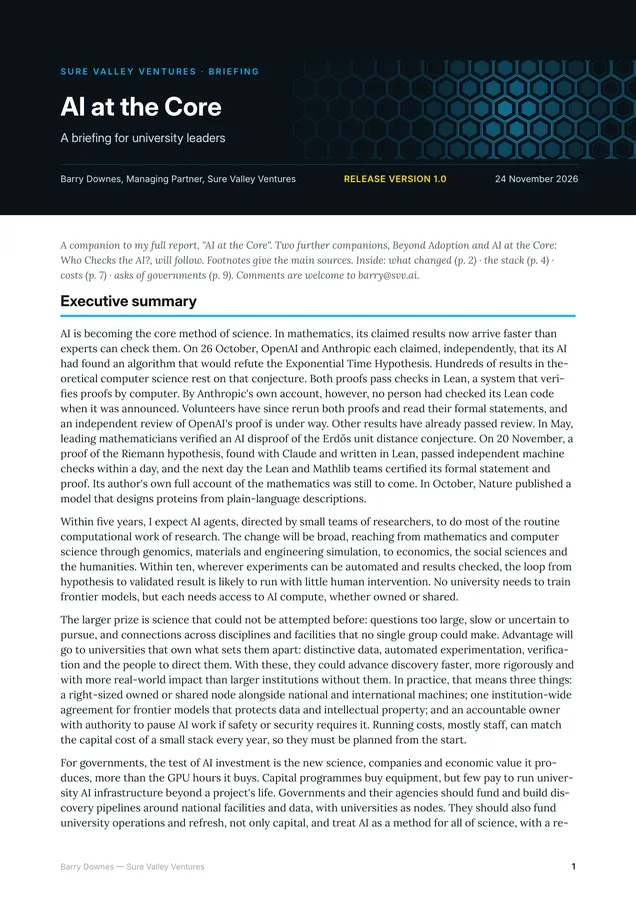
In 2026, AI systems began to produce research results, not just assist with them. In this report I set out what that means for universities and for policy in Ireland, the UK, the EU and the US: the evidence field by field, what research may look like by 2031 and 2036, what a university AI research stack costs to build and run, and six changes I believe governments should make.
Barry Downes, Managing Partner, Sure Valley VenturesRelease version 1.0 · 24 November 2026
How AI is becoming the core method of science, and what universities should do now
The evidence and the recommendations, in more practical detail
I have spent my career on both sides of research: as CEO of a university research institute, as a founder whose company grew out of that work, and now as Managing Partner of Sure Valley Ventures, investing in early-stage AI companies, many of them built on university research. From both sides, 2026 looks like a turning point. My central claim is that AI is becoming the core method of science, not only one of its subjects. The largest returns will go to the institutions and countries that use it to attempt work previously out of reach, more than to those that simply adopt it.
By “core method” I mean a general-purpose instrument used across the research cycle, as statistics and computing became. I do not mean a replacement for experiment, fieldwork or interpretation.
This year, frontier AI systems began to produce research results, and to produce them faster than people can check them. In May, an OpenAI model disproved Erdős’s unit distance conjecture, a problem first posed in 1946, and leading mathematicians published a human-verified version.558 In September, Anthropic’s Claude agents produced the first complete machine-checked proof of Fermat’s Last Theorem, in about 11 days; it formalises existing mathematics rather than proving a new result.50 In October, Nature published Pinal, a model that designs proteins from plain-language descriptions.9 On 26 October, OpenAI and Anthropic each claimed, independently, to have refuted the Exponential Time Hypothesis, on which hundreds of results in theoretical computer science rest.14 In November, Nature published AutoDNA, a laboratory at Shanghai Jiao Tong University in which AI agents ran more than 11,000 experimental steps with people needed only to maintain the equipment.3 On 20 November, a proof of the Riemann hypothesis, found with Claude and written in Lean, passed independent machine checks within a day, and the next day the Lean and Mathlib communities certified its formal statement and proof.1418 Its author’s own full account of the mathematics was still to come.
Some of these results have been checked and some have not. Two are peer reviewed. The proofs that refute the Exponential Time Hypothesis pass computer checks, but by Anthropic’s own account no person had checked its code when it was announced, and an independent review of OpenAI’s proof is under way.5 The report sets out the status of each claim alongside it. But the direction is clear, and the frontier laboratories are now building physical laboratories to close the loop between prediction and experiment.
AI moves fastest where there is good data, a quick way to check answers and a way to act on predictions. Mathematics moved first, because proofs can be checked by machine. Weather forecasting is already operational. In the humanities, AI is helping read scrolls carbonised by Vesuvius.
The life sciences are the largest prize. AI now designs proteins and antibodies, and AI-designed drugs are in late-stage trials. But the life sciences also show the limits: models that predict how cells respond to change do not yet beat simple baselines, because the data is not there. They also carry the most serious risks, which is why access to the most capable tools increasingly depends on biosecurity governance.
By 2031, I expect a typical research group to be a small human team directing a large number of AI agents, with compute, experiments, distinctive data and good questions as the scarce inputs. By 2036, wherever experiments can be automated and results checked, the loop from hypothesis to validated result is likely to run with little human intervention.
The evidence on productivity is still mixed, and the report says so. My forecast concerns the share of work done by agents, not a guaranteed gain in output per researcher.
No university needs to train frontier models. What matters is owning the layers that create lasting advantage, and renting or federating the rest:
The report puts numbers on this. A cluster of 64 to 256 GPUs costs about €2.2M to €14.4M. Running the full stack costs roughly €1.3M to €3.2M a year, and for a modest stack that can match or exceed the whole capital cost every year, mostly in staff. That is the money most programmes do not fund, so plan for it before buying equipment. The report also sets out a phased three-year start for a regional or technical university.
For innovation campuses, the stack is the reason companies co-locate. Sci-Tech Daresbury, which hosts the Hartree Centre, shows how a national computing facility can anchor a campus outside a major city.
The US, the UK, the EU and Ireland agree on the direction. What none has solved is how university-hosted AI infrastructure is run and sustained once the capital is spent. I propose six changes:
The report suggests how four of these could be delivered through instruments that already exist in each jurisdiction.
The companies that will matter in AI for science are less likely to be those with the best general models, which are widely available and hard to turn into lasting advantage, than those with the best operating systems around the models: distinctive data, automated experimentation, verification and workflows that turn AI output into results people can trust. Many will start in universities that have built these layers, and grow on the campuses that share them.
The full report sets out the evidence field by field, from the life sciences to the humanities, with more than 350 sources. The briefing for university leaders sets out the evidence and recommendations in ten pages. I would welcome comments, corrections and counter-evidence.
Interests: Sure Valley Ventures invests in early-stage AI companies, some of which may benefit from the developments described in the report. The report was researched and developed with the assistance of AI tools, including Anthropic’s Claude; the judgements are mine. The declaration of interests in full
The paper or preprint behind each result above, where there is one. The Pinal and AutoDNA papers are peer reviewed, in Nature. Fermat’s Last Theorem and the Exponential Time Hypothesis have no paper yet, so those links are to the companies’ own accounts and to the open letter on the independent review.
Numbered as in the report. All 366 are on the sources page.
Corrections, counter-evidence and examples from your own institution are all welcome.
Comments are welcome to
barry@svv.ai
Send comments through the form on svv.ai (opens in a new tab)