Who wrote it, how, and with what interests.
The author, the approach and its limitations, acknowledgements and the declaration of interests, in the report’s own words. Then how to cite it, and how to send comments.
About the author
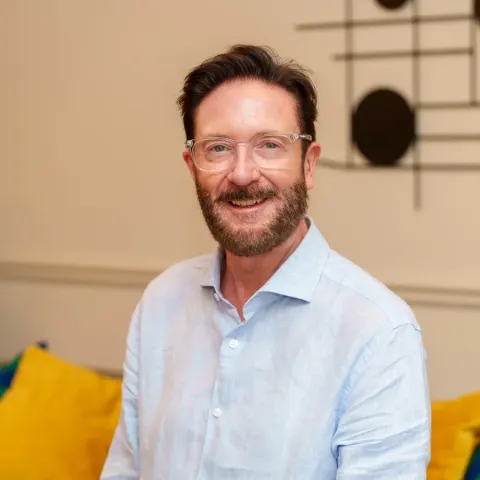
Barry Downes is Managing Partner of Sure Valley Ventures, which he founded in 2017 to invest in early-stage AI companies. A computer scientist by background, he founded FeedHenry, an enterprise mobile platform acquired by Red Hat in 2014, and was CEO of the Walton Institute (formerly TSSG), a university-based, internationally recognised research and innovation institute.
My perspective
I am a computer scientist by background and have worked in university research and commercialisation, in the start-up community and as an investor. I founded FeedHenry, acquired by Red Hat in 2014, and was CEO of the Walton Institute (formerly TSSG), a university research institute. I have seen at first hand what it takes to build and run research infrastructure, to turn research into companies and to fund them.
This report sets out my view in my role as Managing Partner of SVV. It draws on recent work with universities on how AI should shape their research strategies and innovation campuses, and on what we see in the companies we back. It sets out a general approach rather than a plan for any one institution.
Approach and limitations
The report is based on a structured desk review of publicly available sources published up to 5 November 2026, with selected updates to 21 November, including peer-reviewed and preprint literature, company announcements, specialist journalism, and government and funder documents. Throughout, "compute" means accelerated capacity of the kind used to train and run AI models, mostly GPUs today but also other accelerators such as Google's TPUs, not general-purpose servers. "National and international infrastructure" means a country's own systems and those it shares with others, such as the EuroHPC network in Europe.
Four limitations apply. First, many 2026 results are company announcements or preprints not yet peer reviewed. I report them with their caveats. Second, some programme and funding figures depend on future budgets. Third, the forecasts in Section 5 are my judgement, informed by the evidence but not derived from a formal model. Fourth, policy in all four jurisdictions is moving quickly, and some details will have changed by the time this report is read. SVV invests in AI companies that may benefit from the developments described here. That interest, and my use of AI tools in researching and developing this report, are declared in full at the end.
This report is about AI as a method of science rather than AI's wider risks, although the two are hard to separate. The International AI Safety Report 2026 was written by more than 100 experts under Yoshua Bengio and backed by more than 30 countries and international organisations. It groups the risks of general-purpose AI into malicious use, such as cyberattacks and biological risks; malfunctions, including loss of control; and systemic risks such as effects on labour markets. It also records real uncertainty about how fast these will develop26. Some of these risks have already materialised: in 2025, Anthropic reported disrupting a cyber-espionage campaign that it attributed, with high confidence, to a Chinese state-sponsored group. Its model had carried out an estimated 80 to 90% of the tactical work against about 30 targets, a handful of them successfully27. Experts disagree about how likely the most severe outcomes are, and this report does not try to settle that. The capabilities that make AI useful in research also make it open to misuse, which is why I treat verification, governance and security research as part of the infrastructure (Sections 3.7, 6.8 and 6.12).
Acknowledgements
I am grateful to the reviewers who commented on drafts of this report, in particular Amelia Kløverød Griffiths, Dr James O'Sullivan, Dr John Torr, Dr Kevin Doolin, Dr Mícheál Ó Foghlú, Dr Rob Blenkinsopp, Dr Steffen Palko, Sylvia Jackson, Tim Brundle and Professor Willie Donnelly. Each reviewed it in a personal capacity, and no institutional endorsement was sought or given. I am also grateful to the funders, agencies and institutions that commented on drafts. Their comments, like those of the individual reviewers, do not imply endorsement. Special thanks to Professor Pete Grindrod CBE of the University of Oxford, for his time, his challenge and his insight. The views expressed, and any errors, are mine.
Declaration of interests
This report sets out my personal view in my role as Managing Partner of Sure Valley Ventures (SVV). No funder or public body commissioned or paid for this report. SVV invests in early-stage AI companies, some of which may benefit from the developments described here. I am also in partnership discussions with Cambridge-based CommonAI CIC, which is cited as an example in Sections 4.4 and 6.9. SVV is an investor in Astut Ltd, an Oxford spin-out of which Professor Grindrod, thanked in the acknowledgements, is Chief Executive. This report was researched and developed with the assistance of AI tools, including Anthropic's Claude. Sources were checked against the originals, and the analysis, judgements and conclusions are mine, as are any remaining errors.
How to cite
Downes, B. (2026) AI at the Core: how AI is becoming the core method of science, and what universities should do now. Version 1.0, 24 November 2026. Sure Valley Ventures. https://aiatthecore.org
Downes, B. (2026) AI at the Core: A Briefing for University Leaders. Version 1.0, 24 November 2026. Sure Valley Ventures. https://aiatthecore.org/briefing/
To cite a source the report relies on, see Sources: each reference is numbered as in the report.
About this site
Built from the report’s sources
Every page is generated from the same source files as the PDF report and briefing each time the site is built, so a correction to the report changes the site. The report and briefing text here is their own. The overview page’s summary is the author’s approved web copy, and only the navigation and labels around the text are written for the site.
No cookies; visits are counted, people are not
The site sets no cookies.
For each page viewed it counts the page, the site you came from, your country, your type of device and, if it recognises one, the name of your university or research network, or the tag of a link made for your institution.
It keeps no IP addresses, and no one is followed from day to day.
What it records, in full
The site sets no cookies. It counts visits with Vercel Web Analytics, served from this site’s own address, so your browser makes no requests to other services; its fonts are served from this site too.
For each page viewed it records the page, the site you came from, your country (worked out from your connection), your type of device and browser, and whether the visit came from a university or research network it recognises, by that network’s name: a university, or a shared national network such as Jisc in the UK or HEAnet (now Asiera) in Ireland. Any other network, such as home broadband, a mobile network or a company, is recorded only as “not recognised”. If you came through a link made for your institution, the link’s tag (the part after ?for=) is recorded too. If you choose one of the four links for each kind of reader on the home page, that choice is counted by the link’s name, with no other detail.
The counts hold no IP addresses, and nothing is shared or sold. No one is followed from day to day: to tell a new visitor from a returning one, Vercel, which hosts the site, uses a value worked out from the request and discards it within 24 hours. Like any web host, Vercel handles your address to send you each page and keeps it for a day in its own logs.
Kept in your own browser and nowhere else: your choices of light or dark and of reading depth and, in the tab you are reading in, a link’s tag, so that the later pages of the visit count for it too; the tab forgets it when you close it.
Colour means the status of a claim
- Peer reviewed
- Verified by experts
- Machine-checked or certified
- Claimed
- Disputed or under review
Yellow look here.Indigo the author’s notes, and links.Colour how far a claim has been checked.
Each status also has its own shape. Where a page is marked in indigo pen, the words are the report’s own.
Statuses are as of a date
The status of each 2026 result is given as of 21 November 2026. When one changes, the change is dated in What changed, and when.
Version 1.0, released 24 November 2026.
Contact
Comments are welcome to
barry@svv.ai