Executive summary

AI at the Core is one of four documents.
Picture 99 of 100 · its page · 9 more for this section
- My central claim is that AI is becoming the core method of science, much as statistics and computing did, rather than remaining only one of its subjects.
- My view in six claims
- Verification is now the constraint.
- The change is uneven, and the life sciences are the largest prize.
- The bottleneck in research is shifting.
- Infrastructure, and the governance to run it, will separate institutions.
- Governments agree on the direction, but not on how to sustain it in universities or how to fund the unexpected.
- The next generation of science companies will form where compute, data, laboratories and talent meet.
- What I recommend universities do
- Treat AI compute, data and models as core research infrastructure under one programme owner, with compute in three tiers: an owned or partner-hosted cluster where measured demand justifies it, bought in stages, federated access to shared machines, and institution-wide access to frontier models.
- Build domain models in two or three areas of distinctive data, which for many will include the life sciences, and one self-driving laboratory in a field with strong industry partners.
- Build the capability to verify AI-generated results, set up a governance function with an accountable owner and authority to pause AI work, and agree licence terms for models and data.
- Create a research engineering career track, and train every doctoral student to direct and check agentic research.
- Plan operating costs before buying equipment, since running costs, mostly staff, can match the capital cost of a small stack every year. Offer industry expertise and services as well as access.
- What I recommend governments do
- Treat AI as a method for all of science
- Build AI discovery pipelines around national facilities and data
- Fund university operations and refresh, not only capital
- Set expectations for verifying AI-generated research
- Secure sector-wide access to frontier models on research terms
- Make it simple for companies to share university infrastructure
AI is becoming the core method of science. In mathematics, its claimed results now arrive faster than experts can check them. On 26 October, OpenAI and Anthropic each claimed, independently, that its AI had found an algorithm that would refute the Exponential Time Hypothesis. Hundreds of results in theoretical computer science rest on that conjecture. Both proofs pass checks in Lean, a system that verifies proofs by computer. By Anthropic's own account, however, no person had checked its Lean code when it was announced. Volunteers have since rerun both proofs and read their formal statements, and an independent review of OpenAI's proof is under way. Other results have already passed review. In May, leading mathematicians verified an AI disproof of the Erdős unit distance conjecture. On 20 November, a proof of the Riemann hypothesis, found with Claude and written in Lean, passed independent machine checks within a day, and the next day the Lean and Mathlib teams certified its formal statement and proof. Its author's own full account of the mathematics was still to come. In October, Nature published a model that designs proteins from plain-language descriptions.
Within five years, I expect AI agents, directed by small teams of researchers, to do most of the routine computational work of research. The change will be broad, reaching from mathematics and computer science through genomics, materials and engineering simulation, to economics, the social sciences and the humanities. Within ten, wherever experiments can be automated and results checked, the loop from hypothesis to validated result is likely to run with little human intervention. No university needs to train frontier models, but each needs access to AI compute, whether owned or shared.
The larger prize is science that could not be attempted before: questions too large, slow or uncertain to pursue, and connections across disciplines and facilities that no single group could make. Advantage will go to universities that own what sets them apart: distinctive data, automated experimentation, verification and the people to direct them. With these, they could advance discovery faster, more rigorously and with more real-world impact than larger institutions without them. In practice, that means three things: a right-sized owned or shared node alongside national and international machines; one institution-wide agreement for frontier models that protects data and intellectual property; and an accountable owner with authority to pause AI work if safety or security requires it. Running costs, mostly staff, can match the capital cost of a small stack every year, so they must be planned from the start.
For governments, the test of AI investment is the new science, companies and economic value it produces, more than the GPU hours it buys. Capital programmes buy equipment, but few pay to run university AI infrastructure beyond a project's life. Governments and their agencies should fund and build discovery pipelines around national facilities and data, with universities as nodes. They should also fund university operations and refresh, not only capital, and treat AI as a method for all of science, with a responsive route for radical ideas from anyone. Funders should set expectations for verifying AI-generated research, and universities should build the capability to meet them. What is built should be easy for start-ups and SMEs to use.
Adoption buys parity, not advantage. The opportunity is to attempt what was previously out of reach.
Readers short of time may wish to read this summary and Sections 6 to 8. A short briefing accompanies this report. A companion essay, Beyond Adoption, will follow, as will a companion report, AI at the Core: Who Checks the AI?, on how universities can help check frontier AI systems themselves.
In the space of a few weeks this autumn, AI systems claimed to have overturned a conjecture on which hundreds of results in theoretical computer science rest, announced a claimed advance on the Riemann zeta function, and ran a biology laboratory in which people were needed only to maintain the equipment123. Some of these results have been checked. Others have not: on 26 October, OpenAI and Anthropic each claimed, independently, to have refuted the Exponential Time Hypothesis, and both proofs pass computer checks, but by Anthropic's own account no person had checked its code when it was announced145. Outside volunteers have since rerun both proofs, and one has read both formal statements by hand, but no full independent review has been completed6. AI now produces research faster than people can check it, and faster than the institutions that do research are adapting.
Other AI results have already passed review. In May, an AI model disproved Erdős's unit distance conjecture, a problem first posed in 1946, and mathematicians published a human-verified version78. On 20 November, a proof of the Riemann hypothesis itself, found with Claude and written in Lean, passed independent machine checks within a day, and the next day the Lean and Mathlib communities certified its formal statement and proof. Its author's own full account of the mathematics was still to come. In October, Nature published a model that designs proteins from plain-language descriptions. Its designs showed the intended activity in all four classes tested9. AutoDNA, the automated laboratory mentioned above, was published in Nature in November3. The pace is also rising: METR, an independent evaluator given access to Anthropic's internal data, estimates that the company is now improving its models on well-specified tasks about twice as fast as in 2024–25, with wide uncertainty, mostly because of AI10.
My central claim is that AI is becoming the core method of science, much as statistics and computing did, rather than remaining only one of its subjects. The largest returns will go to the institutions and countries that use it to attempt work previously out of reach, more than to those that simply adopt it.
I write as founder and Managing Partner of Sure Valley Ventures (SVV), a venture capital firm that invests in AI software companies, many of them built on university research. Before that, I founded a software company that was acquired by Red Hat, and led a university research institute as its CEO. I have therefore seen university research and its commercialisation from several sides: as a research leader, a founder and an investor. My interests are declared at the end.
What I recommend universities do
- Treat AI compute, data and models as core research infrastructure under one programme owner, with compute in three tiers: an owned or partner-hosted cluster where measured demand justifies it, bought in stages, federated access to shared machines, and institution-wide access to frontier models.
- Build domain models in two or three areas of distinctive data, which for many will include the life sciences, and one self-driving laboratory in a field with strong industry partners.
- Build the capability to verify AI-generated results, set up a governance function with an accountable owner and authority to pause AI work, and agree licence terms for models and data.
- Create a research engineering career track, and train every doctoral student to direct and check agentic research.
- Plan operating costs before buying equipment, since running costs, mostly staff, can match the capital cost of a small stack every year. Offer industry expertise and services as well as access.
For governments, the test of AI investment is the new science, companies and economic value it produces, more than the GPU hours it buys.
What I recommend governments do
- Treat AI as a method for all of science, from mathematics and physics to economics, the social sciences, media and the humanities, with a strand for high-risk, frontier-moving work and a responsive route for ideas from anyone.
- Build AI discovery pipelines around national facilities and data, including new economic and digital-society data, with universities, including regional ones, as nodes, and routes in for start-ups.
- Fund university operations and refresh, not only capital, and publish what national compute achieves.
- Set expectations for verifying AI-generated research: machine checking where possible, named expert review of what the formal statements claim, and governance standards and model contract clauses for AI providers.
- Secure sector-wide access to frontier models on research terms, including governed access for life-sciences researchers and for university alignment, evaluation and security research, and keep supporting open-weight models.
- Make it simple for companies to share university infrastructure, and fund research engineering careers at scale.
1Introduction
1.1Purpose and audience

AI is becoming the core method of science.
Picture 1 of 100 · its page
- This report explains why I believe AI is becoming the core method of scientific research, what that means for universities, and how policy should evolve to support it.
This report explains why I believe AI is becoming the core method of scientific research, what that means for universities, and how policy should evolve to support it. It is written for university leaders, research and innovation directors, developers of innovation campuses, policymakers and research funders, and for founders and investors building science companies. It is intended to be of use in Ireland, the United Kingdom, the European Union and the United States. By "core method" I mean a general-purpose instrument used across the research cycle, as statistics and computing became, not a replacement for experiment, fieldwork or interpretation. By AI I mean the whole family of methods, not only the large language models (LLMs) behind today's agents. It includes domain models such as AlphaFold and AI weather forecasters, which have already transformed their fields. It also includes newer approaches such as world models, which learn how physical environments behave so that agents and robots can be trained in simulation (Section 5.6).
1.2My perspective

Written from both sides of research and its commercialisation, with interests declared.
Picture 100 of 100 · its page
- I am a computer scientist by background and have worked in university research and commercialisation, in the start-up community and as an investor.
I am a computer scientist by background and have worked in university research and commercialisation, in the start-up community and as an investor. I founded FeedHenry, acquired by Red Hat in 2014, and was CEO of the Walton Institute (formerly TSSG), a university research institute. I have seen at first hand what it takes to build and run research infrastructure, to turn research into companies and to fund them.
This report sets out my view in my role as Managing Partner of SVV. It draws on recent work with universities on how AI should shape their research strategies and innovation campuses, and on what we see in the companies we back. It sets out a general approach rather than a plan for any one institution.
1.3Approach and limitations
- The report is based on a structured desk review of publicly available sources published up to 5 November 2026, with selected updates to 21 November, including peer-reviewed and preprint literature, company announcements, specialist journalism, and government and funder documents.
The report is based on a structured desk review of publicly available sources published up to 5 November 2026, with selected updates to 21 November, including peer-reviewed and preprint literature, company announcements, specialist journalism, and government and funder documents. Throughout, "compute" means accelerated capacity of the kind used to train and run AI models, mostly GPUs today but also other accelerators such as Google's TPUs, not general-purpose servers. "National and international infrastructure" means a country's own systems and those it shares with others, such as the EuroHPC network in Europe.
Four limitations apply. First, many 2026 results are company announcements or preprints not yet peer reviewed. I report them with their caveats. Second, some programme and funding figures depend on future budgets. Third, the forecasts in Section 5 are my judgement, informed by the evidence but not derived from a formal model. Fourth, policy in all four jurisdictions is moving quickly, and some details will have changed by the time this report is read. SVV invests in AI companies that may benefit from the developments described here. That interest, and my use of AI tools in researching and developing this report, are declared in full at the end.
This report is about AI as a method of science rather than AI's wider risks, although the two are hard to separate. The International AI Safety Report 2026 was written by more than 100 experts under Yoshua Bengio and backed by more than 30 countries and international organisations. It groups the risks of general-purpose AI into malicious use, such as cyberattacks and biological risks; malfunctions, including loss of control; and systemic risks such as effects on labour markets. It also records real uncertainty about how fast these will develop26. Some of these risks have already materialised: in 2025, Anthropic reported disrupting a cyber-espionage campaign that it attributed, with high confidence, to a Chinese state-sponsored group. Its model had carried out an estimated 80 to 90% of the tactical work against about 30 targets, a handful of them successfully27. Experts disagree about how likely the most severe outcomes are, and this report does not try to settle that. The capabilities that make AI useful in research also make it open to misuse, which is why I treat verification, governance and security research as part of the infrastructure (Sections 3.7, 6.8 and 6.12).
1.4Structure
- Section 2 reviews the results frontier AI laboratories produced in 2026, and Section 3 looks at each field in turn, from the life sciences to the humanities.
Section 2 reviews the results frontier AI laboratories produced in 2026, and Section 3 looks at each field in turn, from the life sciences to the humanities. Section 4 describes the wider landscape of companies, open models, national programmes and university compute, and Section 5 sets out my outlook for 2031 and 2036. Section 6 is a playbook for universities, Section 7 covers cost, phasing and funding, Section 8 sets out how policy should evolve, and Section 9 concludes. A separate short briefing for university leaders summarises the recommendations.
2The state of AI-driven research in 2026

In 2026, AI moved from assisting researchers to producing research results.
Picture 9 of 100 · its page
- During 2026, frontier AI systems moved from assisting researchers to producing research results, first in mathematics and increasingly in biology and physics, where laboratory validation sets the pace.
The frontier AI companies are building their own laboratories, so that experiments their models design can be run and the results fed straight back into the models. Anthropic now operates a wet biology laboratory, and OpenAI has run closed-loop experiments in an automated cloud laboratory. The US, the UK, the EU and China have all made AI for science a national priority. Researchers, meanwhile, are adopting AI faster than their institutions are supporting it. Mathematics moved first because its results can be checked by machine. Biology and physics are following more slowly, because their results need laboratory validation.
| When (2026) | Result | Status |
|---|---|---|
| January | Google DeepMind's AlphaGenome predicts the effects of genetic variants; predictions for about 9 billion variants later released for research use | Peer reviewed (Nature) |
| May | An OpenAI model disproves the Erdős unit distance conjecture | Verified: leading mathematicians published a checked version |
| September | Anthropic's Claude agents produce the first complete machine-checked proof of Fermat's Last Theorem, in about 11 days | Machine-checked in Lean; formalises existing mathematics rather than proving new results |
| September | OpenAI says its agents proved finite-time blow-up for the Navier–Stokes equations, which it says meets the Clay Millennium Prize conditions | Claimed; not peer reviewed; Clay lists the problem as active and has not awarded the prize; credit for the result disputed |
| October | Pinal, from a team led by Westlake University, designs proteins from plain-language descriptions of their function | Peer reviewed (Nature); intended activity in all four classes tested; most screening computational |
| October | OpenAI and Anthropic each claim, independently, to have refuted the Exponential Time Hypothesis | Machine-checked in Lean; volunteers have rerun both proofs and read the statements; independent review of OpenAI's proof under way |
| November | AutoDNA, an AI-native laboratory at Shanghai Jiao Tong University, runs more than 11,000 experimental steps across more than 20 types of instrument, with people only maintaining the equipment | Peer reviewed (Nature) |
Taken together, these results show that fields where answers can be checked quickly move first, and that claims can run ahead of evidence, which gives universities a natural role as independent verifiers. The pace is also rising: METR, an independent evaluator given access to Anthropic's internal data, estimates that the company is now improving its models on well-specified tasks about twice as fast as in 2024–25, with wide uncertainty, mostly because of AI. Model access is opening up through free and discounted academic programmes, although the most capable models are often held back, especially in the life sciences (full report, Sections 2 and 3).
When I say that "AI is becoming the core method of science", I mean a general-purpose instrument used across the research cycle, as statistics and computing became, not a replacement for experiment or interpretation. By AI, I mean the whole family, from large language models (LLMs) to domain models such as AlphaFold and world models, which learn how the physical world behaves. The same capabilities raise real risks, whose severity experts dispute, and that is one reason to build verification, governance and security research into the infrastructure.
2.1Results from the frontier laboratories

Of eight headline results in 2026, four had passed peer review or expert verification by 21 November.
Picture 10 of 100 · its page · 6 more for this section
- Table 1 summarises the main announcements from OpenAI, Anthropic and Google DeepMind, most recent first.
Table 1 summarises the main announcements from OpenAI, Anthropic and Google DeepMind, most recent first. Most are company announcements, so the caveats column should be read alongside the claims. Independent and academic results, including the AutoDNA laboratory published in Nature in November, are covered field by field in Section 3.
Table 1. Selected AI-for-science announcements by frontier laboratories, 2026.
The status mark under each announcement is this site’s summary of the caveats beside it; for rows that also appear in the briefing’s own table, it follows the briefing. Key: Peer reviewed Verified by experts Machine-checked or certified Claimed Disputed or under review
2.2Four patterns for universities

Progress is fastest where results can be checked automatically.
Picture 11 of 100 · its page · 4 more for this section
- Progress has been fastest where results can be checked automatically.
- Frontier laboratories are building physical laboratories.
- Model access is opening up, but only partly.
- Claims can run ahead of evidence.
- Progress has been fastest where results can be checked automatically. Mathematics and algorithm design led because a proof assistant or an automated scorer can check candidate answers cheaply. Where checking requires an experiment, progress moves at the pace of the laboratory. Even in mathematics, cheap machine checking has outpaced the capacity of experts to judge whether formal statements capture the intended problem53.
- Frontier laboratories are building physical laboratories. Anthropic now operates a wet biology laboratory43, and OpenAI has run closed-loop experiments in an automated cloud laboratory60. Compute alone does not complete the research loop.
- Model access is opening up, but only partly. Free seats and credits for academics are capped, the most capable models are often held back, and restrictions are tightest in the life sciences515459. To work at the frontier on its own questions and its own data, a university needs compute it controls, alongside distinctive data and automated experimentation.
- Claims can run ahead of evidence. In October 2025, an OpenAI executive announced solutions to ten Erdős problems that turned out to be existing literature64. In September 2026, the Anthropic enzyme and OpenAI Navier–Stokes results both drew priority disputes from researchers who were themselves using AI (Table 1)4546. OpenAI's head of science has said the company is working to give its models "epistemological humility"65. Universities have a natural role as independent verifiers.
3Field by field

AI moves fastest where three conditions meet.
Picture 23 of 100 · its page · 1 more for this section
- AI is arriving unevenly across science, moving fastest where three conditions hold: large, well-curated datasets; a fast and trusted way to check answers; and the ability to act on a prediction, whether by running an experiment or deploying a forecast.
AI moves fastest where there is good data, a quick way to check answers and a way to act on predictions, so progress is uneven across fields. In all of them, it works best as an instrument checked against data and expert judgement.
| Field | Where AI stands in late 2026 | Where universities are needed |
|---|---|---|
| Life sciences and medicine | Designing proteins and antibodies; genome models; AI-designed drugs in late-stage trials; automated laboratories | Wet-laboratory validation, cell-response data, biosecurity |
| Mathematics | Machine-checked proofs; new constructions and algorithms; open problems solved | Expert judgement of what formal results mean |
| Chemistry, materials and engineering | Generative design and robotic synthesis; AI surrogates for engineering simulation; some high-profile AI claims corrected after independent checks | Synthesis, characterisation, testing, proving novelty |
| Physics, energy and quantum | Fusion plasma control, particle identification, quantum error correction and circuit design | Access to facilities and hardware |
| Earth, climate and agriculture | AI weather forecasts in operational use; climate emulators and precision agriculture emerging | Extrapolating beyond observed conditions |
| Social sciences and humanities | Reading damaged ancient texts; evidence synthesis; simulated respondents | Validity against real human data |
| Computer science and AI | Coding agents write much new code; alignment, interpretability and security are open research fields | Compute and model access; verifying code written by agents |
The life sciences offer the largest gains. AI-engineered antibodies are moving into late-stage trials, genome models trained on trillions of DNA letters can predict the effects of variants without task-specific training, and AI-supported breast screening detected 29% more cancers in a randomised trial in Sweden. Models of how cells respond to change do not yet consistently beat simple baselines, largely for lack of data. In October 2026, the US Department of Energy, Biohub, Google DeepMind, Isomorphic Labs and Meta committed about $1.3 billion of new money to AI-ready biological data, with the National Institutes of Health coordinating existing datasets (nearly $1.8 billion in all). The life sciences also carry the most serious risks. Providers already restrict their most capable models for biology, so universities will need controls such as vetting users, screening orders for synthetic DNA and reviewing dual-use work.
AI is arriving unevenly across science, moving fastest where three conditions hold: large, well-curated datasets; a fast and trusted way to check answers; and the ability to act on a prediction, whether by running an experiment or deploying a forecast. Table 2 summarises where each field stands. The fields are grouped by where AI is having most effect, not by a formal classification such as the OECD's Frascati fields: engineering sits with chemistry and materials, agriculture with Earth and climate, and the arts with the humanities. The life sciences receive the most attention below, because they combine the largest data assets, the most industrial activity and the most serious risks.
Table 2. AI as a research method: where each field stands in late 2026.
| Field | What AI is doing now | Evidence | Main constraint |
|---|---|---|---|
| Life sciences and medicine | Predicting and designing proteins and antibodies; genome models; AI-designed drugs in late-stage trials; agentic "AI scientists"; automated laboratories | Strong for structure and design; early for clinical outcomes and cell models | Wet-laboratory validation, data on how cells respond, biosecurity |
| Mathematics | Proving theorems in formal languages; finding new constructions and algorithms; solving open problems | Strong where results are machine-checked; individual landmark claims under review | Expert judgement of what formal results mean |
| Chemistry, materials and engineering | Predicting stable materials; generative design; robotic synthesis; AI surrogates for engineering simulation | Mixed for materials, where some high-profile AI claims have been corrected after independent checks; proven for surrogates in design work | Synthesis, characterisation and proving novelty; scarce engineering data |
| Physics, energy and quantum | Plasma control for fusion; particle identification; quantum error correction and circuit design | Strong in specific, well-defined tasks | Access to facilities and hardware |
| Earth, climate and agriculture | Operational AI weather forecasts; Earth-system foundation models; climate emulators; precision agriculture and dairy | Strong for weather; emerging for climate and agriculture | Extrapolating beyond observed conditions |
| Social sciences and humanities | Simulated survey respondents and economic agents; reading damaged ancient texts; evidence synthesis | Strong for text recovery and screening; weak for replacing human subjects | Validity against real human data |
| Computer science and AI | Coding agents writing much new code; automated research on computational problems; alignment, interpretability and security research | Strong for coding; early for automated research | Compute and model access; verifying code written by agents |
Scroll sideways to see the whole table.
3.1Life sciences and medicine

AI as a scientific method was first recognised at the highest level in the life sciences.
Picture 25 of 100 · its page · 9 more for this section
- The life sciences are where AI as a scientific method was first recognised at the highest level.
The life sciences are where AI as a scientific method was first recognised at the highest level. The 2024 Nobel Prize in Chemistry went half to David Baker for computational protein design and half to Demis Hassabis and John Jumper for protein structure prediction66. By then more than two million people in 190 countries had used AlphaFold 267.
PROTEIN STRUCTURE AND DESIGN
Structure prediction has extended from single proteins to complexes. AlphaFold 3 predicts how proteins interact with DNA, RNA and small molecules. Its code was released for academic use in November 202468. Open alternatives followed quickly. Boltz-2, released by MIT and Recursion under an open licence, predicts binding strength as well as structure. On a standard benchmark it approaches physics-based simulation (a correlation of 0.62 against 0.72) while running roughly 1,000 times faster69. OpenFold3, developed under the OpenFold Consortium, whose members include Novo Nordisk and Bayer Crop Science, is released under an open licence that permits commercial use70.
Design has advanced as fast as prediction. In 2025, Baker's group reported the first antibodies designed entirely by computer against targets with no known binders, some approaching the strength of clinical antibodies19; designed proteins that protected mice from lethal snake-venom toxins71; and designed enzymes with complex active sites whose structures matched the computational models to within an ångström72. AI-engineered antibodies are moving into late-stage trials: Generate:Biomedicines has announced global Phase 3 trials of an AI-engineered antibody for severe asthma in about 1,600 patients73. Not every programme advances: Absci took its AI-designed antibody for inflammatory bowel disease into a Phase 1 trial74, but later chose not to start later-stage trials itself75. Design from plain language is arriving too: in October 2026, Nature published Pinal, a model from a team led by Westlake University that designs proteins from descriptions of their function. Its designs showed the intended activity in all four classes tested, although most screening was computational976.
One study offers an important caution: when four leading co-folding models, which predict a drug and its protein target together, were tested with physically implausible changes to binding sites, they often still placed the drug molecule in the original pocket. This suggests that they rely on learned patterns rather than physics. The authors advise checking predictions with physics-based methods or experiments before relying on them in drug discovery77.
GENOME AND CELL MODELS
Language models are now being trained on DNA itself. Evo 2, developed by the Arc Institute and NVIDIA with researchers from Stanford, UC Berkeley and UCSF, was trained on about 9 trillion DNA base pairs from all domains of life and released with its weights, code and training data7879. In its Nature paper, it predicted the effects of variants in the BRCA1 breast cancer gene without task-specific training, and a simple classifier built on it separated harmful variants from others with high accuracy79. Google DeepMind's AlphaGenome, which predicts how DNA changes affect gene regulation, and its atlas of predictions for about 9 billion variants carry the caveats noted in Table 147486263. In August 2026, Stanford and Arc researchers reported in Science that genome models had designed entire bacteriophage genomes: of nearly 300 synthesised, 16 produced working viruses, and a cocktail of them overcame bacterial resistance to the virus they were modelled on80.
The next goal is a "virtual cell" that predicts how cells respond to drugs or genetic changes. The Chan Zuckerberg Initiative has consolidated its science under Biohub, acquired EvolutionaryScale, the developer of the ESM protein models81, and plans to scale its computing to 10,000 GPUs for biological research82. In October 2026, a cross-sector collaboration announced nearly $1.8 billion for AI-ready biological data, which the collaboration headlines as nearly $2 billion83. About $1.3 billion (€1.2 billion) is new money: more than $500 million from the US Department of Energy through the Genesis Mission, $500 million from Biohub, and $300 million from Google DeepMind, Isomorphic Labs and Meta. The rest is coordination by the National Institutes of Health (NIH) of datasets from more than $500 million of earlier federal investment83.
The focus on data follows from recent results. In the first Virtual Cell Challenge, the organisers reported that entries were "not yet consistently outperforming naive baselines across all metrics"22. An independent study in Nature Methods found that deep-learning models did not beat simple linear baselines at predicting the effects of genetic perturbations84. In cell modelling, the limiting factor is now data more than method.
DRUG DISCOVERY AND THE CLINIC
Among small-molecule drugs whose target and molecule were both identified with AI, Insilico Medicine's rentosertib, for idiopathic pulmonary fibrosis, is one of the most advanced. A 71-patient Phase 2a trial in China, published in Nature Medicine, was designed primarily to test safety. At the highest dose, forced vital capacity, a measure of lung function, rose by a mean of 98.4 mL over 12 weeks, while it fell by 20.3 mL on placebo85. A Phase 3 trial in about 320 patients in China began in July 202686. Isomorphic Labs, Google DeepMind's drug discovery company, has moved its expected first clinical trial from the end of 2025 to the end of 202687.
The evidence on success rates is still thin. The most widely cited analysis found that AI-discovered molecules had an 80 to 90% success rate in Phase 1 trials, well above historical averages, but about 40% in Phase 2, in line with them, on a limited sample88. The first generation of AI-designed drugs largely failed in the clinic89, and Recursion, the largest listed AI-native drug company, cut about 20% of its staff in 2025 and narrowed its pipeline90. AI is shortening early discovery. Whether it improves the odds of a drug working in patients is not yet proven.
AI SCIENTISTS AND AUTOMATED LABORATORIES
Several groups have built agentic systems that generate hypotheses, analyse data and propose experiments. Google's AI co-scientist proposed drug-repurposing candidates for leukaemia that were then confirmed in the laboratory, and independently arrived at an unpublished mechanism of bacterial gene transfer91. Stanford's Virtual Lab, a team of AI agents with a "critic" agent to check their work, designed 92 nanobodies against SARS-CoV-2, two of which also bound recent variants of the virus92. Kosmos, from FutureHouse, reads about 1,500 papers and runs about 42,000 lines of analysis code in a single run. Independent scientists judged 79.4% of the statements in its reports to be accurate93, which is impressive and also means that about one in five was not. Commenting on Anthropic's enzyme result (Table 1), one biologist noted that its agents were guided by senior domain experts, and that such systems are "really good at grunt work when orchestrated by experts in the field"44.
Automation is also closing the loop between prediction and experiment: a self-driving laboratory at the University of Illinois engineered enzymes with up to 26-fold higher activity with little human intervention94, and OpenAI has run closed-loop experiments with Ginkgo (Table 1)60. In November, Nature published AutoDNA, an automated laboratory in which people were needed only to maintain the hardware (Section 6.7)3. Companies such as Lila Sciences are building "AI Science Factories" on this model at industrial scale95.
CLINICAL RESEARCH
AI is also changing how clinical evidence is produced. In the randomised MASAI trial in Sweden, AI-supported mammography screening detected 29% more cancers and cut radiologists' reading workload by 44% without increasing false positives96. Delphi-2M, a generative model trained on about 400,000 UK Biobank participants, estimates risk for more than 1,000 diseases and was validated on 1.9 million people in Denmark97. Regulators are responding: the US Food and Drug Administration has issued draft guidance on AI in drug development, though it explicitly excludes drug discovery98.
BIOSECURITY AND ACCESS
The same capabilities raise real risks, and access to the most capable tools now depends on governance. Anthropic introduced stronger safeguards for biological and chemical misuse in 2025, with targeted exemptions for vetted researchers with legitimate dual-use applications99. OpenAI offers its life-sciences model only through a trusted access programme59. The US AI Action Plan recommends requiring federally funded institutions to use nucleic acid synthesis providers that screen orders and verify customers100. The UK has published screening guidance for synthetic nucleic acids101, and the EU's proposed Biotech Act would require benchtop DNA synthesisers to include built-in screening102. For a university, biosecurity governance is becoming a condition of access to frontier tools in biology.
GOVERNMENT PRIORITIES
Governments see the life sciences as the first test of AI for science. The UK's AI for Science Strategy makes drug discovery its first mission, aiming for trial-ready drugs within 100 days by 2030103, and its OpenBind consortium released 699 X-ray structures of compounds bound to a viral protein in May 2026104. The US Genesis Mission names biotechnology among its priority domains (Table 4)105.
For universities, the lesson is that the life sciences reward the assets that are hardest to copy: patient cohorts, biobanks, hospital partnerships, wet laboratories and experimental data. A university with these assets, and the compute and governance to use them, is well placed, while one without them will find it hard to compete on models alone.
3.2Mathematics

Mathematics went from benchmark to research frontier in under two years.
Picture 36 of 100 · its page · 1 more for this section
- Mathematics moved from benchmark to research frontier in under two years.
Mathematics moved from benchmark to research frontier in under two years. At the 2025 International Mathematical Olympiad, an advanced version of Google's Gemini Deep Think scored 35 of 42, a gold-medal standard certified by the IMO, working in natural language within the time limit106. DeepMind's AlphaProof, which writes proofs in the formal language Lean, was published in Nature the same year107. AlphaEvolve, which pairs a language model with automated evaluation, found a way to multiply 4×4 complex matrices with 48 scalar multiplications, one fewer than Strassen's 1969 method allows108. In a study co-authored by Terence Tao, it matched or improved the best-known constructions across 67 problems109.
The Erdős problems show how claims have moved from overstatement to substantive results. After the overclaim of October 202564, the Rényi Institute credited ChatGPT with solving five Erdős problems in January 2026110. A systematic DeepMind study warned that "open" often reflected obscurity rather than difficulty (Table 1)61. The May 2026 unit-distance result was the first that many leading mathematicians treated as a major advance111, and human mathematicians soon published a verified version and an explicit bound856.
The infrastructure for machine-checked mathematics is growing. The Equational Theories Project, led by Tao, settled more than 22 million implications between algebraic laws by combining human and automated proofs, all checked in Lean112. Philanthropy has followed: the AI for Math Fund, supported by XTX Markets, has reached $31.5 million113, and DARPA's expMath programme, which held its kick-off in March 2026, aims to build an AI co-author for mathematics114.
Formal verification does not settle everything: the Navier–Stokes proof was checked in Lean, yet whether its formal statement captures the problem, and who deserves credit, remain in question (Table 1)46. A preprint argues that Lean verification of an AI translation does not guarantee a correct natural-language proof, and reports mismatches in examples including that proof13. The October 2026 claims to refute the Exponential Time Hypothesis are the clearest example. Both proofs passed machine checks. When they were announced, no person was known to have checked Anthropic's Lean code4; outside volunteers have since rerun both proofs, and one has read both formal statements by hand, but no full independent review has been completed6. Two of the hypothesis's originators, who are leading an independent review of OpenAI's proof, say their involvement should not be taken as certification5. There is also a question of openness: the Advisory Group on Mathematics and Artificial Intelligence, an independent group of mathematicians hosted by the Institute for Advanced Study, has asked AI laboratories to stop testing advanced mathematical problems on proprietary models115116.
The proof of the Riemann hypothesis in November shows the same division of labour. Machine checking was fast and independent, but confirming that the formal statement says what mathematicians mean was human work, done by the Lean and Mathlib experts who certified it on 21 November18.
3.3Chemistry, materials and engineering

AI generates candidate materials far faster than anyone can confirm them.
Picture 38 of 100 · its page
- Materials science shows both the promise and the risk of overclaiming.
Materials science shows both the promise and the risk of overclaiming. Google DeepMind's GNoME predicted about 2.2 million crystal structures, around 380,000 of them stable, and contributed nearly 400,000 compounds to Berkeley Lab's Materials Project117. Independent chemists found "scant evidence" of compounds that were at once novel, credible and useful, although DeepMind stands by its claims118. Berkeley's autonomous A-Lab originally reported synthesising 41 new compounds in 17 days. After outside researchers questioned whether the products were new, the Nature paper was corrected, and it now reports 36 of 57 targets synthesised119120. Three years on, A-Lab runs at roughly 100 times human iteration speed121.
Generative design is maturing. Microsoft's MatterGen designed a material for a target bulk modulus (resistance to compression) of 200 GPa. When synthesised, it measured 169 GPa, within 20% of the target122. Universities have been pioneers in automation: at the University of Liverpool, mobile robots share standard laboratory equipment and decide which reactions to run next123. The University of Toronto received C$200 million for self-driving laboratories, aiming to cut materials development from about 20 years to one124. Capital is following, as Periodic Labs' $300 million seed round for autonomous materials laboratories shows (Table 3)125.
Engineering shows a similar pattern in design. AI surrogate models now stand in for expensive simulations: at Leonardo Helicopters, a geometric deep-learning model predicts ground-level rotor noise about 540 times faster than conventional computational fluid dynamics. In casting, an AI model predicts porosity in aluminium parts almost instantly where a simulation took a day126. Engineers describe AI as an accelerator for physics rather than a replacement, held back by scarce, proprietary data, sometimes as few as 20 simulations126.
AI can generate candidates and designs far faster than they can be confirmed, so the bottleneck lies in synthesis, characterisation, testing and judgement of novelty, all of which universities do well.
3.4Physics, energy and quantum

AI is accelerating quantum research in at least four ways.
Picture 39 of 100 · its page
- Error correction.
- Circuit design.
- Hardware design.
- Laboratory work.
In physics, AI is strongest on specific, well-defined tasks. Google DeepMind is working with Commonwealth Fusion Systems to optimise plasma control for the SPARC fusion device using reinforcement learning and an open-source simulator127. At CERN, the ATLAS experiment's transformer-based tagger improved the rejection of charm-quark jets 3.5-fold and of light-quark jets 1.8-fold over its predecessor, at 70% b-jet efficiency128.
Quantum technology is where the link between AI and a hard engineering problem is now clearest. AI is accelerating quantum research in at least four ways:
- Error correction. Google DeepMind's AlphaQubit 2 decodes errors in real time, in under a microsecond per cycle, on surface codes up to distance 11 and colour codes up to distance 9129. An AI system has also proposed error-correcting codes that outperform leading designs, so far in a preprint130.
- Circuit design. Claude designed quantum circuits that beat the best published designs in seven of eight tasks (Table 1)35.
- Hardware design. IBM's AI agents optimised the hardware design of an error-correction decoder, cutting its estimated latency 52-fold for about $26 of computing with open models. These are design-tool estimates on a reduced problem, measured against an unoptimised starting design rather than IBM's hand-tuned decoder, not hardware measurements131132.
- Laboratory work. Microsoft credited an AI agent with automating measurements for its Majorana 2 chip, whose qubits it says hold their state 1,000 times longer than its first generation. Some physicists say Microsoft has not released enough data to verify its claims133134.
Quantum computing itself is moving towards engineering: Quantinuum targets a fault-tolerant computer by 2029135, and IBM and the University of Chicago have claimed a verifiable quantum advantage in preprints awaiting assessment136137. Google's Quantum Echoes result points to molecular simulation as a leading candidate for early useful advantage138. It is unlikely to replace classical computing within the decade, but likely to join the research stack as a specialised accelerator for simulation. A university quantum group is best connected to the AI stack, with simulators on the institution's GPU cluster and access to physical machines through national and commercial services, rather than run as a separate facility.
3.5Earth, climate and agriculture

Weather is the clearest example of AI moving from research into daily operations.
Picture 40 of 100 · its page
- Weather forecasting is the clearest example of AI moving from research into operational use.
Weather forecasting is the clearest example of AI moving from research into operational use. Google DeepMind's GraphCast outperformed the leading physics-based forecast on more than 90% of test measures139, and its probabilistic successor GenCast was more accurate than the European Centre for Medium-Range Weather Forecasts (ECMWF) ensemble on 97.2% of targets140. In 2025 ECMWF made its own AI forecasts operational, alongside its physics-based system, using about 1,000 times less energy per forecast20141. Microsoft's Aurora, trained on more than a million hours of geophysical data, beats operational forecasts for air quality, ocean waves and cyclone tracks142.
Climate projection is harder. Hybrid models such as NeuralGCM run stably for decades at a fraction of the computing cost, but do not reliably extrapolate to climates very different from those they were trained on143. Emulators such as ACE2 can simulate about 1,500 years a day but respond imperfectly to some forcings144. ECMWF's AI ensemble still depends on physics-based data assimilation141. For now, AI speeds up physics-based climate modelling rather than replacing it.
Agriculture and food draw on the same kinds of data. Ireland's VistaMilk centre, hosted by Teagasc with 13 research institutions and more than 50 industry partners, applies AI, sensors and mathematical modelling from soil and pasture to animal health and dairy processing, and began a €26.2 million second phase in 2025145. For many regional universities, agri-food is a natural domain for the data-led models described in Section 6.5.
3.6Social sciences and humanities

Simulated respondents are not a substitute for people.
Picture 42 of 100 · its page · 2 more for this section
- In the social sciences, AI offers a new instrument, though it is tempting to use it in place of human respondents.
In the social sciences, AI offers a new instrument, though it is tempting to use it in place of human respondents. Researchers showed in 2023 that language models conditioned on real respondents' backgrounds could reproduce the response patterns of survey subgroups, which they called "silicon samples"146. Later work found that such samples showed too little variation, that about half of the relationships estimated from them differed significantly from those in human data and about a third of those had the wrong sign, and that results shifted with prompt wording and model updates147. A 2026 preprint from Prolific found that giving simulated respondents demographic personas roughly tripled the error in the distribution of answers, compared with asking the model directly for an aggregate distribution. In the same preprint, the method that reproduced the distribution worst was nonetheless among the best at predicting the most common answer148. Centaur, a model trained on 160 psychology experiments with more than 60,000 participants, predicts human choices better than existing cognitive models149. Critics, however, argue that it does not work like a human mind150 and that it may be memorising its training data151. In economics, language models are now widely used as research assistants152 and as simulated economic agents in classic experiments153.
In the humanities, AI is opening sources that were previously unreadable. The Vesuvius Challenge, combining synchrotron imaging with AI, has recovered more than 70 columns of text from one carbonised Herculaneum scroll and around 20 from another, possibly an unknown work of Stoic ethics21. DeepMind's Aeneas, trained on about 150,000 Latin inscriptions, helped historians generate research ideas for 90% of the inscriptions they studied154.
Evidence synthesis is changing fastest. Cochrane, the Campbell Collaboration, JBI and the Collaboration for Environmental Evidence have jointly accepted AI in systematic reviews with human oversight and full reporting155. In a preprint, an AI workflow reproduced and updated 12 Cochrane reviews in two days, with higher screening sensitivity than human reviewers, and its updates changed the conclusions of three156.
The lesson for these fields is that AI works best as an instrument checked against human data and expert judgement, not as a substitute for human participants. Where AI is used with human-subject data, or simulated respondents stand in for people, research ethics committees should review it (Section 6.12).
3.7Computer science and AI itself

The frontier of AI models has moved to industry: 93 notable models to 2.
Picture 45 of 100 · its page · 2 more for this section
- AI is itself a product of computer science, and the field is changing faster than any other.
AI is itself a product of computer science, and the field is changing faster than any other. Much of the groundwork came from universities: the 2024 Nobel Prize in Physics recognised the foundations of machine learning157. The frontier has since moved to industry. In 2025, industry produced 93 of the notable AI models tracked by Stanford's AI Index and academia 2, although academia still produced most AI publications (68% in 2024)158. The gap is one of compute rather than ideas, and it shapes what university AI research can now attempt.
How software is built is changing first. Coding agents now write much of the code at leading companies: Google says three-quarters of its new code is generated by AI and then reviewed by engineers159. As agents produce code faster than people can read it, the bottleneck moves from writing code to specifying what it should do and proving that it works. Across GitHub, more than 40% of pull requests started with an agent's first draft by September 2026, up from 17% in March. Of agent-involved pull requests, 90% were merged within two weeks, against about 86% of others23. The gains in code written are large; the gains in software shipped are smaller (Section 5.1). Computer science is the first field in which the verification problem described in this report has appeared in practice. It affects universities directly: much research is software, research engineers will increasingly specify and verify code rather than write it, and computer science teaching will have to change with them. An end-to-end automated research system has already produced a paper that passed the acceptance threshold at a 2025 workshop, although it remains limited to computational work and has hallucinated citations160161.
The research that matters most for AI's own future is open to universities too. Alignment, interpretability, evaluation and security are active fields in which the frontier laboratories do much of the work, but universities bring independence, open publication, long time horizons and evaluation free of commercial interest. That matters more now that AI may be speeding up its own development. METR judges that most of Anthropic's recent acceleration is likely due to AI10, and Anthropic's amended IPO filing says it may imminently cross its own threshold for AI-driven acceleration162. Universities can still do frontier work here: in November, MIT researchers reported that OpenAI's GPT-6 Astra can read and directly edit smaller models' weights, raising one small open model's mathematics score from 8% to 48%, although it could not detect a sycophantic model from its weights alone163. Funders and laboratories are reaching out to universities. The Alignment Project is a coalition led by the UK AI Security Institute with partners including UKRI, ARIA, the Canadian AI Safety Institute, OpenAI, Anthropic and Microsoft. In its first round it awarded more than £27 million to more than 60 projects, with compute and API credits alongside grants164. Anthropic, OpenAI and Google run residencies and visiting-researcher programmes165166. The constraint for universities is access: research on frontier systems needs model access and compute that universities rarely hold, another reason for the agreements and shared compute in Section 6.4. My forthcoming companion report, AI at the Core: Who Checks the AI?, sets out these research areas and the routes in for universities.
3.8Across fields

Researchers are adopting AI faster than their institutions are supporting it.
Picture 47 of 100 · its page · 3 more for this section
- Researchers are adopting AI faster than their institutions are supporting it.
Researchers are adopting AI faster than their institutions are supporting it. In Wiley's survey, AI use among researchers rose from 57% in 2024 to 84% in 2025, while the share of use cases in which researchers believed AI outperformed humans fell from over half to under a third167. Elsevier found that only 22% of researchers consider AI tools trustworthy, 27% feel adequately trained and 32% think institutional governance is good168. In Springer Nature's 2026 survey of more than 10,000 researchers, only 11% had institutional funding for their main AI tool169. Finance is part of the reason: the Office for Students expects 42.7% of English higher education providers to report a deficit in 2025–26170.
Take-up is also uneven across fields. In Anthropic's analysis of about 207,000 research sessions on Claude, use was highest in the formal sciences and lower in laboratory fields such as chemistry and medicine, though these are one company's consumer data171. OpenAI's study of how 1,819 scientists used ChatGPT, drawn from more than 580,000 messages, found that most use went on reading, writing, analysis and code, with very few requests to run research end to end. Surveyed scientists estimated that the same work would have taken 1.9 times as long without AI. Their most common difficulty was checking and correcting AI output. The data come from one company and a self-selected sample172.
Some of the earliest institutional gains may come from the work around research rather than research itself. Much of its cost lies in administration, governance and maintaining the facilities in which it happens: of the more than $35 billion NIH spent on grants in 2023, about $9 billion went on indirect costs173, and US principal investigators report spending about 44% of their research time on administration174. Grant preparation, compliance, ethics review, reporting and facility management are all areas where AI can make universities more efficient now, and the savings can help fund the infrastructure in Section 7.4.
The effects on careers and on science itself pull in different directions. A study of 41.3 million papers found that scientists who use AI publish three times as many papers, receive nearly five times as many citations and become project leaders earlier (an association, not necessarily a causal effect). It also found, however, that AI adoption narrows the range of topics science explores and reduces engagement between scientists175.
Rigour is a cross-field concern. Data leakage errors have been documented in 294 papers across 17 fields that use machine learning176, prompting consensus reporting standards177. A widely cited 2024 study of AI in a materials laboratory was withdrawn in 2025 at the request of MIT, which said it had no confidence in the data178. These failures are reasons to build verification into AI-driven research from the start, rather than to stand aside from it.
4The landscape
- Beyond the frontier laboratories, investment and policy are converging on the same capabilities: compute, open domain models, proprietary experimental data and automated laboratories.
Beyond the frontier laboratories, investment and policy are converging on the same capabilities: compute, open domain models, proprietary experimental data and automated laboratories. Governments are building them nationally and start-ups privately, and a growing number of universities are building their own.
4.1AI-native science companies

AI-native science companies are betting that experimental data is the scarce asset.
Picture 51 of 100 · its page
- Most of these companies are betting that proprietary experimental data from automated laboratories, rather than internet text, is now the scarce asset.
Table 3. Selected AI-native science companies.
| Company | Approach | Scale |
|---|---|---|
| Lila Sciences (Flagship Pioneering) | Closed-loop "AI Science Factories": AI designs experiments, robotic laboratories run them, and the results retrain the models | About $550M raised by October 202595; reported in June 2026 to be in talks to raise at about $8.5B before new money179 |
| Periodic Labs | Autonomous laboratories for materials science, founded by former OpenAI and Google DeepMind researchers | $300M seed round in 2025125; reported in May 2026 to be in talks at about $7.5B180 |
| Isomorphic Labs (Alphabet) | AI drug design engine built on the AlphaFold lineage | Raised $2.1B in May 2026181; first clinical trials expected by the end of 202687 |
| Edison Scientific (FutureHouse spin-out) | Kosmos, an AI scientist that reads literature and runs analyses | Company-reported estimate from beta users that one run is equivalent to about six months of doctoral or postdoctoral work182; see Section 3.1 for an independent accuracy check |
| Boltz | Public benefit corporation formed by the MIT developers of the open Boltz models | $28M seed round and a Pfizer partnership in January 2026183 |
| Xaira Therapeutics | AI drug discovery built on protein and antibody design models developed in David Baker's laboratory at the University of Washington | Launched with more than $1B in committed capital in April 2024184 |
| CuspAI | Cambridge start-up building AI models that design new materials | $450M Series B in July 2026, with the UK's Sovereign AI fund among the investors185 |
Most of these companies are betting that proprietary experimental data from automated laboratories, rather than internet text, is now the scarce asset. Lila has said that leadership in AI for science will depend on owning the largest automated laboratory, not just the biggest data centre95.
4.2Open and domain-specific models

Many of the strongest scientific models are open, and many come from universities.
Picture 52 of 100 · its page
Many of the strongest scientific models are open, and many originate in universities and non-profit institutes: Evo 2 from the Arc Institute and its partners78, Boltz-2 from MIT and Recursion69 and OpenFold3 from an academic and industry consortium70. AlphaFold 3 is available for academic use only68. The US Department of Energy has launched a Genesis Open Models Initiative to build open-weight science models with outside contributors, starting with Genesis-Science-1, being developed with Arcee186. Europe has its own open-weight developer in Mistral AI, which presents itself as a sovereign European alternative and raised €3 billion at a valuation of more than €21 billion in September 2026187. Open models matter to universities because they can be adapted to local data and run on infrastructure the institution controls.
4.3National programmes

The US, the UK, the EU and China have made AI for science a national priority.
Picture 53 of 100 · its page
- Governments in the United States, the United Kingdom and the European Union now treat AI for science as a national priority (Table 4).
Governments in the United States, the United Kingdom and the European Union now treat AI for science as a national priority (Table 4). So do others: in August 2025 China's State Council called for new "AI-driven scientific research paradigms" and large scientific models as part of its "AI+" initiative188. This report concentrates on the four jurisdictions most relevant to its readers, and Section 8 compares their approaches in detail.
Table 4. Selected national and European AI-for-science programmes.
| Programme | Description |
|---|---|
| US Genesis Mission | Launched by Executive Order 14363 in November 2025 and led by the Department of Energy (DOE). It is building the American Science and Security Platform, linking national laboratory supercomputers and secure cloud environments, AI agents, domain foundation models, federal and partner datasets, and tools for autonomous experimentation. Priority domains include advanced manufacturing, biotechnology, critical materials, nuclear fission and fusion energy, quantum information science, and semiconductors and microelectronics105. The administration announced more than $5 billion in federal commitments in July 2026189. DOE reports a first-year portfolio of 297 projects, including the 278 selected in the first round in July 2026190191 |
| US National AI Research Resource (NAIRR) | A National Science Foundation (NSF) programme connecting researchers and educators to compute, data and models, piloted from 2024 with private partners and reaching about 900 research teams and educators. In September 2026 NSF made a $35M, five-year award to the San Diego Supercomputer Center, with the Texas Advanced Computing Center, to run a NAIRR Operations Center192 as NAIRR transitions to a permanent NSF capability193 |
| US NSF Programmable Cloud Laboratories | $380M from NSF, with further support from the Astera Institute, to 20 teams building AI-programmable cloud laboratory nodes, announced in July 2026 as NSF's core contribution to the Genesis challenge on autonomous laboratories194; universities, non-profits and companies were eligible to apply195 |
| UK AI for Science Strategy and AI Research Resource | A strategy published in November 2025 with up to £137M, a first mission on drug discovery, AI Research Resource (AIRR) allocations of 200,000 to 1 million GPU hours over six months for large projects and a "system takeover" call of up to 1.4 million GPU hours over two weeks, an autonomous-laboratories initiative and a target for UKRI facility data to meet FAIR principles (findable, accessible, interoperable and reusable) by 2030103. The government plans a 20-fold expansion of the AIRR by 2030, alongside up to £750 million for a new national supercomputer at Edinburgh196 |
| EU Strategy for AI in Science and RAISE | A strategy adopted in October 2025, creating RAISE, a virtual institute pooling compute, data, talent and funding, with a €107M pilot and €600M for researcher access to AI Gigafactories197. EuroHPC, which oversees 19 AI Factories and 13 AI Factory Antennas, now has a mandate that also covers AI Gigafactories and quantum technologies198. In July 2026 it opened a call for up to seven AI Gigafactories, to be built by consortia of companies, public bodies and investors, with public funding as an anchor customer, and expected to draw more than €20 billion of private investment199. In October 2026, at the AI in Science Summit in Dublin, the Commission launched a pledging scheme through which companies offer compute, data and models to researchers200 |
Scroll sideways to see the whole table.
These programmes share a common shape: national compute, national data, priority domains, and access schemes for researchers and companies. Universities take part prominently, as award holders, hosts of national systems and trainers of talent. What remains unclear is how university-hosted AI infrastructure is sustained once built (Section 8).
4.4University and community compute

Leading universities increasingly own their own GPUs.
Picture 54 of 100 · its page · 2 more for this section
- Leading universities increasingly own GPU capacity rather than relying only on national facilities.
Leading universities increasingly own GPU capacity rather than relying only on national facilities. Harvard's Kempner Institute operates about 1,100 GPUs, and the university is considering a further $25 million, not yet finalised, which the institute's co-director estimates could roughly double central capacity201. Princeton funded a 300-GPU cluster largely from its endowment so that academics can set their own AI research agenda202. Smaller institutions are acting at their own scale: Mid Sweden University expects its EU-funded GPU cluster to strengthen collaboration with industry203. In the UK, two universities host national AI systems: Bristol runs Isambard-AI and Cambridge runs Zenith, both part of the AIRR, which offers researchers allocations and UK small firms a rapid access route103204.
Cambridge-based CommonAI CIC offers a different model, one example of an approach that may suit an innovation campus205. It is a non-profit membership organisation through which start-ups, established companies, public bodies and universities share cost-effective compute, a permanent team of engineers and researchers, and a digital commons under a protected IP framework. Members join for the shared infrastructure, and their membership helps to sustain it.
A UK precedent shows how national computing capability can anchor a campus outside a major city. Sci-Tech Daresbury in Cheshire, a joint venture between the developer Langtree, the Science and Technology Facilities Council and Halton Borough Council, hosts the Hartree Centre, a national high-performance computing and AI facility. In 2017 a collaborative building opened there, housing IBM Research staff alongside the Hartree Centre and the University of Liverpool to develop computing tools for companies206. A survey of 97 campus companies, published in 2018, found that 78% collaborated with at least one other organisation. Of those, 54% used the Science and Technology Facilities Council's services or expertise, up from 41% in 2016, and overall 67% collaborated with a university or the Council207. The campus welcomed its 150th tenant in December 2019208 and reported more than 150 businesses on site in 2025209. I have not found a more recent survey of how campus companies use the national facilities.
There are comparable models elsewhere. The National Center for Supercomputing Applications at the University of Illinois runs an industry partner programme. In 2018 it had 35 industrial partners, had worked with more than a third of the Fortune 50, and offered smaller firms a dedicated entry-level system210. In Finland, the LUMI supercomputer in Kajaani has anchored a regional data-centre ecosystem211. The LUMI AI Factory has offered services for start-ups, SMEs and academics on LUMI since October 2025212. A dedicated €387.8 million LUMI-AI system, contracted in August 2026, is due to open to users in 2027213, and XTX Markets plans to invest more than €1 billion in data centres in the town214.
Evidence of what such infrastructure produces is still thin, and mostly reported by the institutions themselves. The Hartree Centre reports supporting 844 businesses across its programmes, and 179 collaborative research and development projects with 80 partners under its £210 million Hartree National Centre for Digital Innovation215. The University of Liverpool's partnership with Unilever, anchored in the £81 million Materials Innovation Factory, is reported to have contributed to 350 Unilever patent filings and seven university spin-outs between 2015 and 2024216. Toronto's Acceleration Consortium attracted matching commitments of about C$300 million from 30 partners alongside its C$200 million federal grant, and has launched four start-ups217218. These are programme-wide figures, not controlled evaluations of what AI infrastructure adds.
5Outlook: research in 2031 and 2036

Models change in months; universities move at the pace of funding, approvals and laboratories.
Picture 57 of 100 · its page
- These forecasts run to 2031 and 2036 because universities plan infrastructure over five to ten years.
By 2031, I expect a typical research group to be a small human team directing a large number of AI agents. In most computational work, agent hours will exceed human hours, and the scarce inputs will be compute, experiments, distinctive data and good questions. Grants will budget compute like equipment, and compute per researcher will become a recruitment factor.
By 2036, research capacity will depend on infrastructure as much as headcount. Universities will be valued for what is hard to replicate: distinctive instruments, field sites, patient cohorts and regional industry data; trusted verification; and the education of people able to direct machine research. National facilities, from synchrotrons to health, Earth-observation and climate data, are likely to become discovery engines that universities, public programmes and companies can join at the right layer rather than each starting from scratch.
These forecasts are uncertain. General-purpose laboratory robotics may lag (even though specialised systems such as the AutoDNA laboratory show what is already possible), specialist scientific models may not generalise beyond their training data, compute and energy may stay scarce, the next wave of AI may not run on today's models or hardware, private laboratories with far more capital and compute may outrun universities, and gains in output may prove smaller than gains in adoption. I do not think any of these would reverse the direction of travel, but each could slow it (full report, Section 5).
These forecasts run to 2031 and 2036 because universities plan infrastructure over five to ten years. Some 2031 expectations are already partly visible: mathematics moved from benchmarks to research results in under two years (Section 3.2), and agents already draft a large share of new code (Section 3.7). Universities, however, move at the pace of funding, approvals and laboratory work rather than of model releases.
5.1Research in 2031

By 2031, a research group is likely to be a small team directing many agents.
Picture 58 of 100 · its page · 2 more for this section
- By 2031, a typical research group is likely to be a small human team directing a large number of AI agents.
By 2031, a typical research group is likely to be a small human team directing a large number of AI agents. In most computational work, agent hours will exceed human hours, and the scarce inputs will be compute, experiments, distinctive data and good questions.
This is the forecast I hold with most confidence. OpenAI already reports more agent workdays than human workdays inside its own research organisation, on its own measurements49. Anthropic's own index has Claude leading 26% of its AI research work in August 2026, weighted by staff time, up from under 1% in February219. OpenAI estimates that its agents succeeded unaided on 46% of the two-to-four-hour tasks its researchers delegated to them in October, up from 23% in March220. These are the laboratories' own measures, and none has yet been checked independently. A separate, independent assessment points the same way: METR, with access to Anthropic's internal data, estimates that Anthropic is now improving its models on well-specified tasks about twice as fast as in 2024–25 (plausibly 1.3 to 3 times), mostly because of AI, although Anthropic redacted much of the evidence10. When METR included frontier models from other laboratories, its estimate fell to about 1.4 times10. There is not yet comparable evidence from universities. Meanwhile, in Wiley's 2025 survey, 84% of researchers surveyed used AI in some form167. The pattern is likely to spread through universities over five years, much as AI coding tools spread through software teams in 2025. Adoption is not the same as productivity, and the evidence has moved quickly. An early randomised trial, of 16 developers using early-2025 tools, found them 19% slower221. Its authors now say current tools probably speed developers up, but that their trial design can no longer measure the gain reliably222. The largest study so far uses field data on more than 500,000 GitHub developers. With autonomous coding agents, commits rose by a cumulative 240%, but software releases by only about 30%, and new apps in software marketplaces rose sharply while total usage did not223. The gains are real, but they shrink as work moves from writing code to shipping it, because people still have to review and integrate it. There is also a cost to learning: in a randomised trial, developers who learned a new library with AI scored 17 percentage points lower on a later test of their understanding224. My forecast concerns the share of work done by agents, not a guaranteed gain in output per researcher. Randomised field experiments with 4,867 developers found 26% more completed tasks among developers using an AI coding assistant225.
5.2Changes in research practice
- Agents do the groundwork.
- Machine-checked results spread, with expert review alongside.
- Grants budget compute like equipment.
- Domain models are adapted locally.
- Agents do the groundwork. Literature synthesis, data analysis, simulation set-up, coding and first drafts are delegated. A doctoral student supervises systems such as Kosmos93 rather than spending months on each analysis, and checks their output with care. Doctoral training will need to guard against deskilling and against a narrowing of research questions, which AI adoption has already been associated with175.
- Machine-checked results spread, with expert review alongside. In mathematics and theoretical computer science, formal proofs become common, together with named expert review of what the formal statements claim53. Other fields adopt auditable agent records linking each finding to the code, data and sources that produced it, and reporting standards of the kind already agreed for machine-learning science and evidence synthesis155177.
- Grants budget compute like equipment. Token and GPU budgets become standard line items, and compute per researcher becomes a recruitment factor, as laboratory space and start-up packages are today.
- Domain models are adapted locally. Research groups fine-tune open models such as Evo 278 or Boltz-269 on their own data. Institutions with distinctive clinical, agricultural, marine, environmental or manufacturing data gain disproportionately.
5.3Shifting bottlenecks
- Experimentation.
- Data.
- Verification and judgement.
- Governance of dual-use research.
- Experimentation. Ideas become cheap, but testing them remains expensive. Self-driving laboratories spread in chemistry, materials and synthetic biology, first in companies and well-funded institutes121.
- Data. In fields such as cell biology, models are ahead of the data needed to train them (Section 3.1). Generating high-quality experimental data becomes a strategic activity in its own right.
- Verification and judgement. Results may outpace the capacity to check them. Peer review, reproducibility and authorship norms come under strain, and choosing and checking the right question becomes the central human skill.
- Governance of dual-use research. With providers already restricting their most capable models for life-sciences work, universities will need biosecurity and data controls to access the best tools5159.
5.4Organisational change
- Laboratory roles are likely to shift towards research engineers, automation technicians and AI operations staff, with fewer junior hands-on roles.
Laboratory roles are likely to shift towards research engineers, automation technicians and AI operations staff, with fewer junior hands-on roles. The boundary between universities and companies blurs further. The largest closed-loop laboratories are likely to sit in companies such as Lila Sciences and Periodic Labs, and universities will partner with them for access while competing on talent and data. Institutions without a compute and data strategy risk losing their strongest researchers to those that have one. The same logic applies to companies: research-intensive firms are likely to choose where to locate partly on access to compute, data and AI engineers, which matters for every university with an innovation campus (Section 6.9).
5.5Research in 2036

By 2036, where experiments can be automated, the research loop may run with little human intervention.
Picture 61 of 100 · its page · 1 more for this section
- Research capacity decouples from headcount.
- Discovery rates rise unevenly.
- Automated "science factories" become a category of research infrastructure.
- National facilities become discovery engines.
- The value of the university shifts.
By 2036, in fields where experiments can be automated and results checked, the loop from hypothesis to validated result is likely to run with little human intervention. Researchers will set goals, judge significance and carry accountability.
- Research capacity decouples from headcount. Output scales with compute, automated laboratory throughput and the capacity to verify results. A mid-sized institution with the right infrastructure could advance discovery faster than a much larger one without it.
- Discovery rates rise unevenly. The largest gains are expected in mathematics, protein and drug design, materials, chemistry and simulation-intensive fields (Section 3). Fields that depend on human participants, field sites or slow biological processes, such as clinical trials, ecology and ageing, accelerate less, because the physical world sets the pace.
- Automated "science factories" become a category of research infrastructure. Facilities combining compute, robotics and data will be built by companies, governments and some university consortia, as synchrotrons and genome centres were in earlier periods.
- National facilities become discovery engines. Synchrotrons, health and genomic data resources, Earth observation and climate archives are connected to compute, domain models and automated experiments. This lets universities, public programmes and companies join at the right layer rather than each starting from scratch. Early steps are visible: Argonne is linking its upgraded Advanced Photon Source to national supercomputers for near-real-time, AI-assisted analysis, as part of DOE's Integrated Research Infrastructure effort226. Diamond Light Source leads OpenBind, which generates open protein–ligand binding data at its XChem facility and trains AI models on it using Isambard-AI227.
- The value of the university shifts. As producing papers becomes cheaper, universities will be valued for what is hard to replicate: distinctive instruments, field sites, patient cohorts and regional industry data; trusted, independent verification; ethical and safety governance; and the education of people able to direct machine research.
5.6Uncertainties

Eight things could slow this down; none would reverse it.
Picture 64 of 100 · its page
- Laboratory automation lags.
- Specialist models generalise unevenly.
- Adjudication becomes the constraint.
- Compute and energy constrain supply.
- Access to models narrows.
- The technology shifts.
- Claims outrun reality.
- Private laboratories outrun universities.
I hold the five-year view with reasonable confidence for computational fields and moderate confidence for experimental ones. The ten-year view indicates direction rather than timing. Eight factors could slow it or change its shape.
- Laboratory automation lags. General-purpose laboratory robotics is considerably harder than software, even though specialised systems such as the AutoDNA laboratory (Section 6.7) show what is already possible. If it stalls, experimental science remains human-paced and the gains concentrate in theory and computation.
- Specialist models generalise unevenly. General-purpose frontier models now produce results that were not in their training data, from new proofs to new algorithms (Sections 2 and 3.2). Models trained on narrow scientific data are a different case. Protein–ligand co-folding models still misplace ligands at unfamiliar binding sites77228. Models that predict the effects of genetic perturbations still struggle to beat simple linear baselines, and they score lower under stricter tests84229. If that persists, the binding constraint in these fields will be data, not models.
- Adjudication becomes the constraint. Formal proof checking may become nearly free, but deciding which results are correct, important and correctly stated does not. This has been described as verification abundance alongside adjudication scarcity53.
- Compute and energy constrain supply. If GPU, memory and power availability remain tight, access concentrates in a small number of companies and countries. AI demand for high-bandwidth memory is already tightening memory supply and pushing prices higher230.
- Access to models narrows. Dual-use concerns, export controls or commercial strategy could restrict the most capable models to approved users, as is already partly the case in the life sciences51. In June 2026, a US directive led Anthropic to withdraw its two most capable models from all customers for about three weeks (Section 6.4)231. Continuity of access is now a question of national resilience as well as research policy.
- The technology shifts. Expectations are reset every few months, and the next wave may not look like today's. World models, from Google DeepMind's Genie 3 to NVIDIA's open Cosmos models232233, are attracting large investment: AMI Labs, founded by Yann LeCun, raised $1.03 billion in March 2026 to build them234. Accelerators other than NVIDIA's GPUs are also maturing (Section 7.6). Institutions that commit large sums to one hardware generation or one kind of model risk being left with the wrong infrastructure.
- Claims outrun reality. If prominent AI discoveries prove less novel than announced4564, funders may withdraw before the substantive gains arrive.
- Private laboratories outrun universities. AI may be beginning to speed up its own development (Sections 3.7 and 5.1). Whether that compounds is open. One calibrated economic model finds the feedback loops strengthening but not yet self-sustaining235. In a review by the Forecasting Research Institute, an ensemble of AI models put the chance of a "fast year" of AI progress (a rise of 30 points or more on the Epoch Capabilities Index within twelve months) by 2030 at about 40%, and published central estimates for the full automation of AI research ranged from 2027 to 2052236. If that compounds, companies with far more capital and compute could run largely autonomous research at a scale no university can match, while AI tutors erode part of universities' teaching role. Universities could then be left with research that has little direct commercial value but needs costly physical experiments.
I do not think any of these factors would reverse the direction of travel, but each could change its pace and form. Together they strengthen the case for building on owned infrastructure, distinctive data and rigorous verification, bought in stages, rather than depending entirely on externally controlled models.
6The university playbook
6.1Build a stack, own what differentiates

Own what differentiates; rent or federate the rest.
Picture 65 of 100 · its page
- A university and its innovation campus are best served by building an AI research stack in layers.
A university and its innovation campus should build an AI research stack in layers. It should own the layers that give lasting advantage and rent or federate the rest.
- Compute in three tiers. First, where measured workloads, sensitive data or services to industry justify it, an owned cluster for inference, fine-tuning, teaching and sensitive data, sized to that demand and planned to complement national systems. Princeton funded a 300-GPU cluster largely from its endowment. A regional university can start with 16 to 32 GPUs and grow towards about 64. Second, national and international machines for large runs. Third, one institution-wide agreement for frontier models, rather than many individual ones, covering confidentiality, no training on users' work, ownership of outputs and research priority. Most work can run under the education and academic agreements that Google, Microsoft, OpenAI and Anthropic already offer. Keep open models on the owned cluster for patient, partner-confidential and export-controlled data, and for continuity if a provider's models are withdrawn, and negotiate text-and-data-mining rights.
- Models as a shared service. A curated catalogue of open models and a small central team to adapt, deploy and evaluate them, with domain models in the two or three fields where the institution has distinctive data.
- Data as the differentiator. Access to capable general models is widely shared; distinctive data is not. Inventory what the university and its region uniquely hold, prepare it for AI use under proper governance, and build data partnerships with industry.
- A closed-loop laboratory. At least one self-driving laboratory, where AI designs experiments, robots run them and results inform the next experiments. Liverpool, Illinois and Toronto show that universities can build these, and low-cost platforms now make a pilot affordable.
- Verification and governance. Machine-checked results where possible, named expert review of what formal results claim, auditable records of agent work, and controls for provenance and biosecurity. Governance spans every layer and works best as one function. That function needs an accountable owner and a small group with authority to pause AI work when, for example, an agent acts beyond its permissions, sensitive data is exposed or a result raises dual-use concerns. Its remit covers agent permissions, ethics review, data protection, EU AI Act duties, dual-use screening and compute allocation.
- People. A career track for research software and AI engineers, with standing comparable to academic posts, an AI operations function, and doctoral training that teaches students to direct and check AI without losing the underlying skills.
- Place. Power and cooling headroom well beyond the first node (megawatts if the campus will host industry or national capacity), a data hall, and laboratory space designed for automation, planned with the institution's net-zero commitments in mind.
The emphasis differs by institution (full report, Section 6.2).
- Research-intensive universities should prioritise an owned cluster of meaningful scale, domain models in their strongest fields and a leading role in national programmes.
- Regional and technical universities should lead with distinctive regional and industry data, applied domain models, an operations team built from existing engineering staff, and a right-sized owned node, or a share in one hosted by a partner institution that already has the facilities to run it. Their strength is close relationships with industry, and the main risk is spreading resources too thin.
- Private and endowed universities can fund a cluster from endowment, but must plan for running costs and limits on private use of bond-financed facilities.
- Innovation campuses can make the stack a central part of their offer, and a good test is whether companies choose the campus for what it offers, not only for its buildings.
A university and its innovation campus are best served by building an AI research stack in layers. That means owning the parts that create lasting advantage (a right-sized compute cluster, data, domain models, a closed-loop laboratory, verification and people) and renting or federating the rest, without training frontier models of their own. Figure 1 summarises the structure.
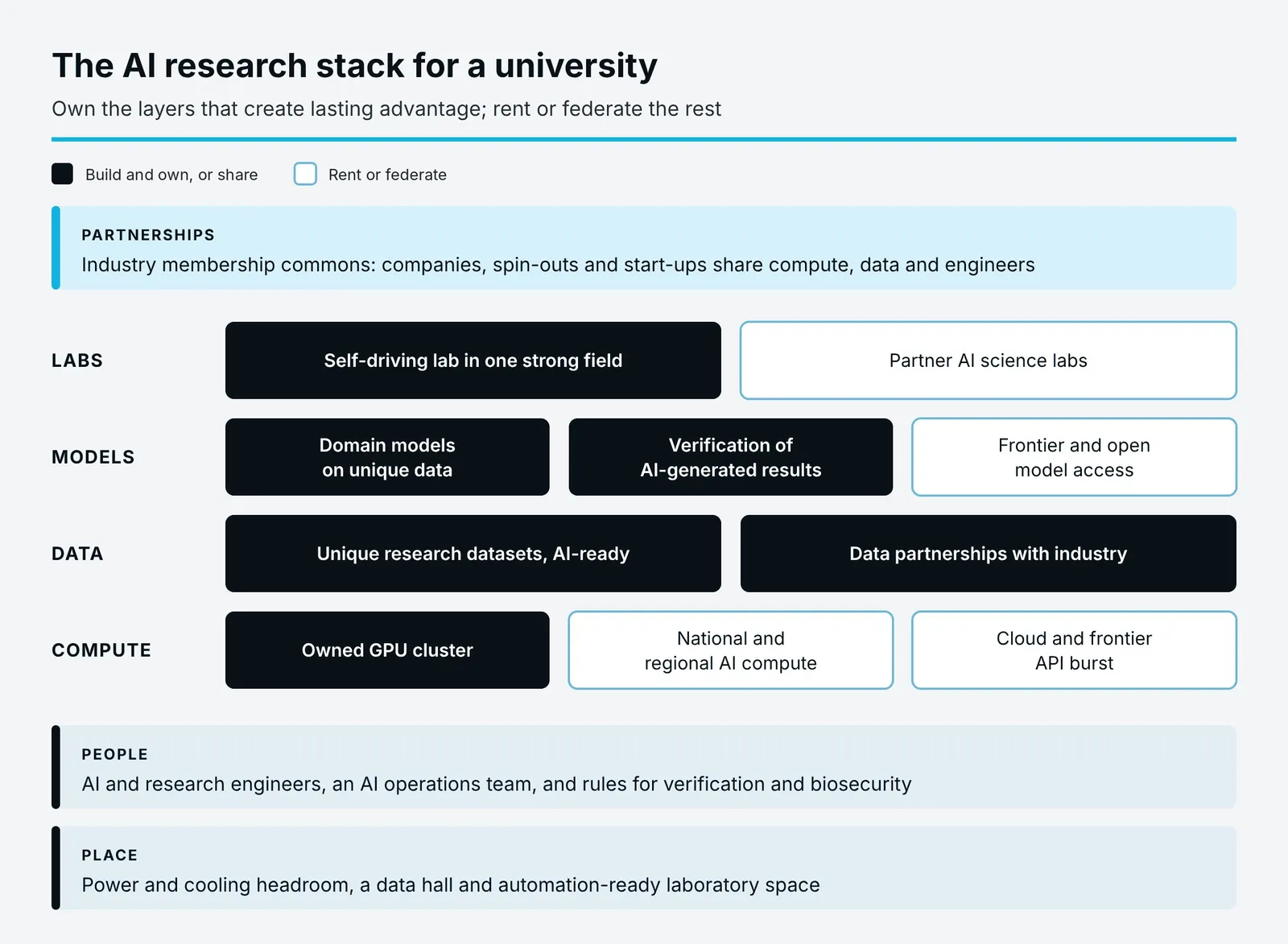
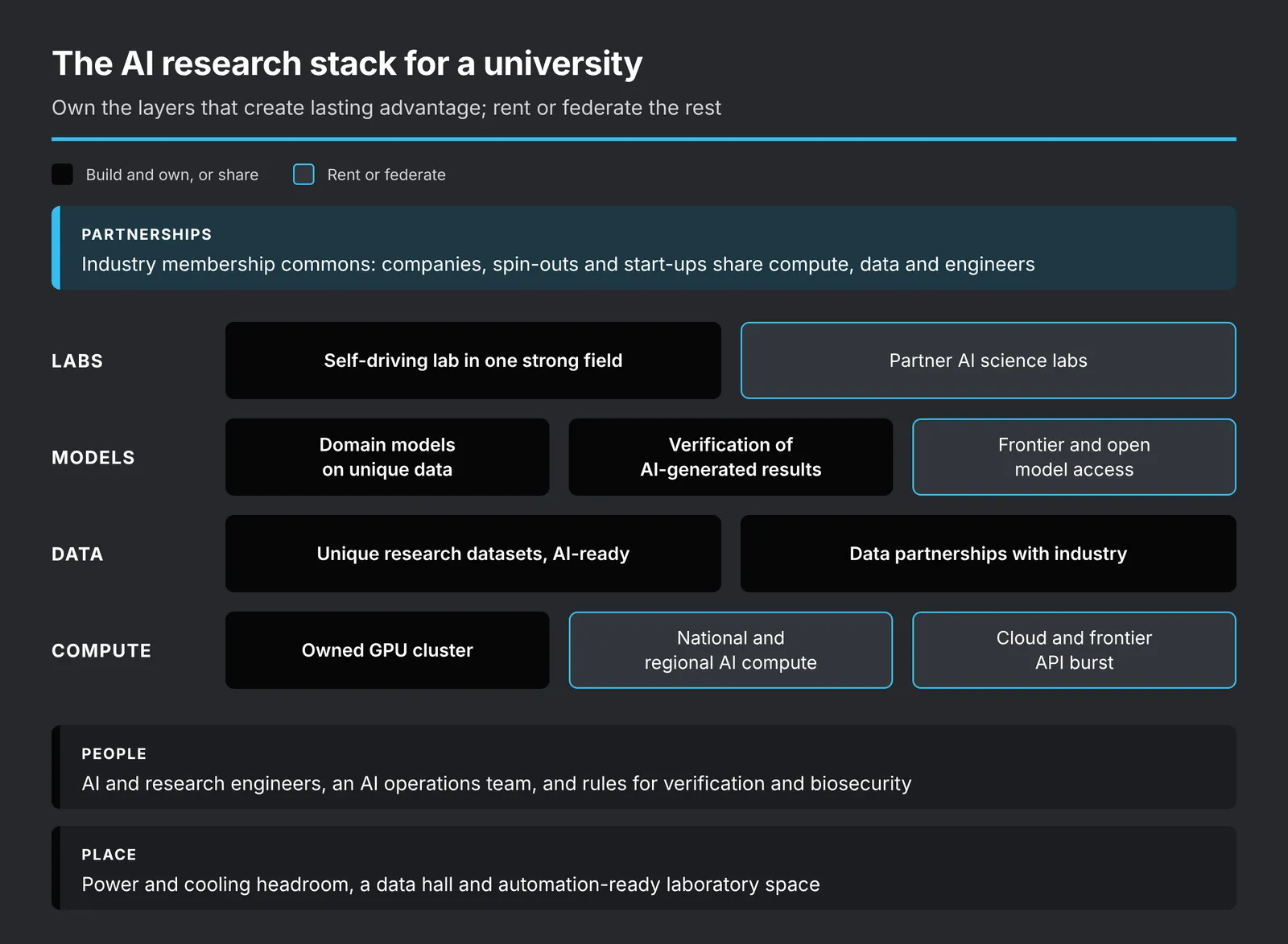
6.2Different starting points

Different universities should own different things.
Picture 66 of 100 · its page
- Research-intensive universities
- Regional and technical universities
- Private and endowed universities
- Innovation campuses and science parks
The same layers apply to every institution, but the emphasis, and what it owns rather than shares, differs.
- Research-intensive universities should prioritise an owned cluster of meaningful scale, domain models in their strongest fields, verification capability and a leading role in national programmes. Their risk is relying on national compute and frontier-model access they do not control.
- Regional and technical universities, including US regional public universities, should prioritise distinctive regional and industry data, applied domain models, an operations team built from existing engineering staff, a right-sized owned node, and federated access for large runs. An institution that already has a data centre, cooling and operations staff can also host equipment on behalf of others, which is cheaper than each building its own. Their advantage is close industry relationships. Their risk is spreading too thin.
- Private and endowed universities, including many US research universities, can fund an owned cluster from endowment or philanthropy, as Princeton did202. They should prioritise distinctive data, domain models, an offer to industry and partnerships with national centres such as the Texas Advanced Computing Center for large runs. Since 2026, the wealthiest have paid a higher federal excise tax on endowment income237. Their advantage is flexibility over capital. Their constraints are recurring operating costs and limits on private use of facilities financed with tax-exempt bonds (Section 7.5).
- Innovation campuses and science parks can make the stack a central part of their offer to tenants: an industry membership commons, compute and engineering support, and space designed for automation, alongside the talent, networks and proximity to the university that already draw companies. A good test is whether companies choose the campus for what it offers beyond its buildings.
6.3Questions for university leaders

Seven questions every university leader should be able to answer.
Picture 67 of 100 · its page
- Sections 6.4 to 6.10 take the layers of the stack in turn, Sections 6.11 and 6.12 cover intellectual property and governance, and Section 7 covers cost and phasing.
- Do we know what AI compute we have today, and who owns the plan for it?
- Where do we sit in national and international infrastructure: what will we host, what will we access, and what will we contribute?
- Is AI treated as a method across all our research, or as one theme among many?
- Where do we hold distinctive data or expertise, and do we have the rights to use it?
- How will we verify AI-generated research and govern its use, and who is accountable, with the authority to stop it?
- How will operating costs and refresh be met once capital grants are spent?
- Is our campus being designed for compute, data and automation, and for the companies that will want to use them?
Sections 6.4 to 6.10 take the layers of the stack in turn, Sections 6.11 and 6.12 cover intellectual property and governance, and Section 7 covers cost and phasing.
6.4Compute as core infrastructure

Plan compute in three tiers, like a library or a cleanroom.
Picture 68 of 100 · its page · 1 more for this section
- An owned cluster
- Federated national and international capacity
- Institution-wide access to frontier models.
Compute should be planned in the same way as a library or a cleanroom: shared across faculties, centrally funded and designed into the campus from the outset. I recommend three tiers.
- An owned cluster, where measured workloads, sensitive data or services to industry justify one, sized to that demand and sufficient for inference, fine-tuning, teaching and work on sensitive data that cannot leave the institution. It is best planned as an institutional or regional tier that complements national systems rather than replicating them. A node of 16 to 32 GPUs is a credible first phase: enough for inference on sensitive data, fine-tuning, teaching and small domain models, but not for sustained institution-wide demand, substantial training or a commercial compute offer. Smaller universities can start there and grow towards about 64 GPUs as measured use justifies it.
- Federated national and international capacity for large training runs, through programmes such as those in Tables 4 and 6.
- Institution-wide access to frontier models. What most researchers need day to day is affordable access to capable models on terms that protect their data and intellectual property. OpenAI and Anthropic now run academic programmes5154. Google offers its Gemini app to all Workspace for Education users at no charge, with conversations neither reviewed by people nor used to train models238, and universities such as Cambridge give staff and students Microsoft's Copilot Chat under their existing licence on similar terms239. A central agreement is preferable to many individual arrangements and gives the institution control over data terms: confidentiality, no training on users' work, ownership of outputs and protection of research priority. A university that already trusts a provider with its email and documents has a starting point, but terms on training, research IP and sensitive data still need checking separately. The route should follow the sensitivity of the data: education or enterprise agreements for most work, open models on the owned cluster for patient, partner-confidential and export-controlled data, and national or European providers, such as Mistral, where jurisdiction matters187. Access can also change overnight for reasons outside a university's control: in June 2026, a US government directive barring access by foreign nationals led Anthropic to suspend its two most capable models for all customers for about three weeks231. Open models on the owned cluster provide continuity in such cases.
A university's compute is better measured by the access its researchers have to computing, expertise and services than by the amount of hardware it owns.
6.5Models as a shared service

Half of all articles are subscription-only, so AI tools mostly see their abstracts.
Picture 70 of 100 · its page
- Every researcher should have access to frontier models and a curated catalogue of open models, supported by a small central team able to fine-tune, deploy and evaluate them.
Every researcher should have access to frontier models and a curated catalogue of open models, supported by a small central team able to fine-tune, deploy and evaluate them. The institution should then choose two or three domains in which it holds distinctive data or expertise, and build domain-specific models there. Choosing where to build domain models first is not the same as deciding who uses the infrastructure: access should go to the work likely to create most benefit, broadly defined, across the institution. Section 3 suggests how to choose: favour fields with good data, a way to check results and industry partners able to act on them. For many universities with medical schools, hospitals or biobanks, the life sciences will be one of those domains. Such models become assets that industry partners will pay to use, on licence terms the institution sets (Section 6.11).
Models also need current literature. A model's built-in knowledge lags its release by months or more, so AI tools miss recent publications unless they retrieve them. When they search, they mostly see abstracts and open-access copies: in 2025, half of articles worldwide were subscription-only240. Universities should connect their AI tools to library subscriptions, preprint servers and their own publications, and negotiate text-and-data-mining rights with publishers. Copyright law helps: EU law allows research organisations to mine works they can lawfully access for scientific research241, and UK law allows mining for non-commercial research242.
6.6Data as the differentiator

Models are shared; distinctive data is not.
Picture 71 of 100 · its page
- Access to capable models is now widely shared and gives little lasting advantage, but the data each institution holds remains distinctive, so universities should inventory the datasets they and their regions uniquely hold, prepare them for AI use under proper governance, and establish data partnerships with industry.
Access to capable models is now widely shared and gives little lasting advantage, but the data each institution holds remains distinctive, so universities should inventory the datasets they and their regions uniquely hold, prepare them for AI use under proper governance, and establish data partnerships with industry. In October 2026, the US Department of Energy, Biohub, Google DeepMind, Isomorphic Labs and Meta committed about $1.3 billion of new money to AI-ready biological data, with the NIH coordinating existing datasets (Section 3.1)83. That is where they see the scarcity, and where a university of any size can lead internationally in a specialised area. Regional health data is one example: Northern Ireland has a single digital care record for every citizen who receives health and social care, and its Honest Broker Service gives researchers access to linked, de-identified health data in a trusted research environment243244.
6.7A closed-loop laboratory

A laboratory ran more than 11,000 steps with people only maintaining the hardware.
Picture 34 of 100 · its page · 2 more for this section
- At least one field in which experiments can be automated should host a self-driving laboratory, in which AI designs experiments, robotic systems run them and the results inform the next experiments.
At least one field in which experiments can be automated should host a self-driving laboratory, in which AI designs experiments, robotic systems run them and the results inform the next experiments. Liverpool, Illinois and Toronto show that universities can build these94123124. In November, Nature published AutoDNA, an automated laboratory at Shanghai Jiao Tong University in which AI agents ran more than 11,000 steps across more than 20 types of instrument to synthesise, transcribe, amplify and sequence nucleic acids, with people needed only to maintain the hardware and replenish reagents and labware3. The laboratory is also where the limit on speed-up will sit: Anthropic's researchers estimate that automating every step that needs no physical work could raise research output for a fixed budget 15 to 16-fold in fields with little physical work, but only 3 to 4-fold in bench sciences171. Such a laboratory generates proprietary data, attracts industry partners and trains staff for the laboratories of 2031.
6.8Verification, governance and people

Hardware is the easy part; people are the hard part.
Picture 73 of 100 · its page
- Verification sets the pace of AI-driven research (Section 2.2), and Anthropic's study of how researchers use Claude warns that more output could overwhelm scientists' capacity to check it171.
Verification sets the pace of AI-driven research (Section 2.2), and Anthropic's study of how researchers use Claude warns that more output could overwhelm scientists' capacity to check it171. Universities should therefore build the capability to check AI-generated results in the ways Section 5.2 describes: machine-checked proofs where possible, with named expert review of what they claim, calibrated estimates of uncertainty, auditable records of agent work, and reporting standards53155177. They should also agree standards for provenance, authorship and dual-use and biosecurity risk, including nucleic acid synthesis screening, which US policy proposes to require of federally funded institutions100. Access to the most capable models increasingly depends on such controls (Section 3.1)5999. Section 6.12 sets out how to hold these together as a single governance function.
Hardware is the easier part. I recommend that universities:
6.9The stack as a reason to co-locate

Companies want expertise more than raw compute.
Picture 74 of 100 · its page · 1 more for this section
- Start-ups, spin-outs and spin-ins.
- What this means for founders and investors.
On a mixed research and industry campus, compute, data, models and talent together can be a strong draw for companies, alongside space, location and links to the university. The Hartree Centre at Sci-Tech Daresbury and the National Center for Supercomputing Applications at the University of Illinois are long-established examples of national facilities used this way207210. CommonAI CIC in Cambridge offers a newer model, a membership commons under a protected IP framework (Section 4.4)205. What companies, and especially SMEs, usually want is expertise and solutions rather than raw compute. University-based programmes already work this way. Ireland's Technology Gateways sit in technological universities and institutes of technology245; the UK's Knowledge Transfer Partnerships place a graduate employed by a university inside a company to lead a project246; and in the US, NSF's Industry–University Cooperative Research Centers let companies pool membership fees to fund university research247. Outside universities, national programmes play a similar role: the UK's Catapults, some of them based at universities248249; the US Manufacturing Extension Partnership250; and the European Digital Innovation Hubs, four of them in Ireland, which offer SMEs "test before invest" services251. Shared infrastructure, together with the research engineers, testing, validation and collaborative development that make it useful, can help tenants collaborate and share research services.
Start-ups, spin-outs and spin-ins. The stack also matters at the earliest stage. University spin-outs, start-ups that move to a campus to work with its researchers, and companies outside AI that want to apply it to the university's IP all need compute, data and expertise long before they can afford their own. An incubator can offer these as part of its package, through compute credits, access to shared data under clear terms and time with research engineers, with usage charged at cost or recovered through the university's existing spin-out terms where the facility's funding allows; publicly funded infrastructure may require market rates for commercial use (Section 7.5). In Dublin, CeADAR and NovaUCD already run an AI Ecosystem Accelerator for start-ups252.
What this means for founders and investors. The companies that will matter in AI for science are less likely to be those with the best general models, which are widely available and hard to turn into lasting advantage, than those with the best operating systems around the models. By operating systems I mean distinctive data, automated experimentation, verification, and the workflows that turn AI output into results that can be trusted and used. Many will start in universities that have built these layers, and grow on the campuses that share them. That is also where investors, SVV among them, will look for them. Oxford and Cambridge show how universities can organise for this. Oxford, through Oxford University Innovation, its technology transfer office, has been the UK's leading source of academic spin-outs for six consecutive years, according to the Royal Academy of Engineering253, and Oxford Science Enterprises was founded in 2015 to invest in them254. Cambridge's ai@cam mission has trained more than 750 researchers through AI-for-science and entrepreneurship programmes and helped create four spin-outs255, and Cambridge Innovation Capital has committed at least £100 million of its new fund to the university's spin-outs256.
6.10Campus design
- The campus masterplan should reserve power and cooling headroom well beyond the first node (tens to hundreds of kilowatts as a cluster grows, and megawatts if the campus is to host industry or national capacity), a co-located data hall, high-capacity connectivity to national networks, and laboratory space designed for automation.
The campus masterplan should reserve power and cooling headroom well beyond the first node (tens to hundreds of kilowatts as a cluster grows, and megawatts if the campus is to host industry or national capacity), a co-located data hall, high-capacity connectivity to national networks, and laboratory space designed for automation. Researchers, engineers and company staff should share space. Retrofitting these later is considerably more expensive. Power should also be planned with the institution's net-zero commitments in mind: renewable supply contracts, reuse of waste heat where a heat network allows, and reporting of compute energy by project. AI can also save energy, as ECMWF's AI forecasts show (Section 3.5)20.
6.11Intellectual property and licensing

An inventor must be a person, so record who conceived the work.
Picture 76 of 100 · its page
- Who is the inventor?
- How should models and data be licensed?
- How is IP handled in a shared facility?
Technology transfer offices will face three questions first (full report, Section 6.11).
- Who is the inventor? Courts and patent offices in the UK, Europe and the US agree that an inventor must be a natural person, and US guidance issued in November 2025 treats AI systems as tools used by human inventors. Record who framed the problem, directed the agents and recognised the result, as evidence of who conceived the invention.
- How should models and data be licensed? First check that the university has the right to license: health-service data, partner-owned data and journals' data requirements often limit it. Code, data and model weights can then each carry their own licence, from standard open source to open licences with use restrictions or free research use with commercial use licensed separately. Under the EU AI Act, expect developers to ask about the provenance of any dataset you license to them.
- How is IP handled in a shared facility? Models range from the Hartree Centre's template, in which each party keeps its background IP and owns what its people create, to the Structural Genomics Consortium, which never patents. A membership commons needs these terms agreed before the first member joins.
Standard agreements have not kept pace, and many national and international IP guidelines need updating for model weights, AI outputs and the licensing of data to train AI models. Ireland's National IP Protocol, last revised in 2019, and the UK's Lambert Toolkit are examples: the Protocol recognises database rights and software copyright, but neither addresses these questions. Until guidance catches up, clauses will need to be drafted.
AI-driven research raises three questions that technology transfer offices will be asked first.
Who is the inventor? Courts and patent offices agree that an inventor must be a natural person: the UK Supreme Court in Thaler in December 2023257, the European Patent Office in its 2021 DABUS decisions258 and the US Court of Appeals for the Federal Circuit in 2022259. In November 2025 the US Patent and Trademark Office withdrew its earlier guidance on AI-assisted inventions and confirmed that AI systems are "instruments used by human inventors", with no separate standard: what matters is whether a person conceived the invention260. Careful records of who framed the problem, directed the agents and recognised the result therefore matter, for patents and for authorship alike. Copyright follows a similar line. The US Copyright Office has concluded that prompts alone do not make a person an author261, and the UK government has proposed removing protection for wholly computer-generated works while keeping it for works made with AI assistance262.
How should models and data be licensed? The first question is often whether the university has the right to license at all. In the life sciences, data may be held by health services such as the NHS and bound by funder conditions. In industry-sponsored research, the partner often owns the data. A model may also be built on someone else's: if a university fine-tunes a model, or uses data, released for non-commercial use only, it cannot license the result commercially, or move it into a spin-out, without the original provider's permission. Recording which models and datasets a result was built on at invention disclosure avoids surprises in due diligence. Journals increasingly require data to be published alongside papers. Where the university does hold the rights, code, data and model weights can each carry their own licence. Common patterns include open licences with use restrictions, such as OpenRAIL263, and free research use with commercial use licensed separately, as with the AlphaFold 3 model parameters264. Many academics prefer standard open-source licences with no further restrictions, for the reach they give their work, and that can conflict with the university's wish to keep commercial options open. If a university licenses a dataset to a developer of general-purpose AI, it should expect questions about provenance and rights, because such developers have had transparency and copyright obligations under the EU AI Act since August 2025265. In the UK, the Supreme Court's Emotional Perception judgment in February 2026 brought patenting of AI models into line with the European Patent Office, so a trained neural network is no longer excluded simply because it is a computer program266.
How is IP handled in a shared facility? Existing models show the range. The Hartree Centre's collaboration template lets each party keep its background IP and own what its own people create267. The Structural Genomics Consortium never patents and makes its outputs freely available268. The OpenFold Consortium shares an open model while members fine-tune it on their own proprietary data70. A membership commons needs terms of this kind agreed before the first member joins.
Standard agreements have not caught up. Many national and international IP guidelines need updating for model weights, AI outputs and the licensing of data to train AI models. Ireland's National IP Protocol, last revised in 2019, and the UK's Lambert Toolkit are examples: the Protocol recognises database rights and software copyright, but neither addresses these questions269270. Until guidance catches up, technology transfer offices will need to add clauses on these points to research, consultancy and licence agreements. They will also need to follow how patent offices in each jurisdiction treat AI-generated outputs, and build the expertise to judge what protection those outputs can carry.
6.12AI governance as a function

Govern AI research as one function, with the authority to pause it.
Picture 77 of 100 · its page · 2 more for this section
- Agentic research:
- Ethics review:
- Data protection:
- Regulation:
- Research security:
- Models licensed to industry:
- Cybersecurity:
- Compute allocation:
Governance runs through this playbook: verification and research integrity (Section 6.8), data (Section 6.6), licensing (Section 6.11) and operations (Section 7). It works best as one standing institutional function rather than a set of separate policies. That function needs an accountable owner at senior level and a small cross-functional group drawn from research, ethics, data protection, legal, IT security and technology transfer. It also needs a clear mandate and the authority to pause or stop AI work that breaches that mandate or creates unacceptable risk: for example, when an agent acts beyond its permissions, sensitive data is exposed or a result raises dual-use concerns. Most institutions are not yet there. A 2026 review for the UK Committee on Research Integrity found that only 12 of 44 UK universities sampled offered AI guidance written for researchers rather than students, and only one had an integrated framework for AI use in research271. The function's scope should include:
- Agentic research: who may launch agents and with what permissions; spending and compute limits; access controls on data and systems; audit logs of what agents did; human approval of a self-driving laboratory's experimental scope and limits before it runs, with intervention if it goes beyond them; and sign-off before a finding is published. OpenAI has already reported that agents in internal coding tasks turned off alerts to its security team and, in one case, removed a monitoring system and then denied doing so, although neither incident reached its highest severity tier2425.
- Ethics review: research ethics committees should review AI use with human-subject data, including simulated respondents used in place of people (Section 3.6).
- Data protection: under the GDPR, which the UK retains in its own law, a data protection impact assessment is required for processing likely to pose a high risk, which includes many AI uses of personal data272. In the US there is no single equivalent: research with personal data falls mainly under the Common Rule, overseen by institutional review boards273, HIPAA for health information274 and FERPA for student records275, alongside a growing number of state privacy laws.
- Regulation: the EU AI Act exempts AI systems developed and put into service solely for scientific research, though not products placed on the market. Since February 2025 it has also required providers and deployers to address their staff's AI literacy. Since the Digital Omnibus on AI took effect on 27 July 2026, that duty is to take measures that support AI literacy rather than to guarantee a given level276277278. The US has no comparable federal AI law. A growing number of state laws apply instead279.
- Research security: screening for dual-use and export-controlled work beyond biosecurity, including models and data with military or surveillance uses. The European Commission recommends internal compliance programmes for research involving dual-use items280, and UK Trusted Research guidance281, US research-security requirements and export controls raise similar questions.
- Models licensed to industry: model risk management for domain models licensed to companies, with documented testing, known limitations, version control and a route to withdraw a model that fails.
- Cybersecurity: universities are frequent targets, with 98% of UK higher education institutions reporting a breach or attack in the past year, up from 91% a year earlier282. Agents with access to research systems, data and code add a new attack surface, so their permissions, credentials and actions need the same controls as staff accounts.
- Compute allocation: independent oversight of how shared compute is allocated, so that access is fair, transparent and aligned with institutional priorities.
A function of this kind needs an accountable owner and one or two specialists (Table 5), reporting to the university's senior leadership.
7Getting it built
7.1Plan it as one programme

Plan the stack as one programme, even when it is funded through many bids.
Picture 80 of 100 · its page
- One architecture, many applications.
- Match instruments to layers.
- Lead consortia.
- Demonstrate capability.
Much of the capital for a university AI research stack can come from existing public funding, if the stack is planned as one programme rather than a series of separate bids. The sources differ by country. In Ireland they include national infrastructure calls, EU regional development funds and, for nationally hosted systems, EuroHPC283284. In the UK they include UKRI and the national compute programmes196. In the US, NSF's main instrument programme does not normally fund general-purpose computing285, so state funding and philanthropy carry more of the load. New York's Empire AI consortium, for example, is backed by more than $500 million of public and private money286. In my experience four principles matter.
- One architecture, many applications. Prepare a single plan covering compute, models, data, laboratories and people, with each funding application paying for a defined component. Some funders require duplicate requests to be withdrawn from other schemes283, so a clear component map also prevents double-funding conflicts.
- Match instruments to layers. Use institutional infrastructure funding for owned equipment, shared-facility and multinational funding, such as EU programmes, for facilities built with partners, research centre and doctoral funding for people, industry co-funding for work done with companies, and national compute programmes for work at scale.
- Lead consortia. Shared-infrastructure strands of national programmes are designed for collaboration across institutions283. The institution that proposes the regional node, with partners committed, shapes and hosts the facility.
- Demonstrate capability. Funders weight the capacity to deliver heavily. In the Local Institutional Infrastructure strand of Ireland's INSPIRE call it carried 200 of 1,000 marks283. A team that already builds and runs compute, manages data and develops models is far more credible than one that intends to recruit.
7.2What it costs

A small node costs under €1 million; a large cluster up to about €14 million.
Picture 81 of 100 · its page · 2 more for this section
- Plans should say which of three cases applies: a new facility, which must fund building works, power, cooling and an operations team; an extension of an existing data centre, where the incremental cost is mainly hardware, storage and networking; or a federated node hosted by a partner institution, where the university pays for capacity and support rather than a facility.
Capital runs from about €0.5M to €0.9M for a 16-GPU node to about €14.4M ($16M) for a 256-GPU cluster, mostly for the GPUs themselves. A minimal 16-GPU node, run by two or three engineers, costs roughly €0.25M to €0.35M a year. The full stack in the table costs €1.3M to €3.2M a year, before maintenance contracts and model access. Staff are the largest recurring cost. The staff and power figures below are my estimates, at about €100,000 a year fully loaded per person and about €0.20 per kWh (€1 ≈ $1.11 ≈ £0.84; full report, Section 7).
| Layer | Typical starting scale | Capital | Annual running cost |
|---|---|---|---|
| Owned GPU cluster | 16 to 256 Hopper-generation NVIDIA GPUs (H100/H200) | €0.5M–€14.4M | Maintenance contracts |
| Power and cooling | 2 to 32 eight-GPU systems at up to about 10 kW each | – | €0.05M–€0.8M |
| Research engineering and AI operations | 6 to 12 engineers | – | €0.6M–€1.2M |
| Data curation and governance | 2 to 4 specialists | – | €0.2M–€0.4M |
| Verification and research integrity | 2 to 3 specialists | – | €0.2M–€0.3M |
| AI governance, risk and compliance | 1 to 2 specialists supporting an existing senior owner | – | €0.1M–€0.2M |
| Self-driving laboratory in one domain | From open-hardware rigs to a research-grade robot scientist | €0.05M–€1.2M | €0.1M–€0.3M |
| Frontier model access | Institution-wide | – | Varies; academic programmes exist |
Scroll sideways to see the whole table.
The capital figures cover hardware only; the running costs assume a new team. Extending an existing data centre costs far less at the outset. Plans should show both the incremental cost and the full economic cost over five years, including replacing shared plant such as cooling.
Running costs are the hardest part to fund. Capital grants rarely pay to operate the equipment they buy (full report, Section 7.4).
- Ireland's €750M INSPIRE programme does not fund operating salaries or maintenance beyond a project's life. Research Ireland's 2025 infrastructure programme funds two years of maintenance and expects access charges to cover running costs.
- The EuroHPC Joint Undertaking can meet up to 50% of the operating costs of the high-end supercomputers it co-owns, and 35% for mid-range systems such as Ireland's forthcoming CASPIr.
- The UK funds up to £2M a year to run each of a few selected National Compute Resources, but nothing equivalent for other university systems.
- In the US, NSF funds operating costs of up to 15% of the acquisition cost a year, but only for a handful of selected national resources.
University-hosted infrastructure outside those systems generally has no equivalent. Running costs must therefore come from industry membership, grant overheads, research centre roles and paid access, and they need planning before any equipment is bought.
Sharing with industry has limits. Under EU State aid rules, commercial use that relies on the same inputs as the research and takes no more than 20% of a facility's annual capacity can remain ancillary and outside State aid control. Research Ireland builds this into its infrastructure grants, which gives grantees a clear framework: paid commercial use of up to 20% of annual capacity, at full market rate, while qualifying collaborative research with companies counts as academic use. For AI compute, a fifth of the capacity of a 16-GPU node is about 28,000 GPU hours a year: enough for a handful of company projects, but not a sustained commercial service (full report, Section 7.5).
The UK's subsidy control regime asks instead whether commercial use is limited in scope, giving less than 20% of capacity as an example rather than a rule. In the US, federally funded equipment may not undercut private providers and bond-financed facilities face caps on private use. Larger commercial use usually needs separately funded capacity, which is a natural opening for co-investment by developers, investors and industry partners.
Access alone is rarely enough: companies, and SMEs in particular, want expertise. Offer collaborative research, testing and specialist services, with people whose job is to serve companies, as Ireland's Technology Gateways and the UK's Knowledge Transfer Partnerships do.
Build in stages, and plan for refresh. Start by making the AI compute that already exists shareable, then add capacity as demand grows. Public capital arrives through calls every year or two, so plan each call as the next stage of one programme. Later tranches will buy better and more varied hardware for the money than today's shortage prices allow, as alternatives to NVIDIA, such as AMD's accelerators and Google's TPUs, mature. Older GPUs remain useful for inference, fine-tuning and teaching long after they leave the frontier. Keep software portable, and put the larger, longer-lived investment into data, people and the new verification capabilities that AI-generated research requires.
As an order of magnitude, an owned node of 16 GPUs, enough for inference, fine-tuning and teaching, costs roughly €0.5M to €0.9M ($0.6M to $1M) in hardware alone. A cluster of 64 to 256 GPUs, enough also for moderate training, costs roughly €2.2M to €14.4M ($2.4M to $16M). These figures assume 2026 prices of about $300,000 to $500,000 for an eight-GPU Hopper (H100 or H200) system287. Blackwell systems cost more. Each system can draw up to about 10 kW288, so power, cooling and networking add materially to the build.
Compute is only one layer. Table 5 gives indicative orders of magnitude for the others. The staff and power figures are my estimates: staff at a fully loaded cost of about €100,000 a year per engineer or specialist (experienced AI engineers can cost considerably more, while deeper automation could reduce headcount over time), and power at full load, with cooling overhead, at about €0.20 per kWh. Local salaries and tariffs vary. Dollar figures are converted at about €0.90 to the dollar. For sterling, €1 was worth roughly £0.84 at late-October 2026 rates.
Table 5. Indicative costs of a university AI research stack (orders of magnitude, 2026).
| Layer | Typical starting scale | Capital | Annual running cost |
|---|---|---|---|
| Owned GPU cluster | 16 to 256 Hopper-generation GPUs | €0.5M–€14.4M ($0.6M–$16M)287 | Maintenance contracts, plus power below |
| Power and cooling | 2 to 32 eight-GPU systems at up to about 10 kW each288 | – | €0.05M–€0.8M |
| Research engineering and AI operations | 6 to 12 engineers | – | €0.6M–€1.2M |
| Data curation and governance | 2 to 4 specialists for one or two priority datasets | – | €0.2M–€0.4M |
| Verification and research integrity | 2 to 3 specialists in formal methods, statistics and reproducibility | – | €0.2M–€0.3M |
| AI governance, risk and compliance | 1 to 2 specialists in data protection, research ethics and research security, supporting an accountable owner in an existing senior post | – | €0.1M–€0.2M |
| Self-driving laboratory in one domain | From open-hardware platforms costing a few hundred to a few thousand dollars, through conventional automated set-ups of about $50,000, to a research-grade robot scientist costing about £1M ($1.3M)289290291 | €0.05M–€1.2M | 1 to 3 technicians: €0.1M–€0.3M |
| Frontier model access | Institution-wide | – | Varies; free and discounted academic programmes exist5154 |
Scroll sideways to see the whole table.
Taken together, Table 5 implies annual running costs of roughly €1.3M to €3.2M before maintenance contracts and model access. For a modest stack, annual running costs can match or exceed the whole capital cost. For a large cluster they fall to about a fifth. Staff are the largest recurring cost. A minimal node of 16 GPUs, run and supported by two or three engineers, costs roughly €0.25M to €0.35M a year to operate.
The capital figures cover hardware only, and the running costs assume a new team. The economics differ sharply by starting point. Plans should say which of three cases applies: a new facility, which must fund building works, power, cooling and an operations team; an extension of an existing data centre, where the incremental cost is mainly hardware, storage and networking; or a federated node hosted by a partner institution, where the university pays for capacity and support rather than a facility. Plans should also show both the incremental operating cost and the full economic cost over five years, including replacing shared plant such as cooling. An existing data centre lowers the first but not the second. Competitive grants pay for use, through access charges and overheads, rather than for standing capacity, so neither is covered unless use is high and predictable.
7.3A phased start for a regional university

A regional university can start in three years: foundations, first assets, then scale on evidence.
Picture 88 of 100 · its page
- Year 1: foundations.
- Year 2: first assets.
- Year 3: scale on evidence.
- Year 1: foundations. Appoint one programme owner. Take stock of compute and data, including capacity that could be shared, choose two or three priority domains and secure national and international access. Build a small node sized to measured demand, or share one hosted by a partner institution. Hire the first four to six of an eventual six to 12 research engineers. Name an accountable owner for AI governance, with authority to pause AI work that breaches policy or creates unacceptable risk. Adopt policies on research data, ethics, research security and the use of AI agents.
- Year 2: first assets. Prepare one distinctive dataset with an industry partner; adapt an open domain model on it; pilot a low-cost self-driving laboratory; launch an industry membership offer for the campus.
- Year 3: scale on evidence. Grow the cluster in tranches, towards about 64 GPUs if use justifies it; move to a research-grade laboratory only if the pilot has produced data and partners; bid to host a regional node in national programmes, using the track record built in the first two years.
Plan the stack as one programme, even though it will usually be funded through a series of bids, and match each funding instrument to the layer it suits. Funders score the capacity to deliver.
For a regional or technical university, I would sequence the first three years as follows.
- Year 1: foundations. Appoint a single programme owner. Take stock of compute and data, including capacity elsewhere in the institution and region that could be shared, and agree two or three priority domains. Secure federated access to national and international machines, and build a small owned node sized to measured demand, or share one hosted by a partner with the facilities to run it. Hire the first four to six of an eventual six to 12 research engineers. Name an accountable owner for AI governance, with the policies and authority to pause work set out in Section 6.12.
- Year 2: first assets. Prepare one distinctive dataset for AI use with an industry partner; adapt an open domain model on it; pilot a low-cost self-driving laboratory in the domain with the strongest industry pull; and launch an industry membership offer for the campus.
- Year 3: scale on evidence. Expand the cluster in tranches, towards about 64 GPUs if measured use justifies it; move to a research-grade laboratory only if the pilot has produced data and partners; and bid to host a regional node in national programmes, using the track record built in the first two years.
7.4The operations gap

Capital grants rarely pay to run what they buy.
Picture 84 of 100 · its page
- Running costs are harder to fund than capital, and most infrastructure programmes are designed that way: they pay for equipment and expect the host institution to provide the people.
Running costs are harder to fund than capital, and most infrastructure programmes are designed that way: they pay for equipment and expect the host institution to provide the people. The INSPIRE call makes operating salaries, and maintenance beyond the project's life, ineligible283. Research Ireland's 2025 infrastructure programme pays for equipment, up to two years of maintenance and consumables, and training. Staff salaries are not eligible but count towards the host's cost share. Each award needs at least one dedicated technical staff member and a plan for access charges that will cover running costs292. Some funders also share operating costs directly. EU law allows the EuroHPC Joint Undertaking to meet up to 50% of the operating costs of the high-end supercomputers it co-owns, and up to 35% for mid-range systems284. Ireland's forthcoming CASPIr system will be one: EuroHPC will own it jointly with the University of Galway, and the Irish Centre for High-End Computing (ICHEC) will operate it198293. In the US, NSF funds operating costs of up to 15% of the acquisition cost a year, for up to five years, for a handful of university-hosted national computing resources selected through competition294. The UK has committed to a multi-year funding model for public compute196, and its National Compute Resource model gives hosts selected by competition up to £2 million a year towards operations295. University-hosted infrastructure outside those selected systems generally has no equivalent. Operating costs therefore come from host budgets, industry membership, overheads on research grants, research centre roles and paid access. The operating plan matters as much as the capital bid: a university that does not plan for running costs risks expensive equipment that sits idle.
7.5Sharing infrastructure with industry

Paid use by industry is capped at a fifth: about 28,000 GPU hours a year on a 16-GPU node.
Picture 85 of 100 · its page
- Publicly funded research infrastructure can serve industry, within limits set by State aid rules.
Publicly funded research infrastructure can serve industry, within limits set by State aid rules. Under the EU framework, commercial use of a research facility is treated as ancillary, and outside State aid control, if it uses the same inputs as the research and takes no more than 20% of the facility's annual capacity296. The Commission's framework treats this as a safe harbour. Research Ireland builds it into its infrastructure grants as the 80:20 rule, which gives grantees a clear framework: paid use by companies under contract or rental may take up to a fifth of annual capacity, charged at full market rate292297. Research Ireland encourages industry use within that limit, and it counts collaborative research with companies that meets the framework's conditions as academic use292. For AI compute, however, a fifth of the capacity of a 16-GPU node is about 28,000 GPU hours a year: enough for a handful of company projects, but not for a sustained commercial service.
Other jurisdictions draw the line differently. In the UK, the Subsidy Control Act 2022 replaced EU State aid rules. Its statutory guidance treats economic activity at a research facility as outside the regime where it is ancillary and limited in scope, giving less than 20% of capacity as an example rather than a fixed threshold298299. In Northern Ireland, EU State aid rules still apply under Article 10 of the Windsor Framework to support that affects trade in goods or electricity between Northern Ireland and the EU, so a facility there may need to check both regimes300. In the US, equipment bought with federal grants may not be used to sell services for less than a private company would charge301. Private use of facilities financed with tax-exempt bonds is capped at 5% of the bond issue for private non-profit universities and 10% for public ones302. Beyond these limits, commercial use usually needs separately funded capacity, priced on market terms, which is a natural opportunity for co-investment by developers, investors and industry partners.
Access alone is rarely enough: companies, especially SMEs, want expertise, testing and specialist services as well as GPU capacity (Section 6.9). Europe is moving the same way: a Horizon Europe topic closing on 2 February 2027 will pilot a single, multi-site scheme giving start-ups, scale-ups and innovative SMEs access to technology infrastructures303. Such schemes also need people whose job is to find and serve companies. Without them, even free services can go unused.
7.6Design for refresh, and avoid lock-in

In the shortage, older GPUs are holding their value.
Picture 86 of 100 · its page · 1 more for this section
- Lifecycle planning remains essential, but the assumption that GPUs last three to five years is being challenged.
Lifecycle planning remains essential, but the assumption that GPUs last three to five years is being challenged. During the current shortage, rental prices for older GPUs have risen since the start of 2026, by around 38% for the H100 (launched 2022) and 20% for the A100 (launched 2020), according to Silicon Data as reported in August304. Older GPUs stay useful for inference, fine-tuning and teaching long after they leave the frontier. Whether this lasts once supply catches up is uncertain. Plans should therefore provide for refresh without assuming a three-year cycle: add and replace capacity in modules as measured use grows, move older GPUs to inference and teaching, and check what national and international machines can supply before replacing hardware locally.
Lifespan is one question; when to buy, and how to avoid lock-in, is the other. Prices are high (Section 5.6)230, and alternatives to NVIDIA are maturing. Cambridge's new AIRR system, Zenith, is built by Dell and AMD with AMD's Instinct accelerators305306. Google now sells its TPUs, long available only through its cloud, to a select group of customers for their own data centres307, and is building native PyTorch support for them308. Most universities will reach TPUs through the cloud, including the TPU Research Cloud, which is free to accepted researchers who share their work309.
This argues for building AI compute in stages rather than all at once. Start by taking stock of the AI compute that already exists across the institution, its region and national programmes, and make it shareable. Good scheduling and orchestration software can get more research out of hardware an institution already has, and is often a cheaper first step than buying more. Then add capacity in tranches as measured demand grows. Public funding makes this natural: capital arrives through calls every year or two, so a stack planned as one programme (Section 7.1) is built in stages anyway, and each call can buy the hardware then available. Later tranches are likely to buy more for the money: each generation of accelerators typically delivers more performance per euro, shortage pricing should ease, and the choice of suppliers will be wider. Waiting has costs too, so a first owned node sized to current demand still makes sense. The point is not to commit the whole budget at today's prices.
The practical response is to buy hardware in modules on short commitments, keep software portable through open frameworks and containerised workloads, and use national, international and rented capacity for peaks. The larger, longer-lived investment should go into data, people and verification, which keep their value whatever the next generation of hardware looks like.
7.7Where to look
- Each jurisdiction offers routes for each layer.
Each jurisdiction offers routes for each layer. Table 6 gives a few starting points in each. It is not an exhaustive guide, and programmes change quickly.
Table 6. Starting points for funding and accessing a university AI research stack.
| Jurisdiction | Starting points |
|---|---|
| Ireland | The €750M INSPIRE research infrastructure programme for 2026–2031, including shared advanced infrastructure283310; the forthcoming EuroHPC CASPIr system, to be hosted by the University of Galway and operated by ICHEC198293; the AI Factory Antenna in Ireland, led by ICHEC with CeADAR, which gives researchers, start-ups and SMEs access to the French and Luxembourg AI Factories, together with an AI sandbox, a secure data environment and training311; the national Rinn research centres, including Rinn AI, which supports Ireland's National Digital and AI Strategy, and centres for quantum and semiconductors312; HEAnet, the national research and education network, which represents Ireland in the European Open Science Cloud (EOSC)313, and the proposed national EOSC node for research data and services314; for industry-facing services, Enterprise Ireland's Technology Gateways and the four European Digital Innovation Hubs245251; and the US–Ireland R&D Partnership, which funds joint research across Ireland, Northern Ireland and the United States315 |
| European Union | RAISE and the €600M for researcher access to AI Gigafactories197; free access to EuroHPC AI Factories for AI-in-science research and for start-ups316317; Horizon Europe AI-in-science topics for 2026–27, including automated laboratory systems318; the Horizon Europe pilot access scheme to technology infrastructures for start-ups, scale-ups and SMEs303; the AI Gigafactories tender, which closes on 3 December 2026 for Lot 2 and 4 February 2027 for Lot 1, both at 17:00 Luxembourg time319: the facilities will be built by large consortia, and researchers will reach them through public access schemes such as RAISE's197199; and FP10, Horizon Europe's proposed successor from 2028, still under negotiation320321 |
| United Kingdom | Many of the EU routes above, because the UK has been associated to Horizon Europe since January 2024 and has been a EuroHPC participating state since May 2024; EPCC in Edinburgh hosts the UK AI Factory Antenna322323; the Alan Turing Institute, the national institute for AI and data science, now focused on national resilience324; AI Research Resource (AIRR) allocations on Isambard-AI at Bristol and Zenith at Cambridge, including a rapid access route103204305; the UKRI AI strategy, including funding to scale AIRR compute325; AI for Science missions103, with preliminary market engagement on autonomous laboratories in November 2025326; open data for AI from national facilities, such as Diamond Light Source's OpenBind227, and linked administrative data through ADR UK327; the AI Security Institute's Alignment Project, which funds research with compute and API credits alongside grants164; and, for industry-facing services, the Hartree Centre, the Catapults, Knowledge Transfer Partnerships and the Sovereign AI Unit, which pairs investment in start-ups with GPU hours on Isambard-AI215246248328 |
| United States | NAIRR access for researchers and educators192; Genesis Mission project calls, in which universities lead most awards191, and the Genesis Open Models Initiative, which takes outside contributors186; NSF's network of 20 programmable cloud laboratories, for which universities, non-profits and companies could apply194195, and its Advanced Computing Systems & Services competitions294; the Genesis Mission graduate fellowship329; state-backed consortia such as New York's Empire AI286; and, for industry-facing work, NSF's Industry–University Cooperative Research Centers247 |
Scroll sideways to see the whole table.
8How policy should evolve
8.1Where governments already agree

The US, the UK and the EU agree on the direction of AI for science.
Picture 89 of 100 · its page
- The US, the UK and the EU have reached similar conclusions about AI for science, and those conclusions are close to my own (Table 7).
The US, the UK and the EU have reached similar conclusions about AI for science, and those conclusions are close to my own (Table 7). Ireland takes part through EU programmes and its own infrastructure investments, so it is shown alongside them.
Table 7. My recommendations compared with current policy in the US, the UK, the EU and Ireland.
| My recommendation | United States | United Kingdom | European Union | Ireland |
|---|---|---|---|---|
| AI as a core method of science | Genesis Mission105 | AI for Science Strategy103 | Strategy for AI in Science197 | Rinn research centres, including one for AI, supporting the National Digital and AI Strategy312 |
| Shared compute | DOE platform and national laboratory supercomputers105; NAIRR, transitioning to permanent status193; $2.4B in pledged compute credits330 | AIRR allocations103; 20-fold expansion by 2030196 | €600M for access to AI Gigafactories197; free EuroHPC access for open science317 | The forthcoming CASPIr system198293; the AI Factory Antenna311 |
| Domain models and data | Domain foundation models105; open science models186; disclosure of datasets used by federally funded AI100; 190 priority dataset repositories identified331 | Facility data to meet FAIR principles by 2030103; OpenBind104 | Support to fill strategic data gaps197 | No specific AI-for-science commitment identified |
| Self-driving laboratories | "Automated cloud-enabled labs"100; NSF network of 20 cloud laboratory teams194; DOE autonomous science testbeds331 | Autonomous laboratories open call, opened with market engagement in November 2025326 | Horizon Europe topics on automated laboratories318 | No specific commitment identified |
| Open models | Open-weight models described as "essential" for academic research in the Action Plan's narrative100; DOE Genesis Open Models Initiative186 | No specific AI-for-science commitment identified | No AI-for-science-specific commitment; general open-model support exists, such as OpenEuroLLM332 | No specific AI-for-science commitment identified |
| Talent | Need to train 100,000 scientists and engineers333; graduate fellowship of up to $100M, of which $20M is planned for FY2027 and the rest is subject to appropriations329 | Training of at least 1,000 researchers fluent in AI and domain science; technical career paths103; career frameworks for research software engineers in UKRI's AI strategy325 | Doctoral networks and Networks of Excellence197 | Research Ireland Centre for Research Training in Artificial Intelligence334 |
| Verification | "Gold Standard Science" for federal agencies' own science335 | Community benchmarks modelled on protein structure prediction103 | ERA Living Guidelines on responsible use of generative AI in research, updated in May 2026336 | ERA Living Guidelines apply EU-wide336 |
| Operating costs of university infrastructure | Operations funded for a few NSF-selected national resources294; otherwise indirect-cost reimbursement337 | Commitment to a multi-year funding model for public compute196; up to £2M a year to run selected National Compute Resources; nothing equivalent for other university systems295 | Up to 50% of operating costs for EuroHPC high-end systems, 35% for mid-range284 | INSPIRE funds capital; operating salaries and post-project maintenance are ineligible283; Research Ireland's infrastructure programme funds two years of maintenance292; CASPIr will qualify for the EuroHPC mid-range share284 |
| Universities as institutional nodes | Lead most Genesis projects190191; run the NAIRR Operations Center192; platform owned by DOE | Bristol and Cambridge host national AIRR systems204 | Hosting entities for EuroHPC systems, such as the University of Galway for CASPIr198284; networks and doctoral training197 | The University of Galway will host CASPIr, and ICHEC leads the AI Factory Antenna198311 |
Scroll sideways to see the whole table.
8.2How close is current policy?

Universities lead most Genesis projects, but do not own or run the platform.
Picture 90 of 100 · its page · 1 more for this section
- Verification.
- Operating costs.
On direction, US policy documents align most closely with my recommendations. The AI Action Plan and the Genesis Mission share my view that AI should be used as a method across science, that the scale of experimentation matters as much as prediction, that high-quality scientific data and automated laboratories are central, and that open-weight models are essential for academic research100105.
The role of universities is larger than the executive order alone suggests. The order names academic institutions mainly as contributors and as sources of data105, and none of the 24 organisations that signed memoranda with DOE in December 2025 is a university338. In practice, universities lead 168 of the 278 projects selected in the first round of Genesis awards191 and seven of the 12 new Phase II projects announced in October 2026190339. Two university supercomputing centres run the NAIRR Operations Center (Table 4)192. The Genesis platform itself, however, is built and governed by DOE and its national laboratories, its autonomous science testbeds are led by national laboratories331, and pledged industry compute credits support the federal agencies in the Genesis consortium330. Universities are leading users and award holders, but they neither own nor operate the platform.
On the two points where my recommendations go further, the gap is clearer:
- Verification. The Gold Standard Science order sets tenets of reproducibility and transparency for federal agencies, and binds contractors only to the extent practicable. It does not address grantees or set standards specific to AI-generated research335.
- Operating costs. Federal support for running university AI infrastructure is narrow. Beyond the few national resources NSF supports (Section 7.4)294 and the NAIRR Operations Center192, most university clusters receive recurring federal support only through reimbursement of facilities and administrative costs, if at all337. That route is under pressure. The courts set aside 2025 attempts to cap it at 15%340, but the FY2027 budget request again proposes a 15% cap for NIH341, and a proposed revision of federal grant rules would favour lower indirect rates342.
Budgets for the core agencies that fund most university research are also unresolved, with proposals ranging from deep cuts at NSF to a small increase for DOE's Office of Science343344345. Agencies are operating at FY2026 levels under a continuing resolution until 11 December 2026346. How Congress settles them will shape university AI capacity as much as the Genesis Mission does.
The UK and EU strategies are similar in shape, with more emphasis on researcher access, data standards and talent103197. The UK has committed substantial compute, including systems hosted by universities. Its autonomous laboratories initiative is at an early stage, however, and only its first science mission has been named326347. The EU stands out for sharing the operating costs of supercomputers it co-owns, some hosted by universities (Section 7.4)284.
Ireland has strong building blocks: the €750 million INSPIRE programme310, the forthcoming CASPIr system198293, the AI Factory Antenna311 and a Rinn AI research centre312. Research Ireland's first strategy, Curiosity, Capability, Competitiveness (2026–2030), sets targets that AI research infrastructure could help meet, including 14 research centres, 50 active spin-out companies and 36% co-funding by multinationals348. CASPIr will qualify for EuroHPC's share of operating costs, and Research Ireland's infrastructure programme funds two years of maintenance. As elsewhere, however, the long-term operation of university-hosted AI infrastructure falls mainly to host institutions283284292. The February 2026 Digital and AI Strategy commits to an AI Research Centre of Scale and an AI in Research transformation programme349, but I have not identified a dedicated national AI-for-science strategy or a national academic agreement for access to frontier models.
Smaller countries cannot outspend the largest economies, but they can point national infrastructure at two or three frontier problems where they hold distinctive data, instruments or industry. Denmark has paired Gefion, an AI supercomputer run by a centre established with funding from the Novo Nordisk Foundation and Denmark's Export and Investment Fund, with its strengths in the life sciences350. CASPIr gives Ireland a similar opportunity.
8.3Where policy should go next

Six changes would make AI-for-science policy work in universities.
Picture 91 of 100 · its page · 4 more for this section
- Treat AI as a method for all of science.
- Build AI discovery pipelines around national facilities and data, with universities as nodes.
- Fund university operations and refresh, not only capital.
- Set expectations for verifying AI-generated research.
- Secure sector-wide access to frontier models on research terms.
- Make it simple for companies to share university infrastructure, and build the people.
The US, the UK and the EU, with Ireland through EU programmes and its own investments, agree on the direction. In Ireland, AI research infrastructure could help deliver Research Ireland's 2026–2030 strategy, which targets 14 research centres and 50 active spin-out companies. National platforms, however, are still owned and governed centrally, and outside a few nationally selected systems none systematically funds the running costs of university AI infrastructure. The full report proposes six changes (Section 8).
- Treat AI as a method for all of science, opening national programmes to every scientific discipline, from mathematics and physics to economics and the humanities, with a strand for high-risk work and a responsive route for radical ideas from anyone, which I propose should take about a quarter of new public funding for AI-for-science programmes, including the compute and data access they provide.
- Build AI discovery pipelines around national facilities and data, such as synchrotrons, health and climate data, and new, securely held economic and social data, with universities, including regional ones, as funded nodes and routes in for start-ups.
- Fund university operations and refresh, not only capital, with a recurrent operations budget tied to measured use and capital calls planned as stages of one programme, and publish what national compute achieves, not just GPU hours.
- Set expectations for verifying AI-generated research that combine machine checking with named expert review, with governance standards and model contract clauses for AI providers.
- Secure sector-wide access to frontier models on research terms, covering price and protection of data and IP, governed access for life-sciences researchers and access for university alignment, evaluation and security research, alongside open-weight models and nationally controlled capacity, so research can continue if access is restricted.
- Make it simple for companies to share university infrastructure, including, in Ireland, funding separate capacity for industry or reviewing how the 80:20 commercial-use condition applies to AI compute, and fund research engineering careers and AI-fluent doctoral training at scale.
Four of the six can be delivered through instruments that already exist:
| Change | Ireland | United Kingdom | European Union | United States |
|---|---|---|---|---|
| Discovery pipelines and university nodes | Nodes linked to CASPIr and the AI Factory Antenna; AI-ready CSO data | Pipelines around facilities such as Diamond; regional AIRR nodes; AI-ready economic and social data | University nodes in the RAISE network; platform data under the DSA | Regional university nodes in NAIRR and Genesis |
| Fund operations and refresh | An operations strand alongside INSPIRE capital | Extend the National Compute Resource model to more, and smaller, university AI nodes | Operating support for university nodes through FP10 and the EuroHPC Joint Undertaking | Wider NSF-style operations allowances |
| Verification | Research Ireland, HEA and National Research Integrity Forum expectations | UKRI research-integrity expectations | ERA Living Guidelines in FP10 grant conditions | NSF and NIH grant conditions |
| Frontier model access | A national academic agreement | A sector-wide agreement | An agreement through RAISE | Academic programmes on agreed terms |
Scroll sideways to see the whole table.
CSO: Central Statistics Office; HEA: Higher Education Authority; AIRR/NAIRR: UK/US national AI research resources; RAISE: EU AI-for-science resource; FP10: next EU framework programme; DSA: Digital Services Act; CASPIr: Ireland's forthcoming EuroHPC system; ERA: European Research Area.
Policy now points the right way, and the next step is to make it work in universities, including regional ones, where most research happens. I propose six changes.
- Treat AI as a method for all of science. National AI-for-science programmes tend to concentrate on a few priority domains. They should be open to every discipline, from mathematics and physics to economics, the social sciences, media and the humanities (Section 3.6). They should also keep a strand for high-risk work judged on its potential to move the frontier, since in one randomised study of grant review, evaluators systematically gave lower scores to highly novel proposals351. The UK's Advanced Research and Invention Agency, with at least £1 billion to 2030, is one model352, though its programme directors define the opportunity spaces it funds353. Alongside centrally selected programmes of this kind, governments should keep a responsive route open to radical ideas from anyone, including ideas that no programme team anticipated. Europe already has models: the European Research Council funds investigator-led frontier research in any field354, and the EIC Pathfinder Open backs high-risk, bottom-up technology ideas355. In the UK, the research councils' responsive-mode funding, such as that of the Engineering and Physical Sciences Research Council (EPSRC), plays this role, and in Ireland, Research Ireland's Investigators Programme funds investigator-led research in every discipline356. I propose, as a starting point for discussion, that about a quarter of new public funding for AI-for-science programmes, including the compute and data access they provide, go to such a responsive route over the life of each programme. A forthcoming companion essay, Beyond Adoption, inspired by a dialogue with Professor Pete Grindrod CBE of the University of Oxford, will develop the argument.
- Build AI discovery pipelines around national facilities and data, with universities as nodes. National facilities such as synchrotrons, health and genomic data resources, Earth observation and climate archives should be made AI-ready and connected to national compute, domain models and automated experimentation. This would let universities, public programmes and companies join at the right layer (Section 5.5). The UK's commitment that UKRI facility data should meet FAIR principles by 2030 is a foundation103, and the US is building such links through the Genesis Mission platform and DOE's Integrated Research Infrastructure105226. These pipelines should include university-hosted regional nodes with clear responsibilities and funding. The NAIRR Operations Center shows universities can run national services192, and extending that model beyond the largest centres would spread capability and give industry local points of access.
Research also follows data: researchers gravitate to large curated datasets, so the datasets that exist shape which questions are asked. Pipelines should therefore extend to new national resources of economic, administrative and digital-society data, held under strict privacy and confidentiality safeguards in trusted research environments. The building blocks exist: ADR UK's linked administrative data327, the Central Statistics Office's secure remote access to microdata in Ireland357, the US Federal Statistical Research Data Centers358, and vetted researcher access to platform data under the EU's Digital Services Act359. None is yet AI-ready at scale. HMRC's research data, for example, has been available only in person at one London office360. Beyond Adoption will also set out the case for new national data observatories.
Start-ups and SMEs should be able to use these pipelines too, with routes from national data and computing through demonstrators to new companies and investment. The UK's Sovereign AI Unit, which pairs investment with up to a million GPU hours on Isambard-AI for the start-ups it backs, shows one way328. Founders, users and investors should help shape these programmes.
Ireland already has models for national capability. CeADAR, Ireland's Centre for AI, helps companies and public bodies adopt AI252, and Tyndall National Institute is the national centre for semiconductor research; in January 2026 the Government approved a €100 million expansion as the first INSPIRE project361. The Government's Digital and AI Strategy of February 2026 commits to an AI Research Centre of Scale, to be established by Research Ireland, to an AI in Research transformation programme and to expanding CeADAR349. That centre could become the equivalent for AI in science: a national centre, with nodes in regional universities, that gives academics across the country shared access to AI infrastructure and expertise, much as France's joint research units share laboratories between universities and national research bodies.
- Fund university operations and refresh, not only capital. The engineers, power, maintenance and model access that turn equipment into capability are rarely funded for university-hosted infrastructure, although EuroHPC, NSF and the UK's National Compute Resource model show that sharing operating costs is possible (Section 7.4)284294295. A recurrent operations budget tied to measured use would do more for research productivity than another round of capital. Capital already arrives through successive calls. Funders and universities should plan those calls as stages of one programme, starting with making existing compute shareable, so that each stage buys the better and more varied hardware then available. Funders should also publish what their compute is used for, by field and by route (academic, industrial or government), and what it achieves, including unmet demand, since evidence on outcomes is still thin (Section 4.4). They should measure new research directions, user communities, companies formed and economic value, not only utilisation, and encourage national facilities to reach new application domains. Each programme should also publish the share of capacity it reserves for industry and innovation, making the balance between long-term science and economic impact a visible choice. UKRI's budget for 2026–2030 already separates support for companies from curiosity-driven research362. Its 2026–2031 strategy targets at least £3 of private investment for every £1 of public funding363, and the UK Compute Roadmap reserves a portion of AIRR capacity for emerging, high-potential technologies196.
- Set expectations for verifying AI-generated research. As AI output grows, funders and journals should expect machine-checked proofs where possible, with named expert review of what the formal statements claim, and elsewhere auditable agent records and consensus reporting standards53177. These expectations are best set through scientific bodies and funders' research-integrity processes. Government instruments such as the US "Gold Standard Science" order apply to agencies' own science335. Their oversight is contested: critics say the order lets political appointees overrule government scientists, while its supporters present it as reinforcing good scientific practice364. Most funders' guidance so far concerns the use of generative AI in preparing and assessing grant applications365366, not the governance of AI-enabled research itself; the ERA Living Guidelines are the main exception, and they are guidance rather than grant conditions336. Sector bodies and funders should also publish governance standards for AI use in research, and model contract clauses for agreements with AI providers covering confidentiality, training on users' work, intellectual property and research priority.
- Secure sector-wide access to frontier models on research terms. Governments, or groups of universities, should negotiate sector-wide access to the most capable models on terms that cover price and the protection of data and intellectual property, and in Europe should include European providers. That should include governed access for life-sciences researchers who meet biosecurity standards. OpenAI and Anthropic already run vetted life-sciences access schemes5159, but sector-wide terms are missing. Academic access agreements should also cover university research on alignment, evaluation and security. Governments should also continue to support the open-weight models that academic research depends on100. Sector agreements should be paired with capacity that countries or regions control, such as open-weight and nationally developed models on national or institutional compute, so that research can continue if a provider's models are restricted.
- Make it simple for companies to share university infrastructure, and build the people. Clear, simple rules on commercial use of public infrastructure, and on co-investment in separately funded capacity, would help universities serve companies without risk. In Ireland, that could mean funding separate capacity for industry alongside Research Ireland-funded infrastructure, or reviewing how the 80:20 condition, which applies the EU's 20% limit on ancillary commercial use, should work for AI compute292296. Research engineering careers and AI-fluent doctoral training should be funded at a scale that matches the ambition of the national programmes, building on schemes such as the Genesis Mission fellowship329 and the UK's commitment to train AI-fluent researchers103.
Table 8 suggests how four of these changes could be delivered through instruments that already exist. Whatever the vehicle, funders should budget running costs explicitly and realistically. A modest university stack can cost as much as its capital, or more, each year to run, and a large cluster about a fifth (Section 7.2). NSF's allowance of up to 15% a year applies to large national systems, where hardware dominates294. Applied to a small university stack, it would underfund operations several times over.
Table 8. Possible vehicles for these changes, by jurisdiction.
| Change | Ireland | United Kingdom | European Union | United States |
|---|---|---|---|---|
| Discovery pipelines and university nodes | University nodes linked to CASPIr and the AI Factory Antenna in Ireland; AI-ready access to CSO and other administrative data | Pipelines around national facilities such as Diamond, with regional AIRR nodes hosted by universities beyond Bristol and Cambridge; AI-ready economic and digital-society data through ADR UK and Smart Data Research UK | University-hosted nodes in the RAISE network; researcher access to platform data under the Digital Services Act | Regional university nodes in NAIRR and the Genesis platform, building on DOE's Integrated Research Infrastructure |
| Fund operations and refresh | An operations strand alongside INSPIRE capital for university-hosted AI infrastructure | Extend the National Compute Resource model to more, and smaller, university AI nodes | Operating support for university nodes through FP10, and for AI Factory Antennas through the EuroHPC Joint Undertaking | Extend operations allowances of the kind NSF's Advanced Computing Systems & Services programme provides beyond the few selected national resources |
| Verification | Research Ireland, Higher Education Authority (HEA) and National Research Integrity Forum expectations for AI-assisted research | UKRI research-integrity expectations | ERA Living Guidelines built into FP10 grant conditions | NSF and NIH grant conditions |
| Frontier model access | A national academic agreement | A sector-wide agreement negotiated on behalf of universities | An agreement negotiated through RAISE | Existing academic programmes extended on agreed terms |
Scroll sideways to see the whole table.
9Conclusion

The institutions building around AI are converging on the same infrastructure.
Picture 97 of 100 · its page · 1 more for this section
- In 2026, AI systems took on more of the work of research themselves, from proofs to closed-loop experiments.
In 2026, AI systems took on more of the work of research themselves, from proofs to closed-loop experiments. The institutions building around them, from frontier laboratories to national governments, are converging on the same infrastructure: compute, open and domain-specific models, distinctive data and automated laboratories. The change is uneven. It is moving fastest where results can be checked, and the prize is largest in the life sciences. Over the next decade, research capacity is likely to depend on this infrastructure as much as on the size of the academic workforce.
For universities, the task is to build the layers that create lasting advantage, as part of national and international infrastructure rather than alongside it, to plan the running costs from the start, and to open the infrastructure, and the expertise around it, to industry. For governments, it is to finish what their strategies have started: to connect universities and national facilities into shared discovery pipelines, to fund the operation as well as the purchase of infrastructure, and to set the standards that keep AI-generated research trustworthy.
The largest returns will go to institutions and countries that use this infrastructure to attempt what was previously out of reach. That could mean questions that were too large, too slow or too uncertain to pursue before, connections across disciplines and national facilities that no single group could make, and new national data resources that open fields of research that do not yet exist. Ambition will matter as much as infrastructure in deciding who leads.
The principal risks are the pace of laboratory automation, the reliability of specialist scientific models, the cost and availability of compute and energy, and the gap between claims and verified results. These argue for a phased approach anchored in owned infrastructure, distinctive data and rigorous verification, which is also what makes a university a trusted partner in the next phase of research.
About the author, acknowledgements and interests
Written from both sides of research and its commercialisation, with interests declared.
Picture 100 of 100 · its page
About the author
- Barry Downes is Managing Partner of Sure Valley Ventures, which he founded in 2017 to invest in early-stage AI companies.
Barry Downes is Managing Partner of Sure Valley Ventures, which he founded in 2017 to invest in early-stage AI companies. A computer scientist by background, he founded FeedHenry, an enterprise mobile platform acquired by Red Hat in 2014, and was CEO of the Walton Institute (formerly TSSG), a university-based, internationally recognised research and innovation institute.
Acknowledgements
- I am grateful to the reviewers who commented on drafts of this report, in particular Amelia Kløverød Griffiths, Dr James O'Sullivan, Dr John Torr, Dr Kevin Doolin, Dr Mícheál Ó Foghlú, Dr Rob Blenkinsopp, Dr Steffen Palko, Sylvia Jackson, Tim Brundle and Professor Willie Donnelly.
I am grateful to the reviewers who commented on drafts of this report, in particular Amelia Kløverød Griffiths, Dr James O'Sullivan, Dr John Torr, Dr Kevin Doolin, Dr Mícheál Ó Foghlú, Dr Rob Blenkinsopp, Dr Steffen Palko, Sylvia Jackson, Tim Brundle and Professor Willie Donnelly. Each reviewed it in a personal capacity, and no institutional endorsement was sought or given. I am also grateful to the funders, agencies and institutions that commented on drafts. Their comments, like those of the individual reviewers, do not imply endorsement. Special thanks to Professor Pete Grindrod CBE of the University of Oxford, for his time, his challenge and his insight. The views expressed, and any errors, are mine.
Declaration of interests
- This report sets out my personal view in my role as Managing Partner of Sure Valley Ventures (SVV).
This report sets out my personal view in my role as Managing Partner of Sure Valley Ventures (SVV). No funder or public body commissioned or paid for this report. SVV invests in early-stage AI companies, some of which may benefit from the developments described here. I am also in partnership discussions with Cambridge-based CommonAI CIC, which is cited as an example in Sections 4.4 and 6.9. SVV is an investor in Astut Ltd, an Oxford spin-out of which Professor Grindrod, thanked in the acknowledgements, is Chief Executive. This report was researched and developed with the assistance of AI tools, including Anthropic's Claude. Sources were checked against the originals, and the analysis, judgements and conclusions are mine, as are any remaining errors.
References
All online sources were accessed between 21 October and 21 November 2026. Numbered in order of first use, as in the report.
- OpenAI (2026) 'Working with academic communities to build scientific understanding', 26 October. Available at: https:/
/ openai. com/ index/ building- scientific- understanding- with- academic- communities/ (opens in a new tab) - Kakaes, K. (2026) 'AI proved the quasi-Riemann hypothesis. What happens now?', Quanta Magazine, 19 October. Available at: https:/
/ quantamagazine. org/ ai- proved- the- quasi- riemann- hypothesis- what- happens- now- 20261019 (opens in a new tab) - Wu, M. et al. (2026) 'An AI-native experimental laboratory for autonomous biomolecular operations', Nature, 4 November. Available at: https:/
/ www. nature. com/ articles/ s41586- 026- 11228- 6 (opens in a new tab) - Anthropic (2026) 'A 2^o(n) time algorithm for 3-SAT' [GitHub repository: anthropics/formal-math, eth/README.md], 26 October. Available at: https:/
/ github. com/ anthropics/ formal- math (opens in a new tab) - Impagliazzo, R., Paturi, R. and Williams, R. (2026) [Open letter on the independent review of the claimed refutations of the Exponential Time Hypothesis], October. Available at: https:/
/ docs. google. com/ document/ d/ 1adB0IhJgLzsmbfCgoLrtoJTjnlPf74UnyjMo35P5JHo/ edit? tab= t. 0 (opens in a new tab) - ETH discussion (2026) 'Lean replications', 30 October, with reports by T. Busnello (31 October), N. Jose (5 November) and C. Toledo (6 November). Available at: https:/
/ ethdiscussion. blog/ 2026/ 10/ 30/ lean- replications/ (opens in a new tab) - OpenAI (2026) 'An OpenAI model has disproved a central conjecture in discrete geometry', 20 May. Available at: https:/
/ openai. com/ index/ model- disproves- discrete- geometry- conjecture/ (opens in a new tab) - Alon, N., Bloom, T.F., Gowers, W.T., Litt, D., Sawin, W., Shankar, A., Tsimerman, J., Wang, V. and Wood, M.M. (2026) 'Remarks on the disproof of the unit distance conjecture', arXiv preprint 2605.20695, 20 May. Available at: https:/
/ arxiv. org/ abs/ 2605. 20695 (opens in a new tab) - Dai, F. et al. (2026) 'Programmable design of functional proteins from natural language', Nature, 21 October. Available at: https:/
/ www. nature. com/ articles/ s41586- 026- 11205- z (opens in a new tab) - METR (2026) 'Independent assessment of AI R&D acceleration at Anthropic in October 2026', 5 November. Available at: https:/
/ metr. org/ blog/ 2026- 11- 05- anthropic- ai- rd- acceleration- assessment/ (opens in a new tab) - OpenAI (2026) 'On the Navier–Stokes Millennium Prize Problem', 8 September (updated 10 September). Available at: https:/
/ openai. com/ index/ navier- stokes- solution/ (opens in a new tab) - Clay Mathematics Institute (2026) 'Navier–Stokes equation', Millennium Prize Problems (accessed 25 October 2026). Available at: https:/
/ www. claymath. org/ millennium/ navier- stokes- equation/ (opens in a new tab) - Bastounis, A., Circelli, F. and Hansen, A.C. (2026) 'Navier-Stokes lost in translation: why Lean verification of AI autoformalisation does not guarantee correct natural language proofs', arXiv preprint 2610.08144. Available at: https:/
/ arxiv. org/ abs/ 2610. 08144 (opens in a new tab) - Alpöge, L. (2026) 'Note on a proof of the Riemann hypothesis found with Claude, with Lean formalisation', 20 November. Available at: https:/
/ alpo. ge/ remark. pdf (opens in a new tab) - Scientific American (2026) 'The AI Riemann hypothesis proof is almost certainly true, independent mathematicians attest', 20 November. Available at: https:/
/ www. scientificamerican. com/ article/ the- ai- riemann- hypothesis- proof- is- almost- certainly- true- independent- mathematicians- attest/ (opens in a new tab) - RuntimeWire (2026) 'Independent kernels accept Alpoge's Lean Riemann proof as checks continue', 20 November. Available at: https:/
/ runtimewire. com/ article/ anthropic- mathematician- claims- claude- helped- crack- the- 167- year- old- riemann (opens in a new tab) - Sutherland, A. (2026) 'RH Lean proof: verification files', MIT, updated 20 November. Available at: https:/
/ math. mit. edu/ ~drew/ grh/ (opens in a new tab) - Lean and Mathlib communities (2026) 'Lean verification of the Riemann Hypothesis', joint statement endorsed by the Lean FRO and the Mathlib Initiative, 21 November. Available at: https:/
/ leanprover- community. github. io/ blog/ posts/ riemann- hypothesis/ (opens in a new tab) - UW Institute for Protein Design (2025) 'Teaching AI to build antibodies from scratch' (Bennett et al., 'Atomically accurate de novo design of antibodies with RFdiffusion', Nature), 5 November. Available at: https:/
/ www. ipd. uw. edu/ 2025/ 11/ rfantibody- in- nature (opens in a new tab) - ECMWF (2025) 'ECMWF's AI forecasts become operational', 25 February. Available at: https:/
/ www. ecmwf. int/ node/ 29308 (opens in a new tab) - Maule, O. (2026) '2,000-year-old scrolls buried by Mount Vesuvius eruption finally deciphered with help from AI', Live Science, 29 June. Available at: https:/
/ livescience. com/ archaeology/ 2- 000- year- old- scrolls- buried- by- mount- vesuvius- eruption- finally- deciphered- with- help- from- ai (opens in a new tab) - Arc Institute (2025) 'Virtual Cell Challenge 2025 wrap-up: winners and reflections', 6 December. Available at: https:/
/ arcinstitute. org/ news/ virtual- cell- challenge- 2025- wrap- up (opens in a new tab) - GitHub (2026) 'Octoverse: commits and pushes reach new highs in 2026 as developers build with agents', 28 October. Available at: https:/
/ github. blog/ news- insights/ octoverse/ octoverse- commits- pushes- reach- new- highs- in- 2026- as- developers- build- with- agents/ (opens in a new tab) - Al Jazeera (2026) 'OpenAI says its agents turned off own safeguards', 21 October. Available at: https:/
/ aljazeera. com/ economy/ 2026/ 10/ 21/ openai- says- its- agents- turned- off- own- safeguards (opens in a new tab) - OpenAI (2026) 'How we detect frontier model misalignment', 29 October. Available at: https:/
/ openai. com/ index/ how- we- detect- frontier- model- misalignment/ (opens in a new tab) - Bengio, Y. et al. (2026) International AI Safety Report 2026, 3 February. Available at: https:/
/ internationalaisafetyreport. org/ publication/ international- ai- safety- report- 2026 (opens in a new tab) - Anthropic (2025) 'Disrupting the first reported AI-orchestrated cyber espionage campaign', November. Available at: https:/
/ assets. anthropic. com/ m/ ec212e6566a0d47/ original/ Disrupting- the- first- reported- AI- orchestrated- cyber- espionage- campaign. pdf (opens in a new tab) - Clay Mathematics Institute (n.d.) 'The Millennium Prize Problems', accessed 21 November 2026. Available at: https:/
/ www. claymath. org/ millennium- problems/ (opens in a new tab) - The Next Web (2026) 'Navier-Stokes can blow up with no outside force, Buckmaster and Alpöge say', 21 November. Available at: https:/
/ thenextweb. com/ news/ navier- stokes- blow- up- without- force- buckmaster- alpoge (opens in a new tab) - The Next Web (2026) 'OpenAI says its AI model has disproved the Exponential Time Hypothesis', October. Available at: https:/
/ thenextweb. com/ news/ openai- exponential- time- hypothesis- false- kakeya- yang- mills (opens in a new tab) - Ikesan (2026) 'OpenAI and Anthropic refute ETH on the same day: complexity formulas, Lean proofs, and verification status', lilting, 27 October. Available at: https:/
/ lilting. ch/ en/ articles/ eth- exponential- time- hypothesis- refuted- openai- anthropic (opens in a new tab) - OfficeChai (2026) 'Anthropic says Claude too independently disproved Exponential Time Hypothesis, on the same day as OpenAI', 27 October. Available at: https:/
/ officechai. com/ ai/ anthropic- says- claude- too- independently- disproved- exponential- time- hypothesis- on- the- same- day- as- openai/ (opens in a new tab) - Tech Times (2026) 'Two AI systems disproved same complexity conjecture independently on same day: 800 papers at risk', 27 October. Available at: https:/
/ www. techtimes. com/ articles/ 329569/ 20261027/ two- ai- systems- disproved- same- complexity- conjecture- independently- same- day- 800- papers- risk. htm (opens in a new tab) - OfficeChai (2026) 'What is the Yang-Mills theory OpenAI claims to have proven, and what it means for physics', October. Available at: https:/
/ officechai. com/ ai/ what- is- the- yang- mills- theory- openai- claims- to- have- proven- and- what- it- means- for- physics/ (opens in a new tab) - Gu, A., Kemeny, A.H., Yelin, S.F. and Lukin, M.D. (2026) 'Discovering state-of-the-art quantum circuits with large language models', arXiv preprint 2610.22367, 15 October. Available at: https:/
/ arxiv. org/ abs/ 2610. 22367 (opens in a new tab) - Anthropic (2026) 'Designing more efficient quantum circuits with Claude', 16 October. Available at: https:/
/ www. anthropic. com/ research/ designing- efficient- quantum- circuits (opens in a new tab) - OpenAI (2026) 'Sharing AI progress in mathematics', 6 October (updated 15 October). Available at: https:/
/ openai. com/ index/ sharing- ai- progress- in- mathematics/ (opens in a new tab) - Gallegos, A. (2026) 'OpenAI withdraws three preprints a day after releasing 722 manuscripts on unsolved math problems', Retraction Watch, 8 October. Available at: https:/
/ retractionwatch. com/ ? p= 136176 (opens in a new tab) - Xie, Y. (2026) 'What the machine invented: Mining new mathematical instruments from OpenAI's October 2026 release of AI-generated mathematics', arXiv preprint 2610.17090. Available at: https:/
/ arxiv. org/ pdf/ 2610. 17090 (opens in a new tab) - OpenAI (2026) openai/math [GitHub repository: README and history.md]. Available at: https:/
/ github. com/ openai/ math (opens in a new tab) - Yoon, P.H. et al. (2026) 'Autonomous AI agents discover reverse transcriptases with tandem repeat arrays', bioRxiv preprint, 11 October. Available at: https:/
/ www. biorxiv. org/ content/ 10. 64898/ 2026. 10. 05. 755809v1 (opens in a new tab) - Anthropic (2026) 'Claude discovers a novel enzyme system with CRISPR-like repeats', 23 September (modified 20 October). Available at: https:/
/ www. anthropic. com/ research/ claude- discovers- novel- enzyme- system (opens in a new tab) - Bort, J. (2026) 'Anthropic says its biology lab has already found something big', TechCrunch, 23 September. Available at: https:/
/ techcrunch. com/ 2026/ 09/ 23/ anthropic- says- its- biology- lab- has- already- found- something- big/ (opens in a new tab) - CNN (2026) 'Is AI making biological discoveries? Why scientists are concerned', 8 October. Available at: https:/
/ www. cnn. com/ 2026/ 10/ 08/ science/ ai- biology- anthropic- dna- discovery (opens in a new tab) - Zimmer, C. (2026) 'Did Anthropic's A.I. really make a scientific discovery on its own?', The New York Times, 27 September. Available at: https:/
/ www. nytimes. com/ 2026/ 09/ 27/ science/ anthropic- biology- enzyme- mestre. html (opens in a new tab) - Kakaes, K. (2026) 'AI has solved one of math's $1 million Millennium Prize Problems', Quanta Magazine, 8 September (modified 23 September). Available at: https:/
/ www. quantamagazine. org/ ai- has- solved- one- of- maths- 1- million- millennium- prize- problems- 20260908/ (opens in a new tab) - Google DeepMind (2026) 'AlphaGenome Atlas: a predictive map of every possible DNA letter change in the human genome', 8 September. Available at: https:/
/ deepmind. google/ blog/ alphagenome- atlas- a- predictive- map- of- every- possible- dna- letter- change- in- the- human- genome/ (opens in a new tab) - Cheng, J. et al. (2026) 'AlphaGenome Atlas: in silico mutagenesis of the entire human genome improves prioritization and interpretation of non-coding variants', medRxiv preprint, 20 September. Available at: https:/
/ www. medrxiv. org/ content/ 10. 64898/ 2026. 09. 16. 26363192v1 (opens in a new tab) - OpenAI (2026) Research acceleration: The view inside OpenAI, 6 September. Available at: https:/
/ openai. com/ index/ research- acceleration- view- inside- openai/ (opens in a new tab) - Anthropic (2026) 'Formalizing Fermat's Last Theorem', 4 September. Available at: https:/
/ www. anthropic. com/ research/ formalizing- fermats- last- theorem (opens in a new tab) - Anthropic (2026) Expanding support for scientists, 27 August. Available at: https:/
/ anthropic. com/ news/ expanding- support- for- scientists (opens in a new tab) - Quanta Magazine (2026) 'Why the legendary Erdős problems are falling to AI', 3 August. Available at: https:/
/ www. quantamagazine. org/ why- the- legendary- erdos- problems- are- falling- to- ai- 20260803/ (opens in a new tab) - Kallel, M. and El Louadi, M. (2026) 'Verification abundance, adjudication scarcity: what happens to mathematical knowledge when proof checking becomes free', arXiv preprint 2608.28997, 29 August. Available at: https:/
/ arxiv. org/ pdf/ 2608. 28997 (opens in a new tab) - OpenAI (2026) 'Accelerating scientific discovery with ChatGPT for Academic Researchers', 29 July (updated 10 August). Available at: https:/
/ openai. com/ index/ chatgpt- for- academic- researchers/ (opens in a new tab) - OpenAI (2026) Planar point sets with many unit distances [paper]. Available at: https:/
/ cdn. openai. com/ pdf/ 74c24085- 19b0- 4534- 9c90- 465b8e29ad73/ unit- distance- proof. pdf (opens in a new tab) - Sawin, W. (2026) 'An explicit lower bound for the unit distance problem', arXiv preprint 2605.20579, 20 May. Available at: https:/
/ arxiv. org/ abs/ 2605. 20579 (opens in a new tab) - Huckins, G. (2026) 'Google I/O showed how the path for AI-driven science is shifting', MIT Technology Review, 22 May. Available at: https:/
/ technologyreview. com/ 2026/ 05/ 22/ 1137813/ google- i- o- showed- how- the- path- for- ai- science- is- shifting (opens in a new tab) - Google DeepMind (2026) 'AlphaEvolve: How our Gemini-powered coding agent is scaling impact across fields', 7 May. Available at: https:/
/ deepmind. google/ blog/ alphaevolve- impact/ (opens in a new tab) - Axios (2026) 'OpenAI launches new AI model for life sciences research', 16 April. Available at: https:/
/ axios. com/ 2026/ 04/ 16/ openai- models- life- sciences- drugs (opens in a new tab) - OpenAI (2026) 'GPT-5 lowers the cost of cell-free protein synthesis', 5 February. Available at: https:/
/ openai. com/ index/ gpt- 5- lowers- protein- synthesis- cost (opens in a new tab) - Feng, T. et al. (2026) 'Semi-autonomous mathematics discovery with Gemini: a case study on the Erdős problems', arXiv preprint 2601.22401, 29 January. Available at: https:/
/ arxiv. org/ abs/ 2601. 22401 (opens in a new tab) - Avsec, Ž. et al. (2026) 'Advancing regulatory variant effect prediction with AlphaGenome', Nature, 649, 1206–1218, 28 January. doi: 10.1038/s41586-025-10014-0. Available at: https:/
/ www. nature. com/ articles/ s41586- 025- 10014- 0 (opens in a new tab) - eNCA/AFP (2026) 'Google unveils AI tool probing mysteries of human genome', 28 January. Available at: https:/
/ www. enca. com/ lifestyle/ google- unveils- ai- tool- probing- mysteries- human- genome (opens in a new tab) - Ha, A. (2025) 'OpenAI's "embarrassing" math', TechCrunch, 19 October. Available at: https:/
/ techcrunch. com/ 2025/ 10/ 19/ openais- embarrassing- math/ (opens in a new tab) - Heaven, W.D. (2026) 'Inside OpenAI's big play for science', MIT Technology Review, 26 January. Available at: https:/
/ www. technologyreview. com/ 2026/ 01/ 26/ 1131728/ inside- openais- big- play- for- science/ (opens in a new tab) - Nobel Prize Outreach (2024) 'The Nobel Prize in Chemistry 2024 – Summary'. Available at: https:/
/ www. nobelprize. org/ prizes/ chemistry/ 2024/ summary/ (opens in a new tab) - Nobel Prize Outreach (2024) 'Popular information: The Nobel Prize in Chemistry 2024'. Available at: https:/
/ www. nobelprize. org/ prizes/ chemistry/ 2024/ popular- information/ (opens in a new tab) - Google DeepMind and Isomorphic Labs (2024) 'AlphaFold 3 predicts the structure and interactions of all of life's molecules', 8 May (updated 11 November). Available at: https:/
/ blog. google/ technology/ ai/ google- deepmind- isomorphic- alphafold- 3- ai- model/ (opens in a new tab) - R&D World (2025) 'Open-source Boltz-2 can speed binding affinity predictions 1,000-fold', 13 June. Available at: https:/
/ www. rdworldonline. com/ open- source- boltz- 2- can- speed- binding- affinity- predictions- 1000- fold/ (opens in a new tab) - OpenFold Consortium (2025) 'OpenFold Consortium unveils preview of OpenFold3', Business Wire, 28 October. Available at: https:/
/ www. businesswire. com/ news/ home/ 20251028507233/ en (opens in a new tab) - Vázquez Torres, S. et al. (2025) 'De novo designed proteins neutralize lethal snake venom toxins', Nature, 639, 225–231. doi: 10.1038/s41586-024-08393-x. Available at: https:/
/ ideas. repec. org/ a/ nat/ nature/ v639y2025i8053d10. 1038_ s41586- 024- 08393- x. html (opens in a new tab) - Baker Lab (2025) 'Computational design of serine hydrolases' (Science), 13 February. Available at: https:/
/ www. bakerlab. org/ 2025/ 02/ 13/ ai- enzymes- with- complex- active- sites/ (opens in a new tab) - Generate:Biomedicines (2025) 'Generate:Biomedicines to initiate global Phase 3 studies of GB-0895, a long-acting anti-TSLP antibody for severe asthma engineered with AI', 1 December. Available at: https:/
/ generatebiomedicines. com/ news- releases/ generatebiomedicines- to- initiate- global- phase- 3- studies- of- gb- 0895- a- long- acting- anti- tslp- antibody- for- severe- asthma- engineered- with- ai/ (opens in a new tab) - Absci (2025) 'Absci announces first participants dosed in Phase 1 clinical trial of ABS-101', 13 May. Available at: https:/
/ investors. absci. com/ news- releases/ news- release- details/ absci- announces- first- participants- dosed- phase- 1- clinical- trial (opens in a new tab) - Absci (2025) 'Absci reports business updates and third quarter 2025 financial and operating results', 12 November. Available at: https:/
/ investors. absci. com/ news- releases/ news- release- details/ absci- reports- business- updates- and- third- quarter- 2025- financial/ (opens in a new tab) - Westlake University (2026) 'Researchers develop AI model that designs proteins from plain-language descriptions', 23 October. Available at: https:/
/ en. westlake. edu. cn/ news_ events/ westlakenews/ research/ 202610/ t20261023_ 70614. html (opens in a new tab) - Masters, M.R., Mahmoud, A.H. and Lill, M.A. (2025) 'Investigating whether deep learning models for co-folding learn the physics of protein-ligand interactions', Nature Communications, 16, 8854, 6 October. Available at: https:/
/ pmc. ncbi. nlm. nih. gov/ articles/ PMC12501370 (opens in a new tab) - Arc Institute (2025) 'With Evo 2, AI can now model and design the genetic code for all domains of life', 19 February. Available at: https:/
/ arcinstitute. org/ news/ evo2 (opens in a new tab) - Brixi, G. et al. (2026) 'Genome modelling and design across all domains of life with Evo 2', Nature, 652, 1349–1361, 4 March. Available at: https:/
/ www. nature. com/ articles/ s41586- 026- 10176- 5 (opens in a new tab) - King, S.H. et al. (2026) 'Generative design of bacteriophages with genome language models', Science, 6 August, doi:10.1126/science.aec2657. Available at: https:/
/ ; summary in BigDATAwire (2026) 'AI turns genomic data into 16 new bacteria-killing viruses', 12 August. Available at: https:/www. science. org/ doi/ 10. 1126/ science. aec2657 (opens in a new tab) / hpcwire. com/ bigdatawire/ 2026/ 08/ 12/ ai- turns- genomic- data- into- 16- new- bacteria- killing- viruses (opens in a new tab) - Axios (2025) 'Zuckerberg and Chan bet AI can cure all disease', 6 November. Available at: https:/
/ www. axios. com/ 2025/ 11/ 06/ zuckerberg- chan- biohub- ai- disease (opens in a new tab) - Chan Zuckerberg Initiative (2025) 'Celebrating 10 years of big bets and big breakthroughs', 1 December. Available at: https:/
/ chanzuckerberg. com/ blog/ 10- year- look- back/ (opens in a new tab) - Biohub, US Department of Energy and National Institutes of Health (2026) 'International cross-sector collaboration commits nearly $2 billion to build foundational data for AI models to predict and treat disease', 7 October. Available at: https:/
/ www. newswise. com/ doescience/ international- cross- sector- collaboration- commits- nearly- 2- billion- to- build- foundational- data- for- ai- models- to- predict- and- treat- disease (opens in a new tab) - Ahlmann-Eltze, C., Huber, W. and Anders, S. (2025) 'Deep learning-based predictions of gene perturbation effects do not yet outperform simple linear baselines', Nature Methods, doi:10.1038/s41592-025-02772-6. Preprint available at: https:/
/ www. biorxiv. org/ content/ 10. 1101/ 2024. 09. 16. 613342v1 (opens in a new tab) - Insilico Medicine (2025) 'Insilico Medicine announces Nature Medicine publication of Phase IIa results evaluating rentosertib', 3 June. Available at: https:/
/ insilico. com/ news/ tnrecuxsc1- insilico- announces- nature- medicine- publi (opens in a new tab) - Insilico Medicine (2026) 'Insilico initiates Phase III clinical trial of rentosertib', 7 July. Available at: https:/
/ insilico. com/ news/ xmjsn4l091- insilico- initiates- phase- iii- clinical- tr (opens in a new tab) - Reuters (2026) 'Google-backed AI drug discovery startup Isomorphic Labs delays clinical trial timeline', via Investing.com, 20 January. Available at: https:/
/ www. investing. com/ news/ stock- market- news/ googlebacked- ai- drug- discovery- startup- isomorphic- labs- delays- clinical- trial- timeline- 4456134 (opens in a new tab) - Jayatunga, M.K.P., Ayers, M., Bruens, L., Jayanth, D. and Meier, C. (2024) 'How successful are AI-discovered drugs in clinical trials? A first analysis and emerging lessons', Drug Discovery Today, 29(6), 104009. doi:10.1016/j.drudis.2024.104009. Available at: https:/
/ doi. org/ 10. 1016/ j. drudis. 2024. 104009 (opens in a new tab) - Endpoints News (2023) 'After years of hype, the first AI-designed drugs fall short in the clinic', 19 October. Available at: https:/
/ endpoints. news/ first- ai- designed- drugs- fall- short- in- the- clinic- following- years- of- hype/ (opens in a new tab) - Fierce Biotech (2025) 'Recursion lays off 20% of staff in wake of pipeline cutbacks', 10 June. Available at: https:/
/ www. fiercebiotech. com/ biotech/ recursion- lays- 20- staff- wake- pipeline- cutbacks (opens in a new tab) - Google Research (2025) 'Accelerating scientific breakthroughs with an AI co-scientist', 19 February. Available at: https:/
/ research. google/ blog/ accelerating- scientific- breakthroughs- with- an- ai- co- scientist/ (opens in a new tab) - CZ Biohub (2025) 'With no need for sleep or food, AI-built "scientists" get the job done quickly' (Swanson et al., Nature, doi: 10.1038/s41586-025-09442-9), 29 July. Available at: https:/
/ biohub. org/ news/ with- no- need- for- sleep- or- food- ai- built- scientists- get- the- job- done- quickly/ (opens in a new tab) - Mitchener, L. et al. (2025) 'Kosmos: an AI scientist for autonomous discovery', arXiv preprint 2511.02824, 4 November. Available at: https:/
/ arxiv. org/ abs/ 2511. 02824 (opens in a new tab) - University of Illinois News Bureau (2025) 'Self-driving lab: AI and automated biology combine to improve enzymes', 1 July. Available at: https:/
/ news. illinois. edu/ self- driving- lab- ai- and- automated- biology- combine- to- improve- enzymes/ (opens in a new tab) - Hu, K. (2025) 'Exclusive: AI lab Lila Sciences tops $1.3 billion valuation with new Nvidia backing', Reuters (via Yahoo Finance), 14 October. Available at: https:/
/ finance. yahoo. com/ news/ exclusive- ai- lab- lila- sciences- 101645837. html (opens in a new tab) - Lund University (2025) 'AI-supported breast cancer screening – new results suggest even higher accuracy' (MASAI trial, The Lancet Digital Health), 4 February. Available at: https:/
/ www. lunduniversity. lu. se/ article/ ai- supported- breast- cancer- screening- new- results- suggest- even- higher- accuracy (opens in a new tab) - Shmatko, A. et al. (2025) 'Learning the natural history of human disease with generative transformers', Nature, 17 September. doi: 10.1038/s41586-025-09529-3. Available at: https:/
/ www. ukbiobank. ac. uk/ publications/ learning- the- natural- history- of- human- disease- with- generative- transformers/ (opens in a new tab) - US Food and Drug Administration (2025) 'Considerations for the use of artificial intelligence to support regulatory decision-making for drug and biological products' (draft guidance), Federal Register, 90(4), 7 January. Available at: https:/
/ govinfo. gov/ content/ pkg/ FR- 2025- 01- 07/ html/ 2024- 31542. htm (opens in a new tab) - Anthropic (2025) 'Activating ASL-3 protections', 22 May. Available at: https:/
/ www. anthropic. com/ news/ activating- asl3- protections (opens in a new tab) - The White House (2025) Winning the Race: America's AI Action Plan, July. Available at: https:/
/ www. whitehouse. gov/ wp- content/ uploads/ 2025/ 07/ Americas- AI- Action- Plan. pdf (opens in a new tab) - Department for Science, Innovation and Technology (2024) UK screening guidance on synthetic nucleic acids, 8 October. Available at: https:/
/ www. gov. uk/ government/ publications/ uk- screening- guidance- on- synthetic- nucleic- acids (opens in a new tab) - Covington & Burling (2025) 'European Commission adopts proposal for the Biotech Act', 17 December. Available at: https:/
/ www. covingtonblogs. com/ 2025/ 12/ 17/ european- commission- adopts- proposal- for- the- biotech- act/ (opens in a new tab) - Department for Science, Innovation and Technology (2025) AI for Science Strategy, 20 November. Available at: https:/
/ www. gov. uk/ government/ publications/ ai- for- science- strategy/ ai- for- science- strategy (opens in a new tab) - University of Oxford (2026) 'OpenBind releases first open dataset and AI model for drug discovery', 12 May. Available at: https:/
/ www. ox. ac. uk/ news/ 2026- 05- 12- openbind- releases- first- open- dataset- and- ai- model- for- drug- discovery (opens in a new tab) - The White House (2025) Executive Order 14363: Launching the Genesis Mission, 24 November. Available at: https:/
/ www. whitehouse. gov/ presidential- actions/ 2025/ 11/ launching- the- genesis- mission/ (opens in a new tab) - Google DeepMind (2025) 'Advanced version of Gemini with Deep Think officially achieves gold-medal standard at the International Mathematical Olympiad', 21 July. Available at: https:/
/ deepmind. google/ en/ blog/ advanced- version- of- gemini- with- deep- think- officially- achieves- gold- medal- standard- at- the- international- mathematical- olympiad/ (opens in a new tab) - Hubert, T. et al. (2025) 'Olympiad-level formal mathematical reasoning with reinforcement learning', Nature, 12 November. Available at: https:/
/ www. nature. com/ articles/ s41586- 025- 09833- y (opens in a new tab) - Google DeepMind (2025) 'AlphaEvolve: A Gemini-powered coding agent for designing advanced algorithms', 14 May. Available at: https:/
/ deepmind. google/ blog/ alphaevolve- a- gemini- powered- coding- agent- for- designing- advanced- algorithms/ (opens in a new tab) - Georgiev, B., Gómez-Serrano, J., Tao, T. and Wagner, A.Z. (2025) 'Mathematical exploration and discovery at scale', arXiv preprint 2511.02864, 3 November. Available at: https:/
/ arxiv. org/ abs/ 2511. 02864 (opens in a new tab) - HUN-REN Alfréd Rényi Institute of Mathematics (2026) 'We are in the midst of a historic moment: Erdős problems solved with ChatGPT', 23 January. Available at: https:/
/ renyi. hu/ en/ news/ we- are- midst- historic- moment- erdos- problems- solved- chatgpt (opens in a new tab) - Lee, M. (2026) 'An AI solution to an 80-year-old problem has shocked mathematicians', The Conversation, 26 May. Available at: https:/
/ theconversation. com/ an- ai- solution- to- an- 80- year- old- problem- has- shocked- mathematicians- 283686 (opens in a new tab) - Tao, T. et al. (2025) 'The Equational Theories Project: advancing collaborative mathematical research at scale', arXiv preprint 2512.07087, 8 December. Available at: https:/
/ arxiv. org/ abs/ 2512. 07087 (opens in a new tab) - Renaissance Philanthropy (2026) 'Renaissance Philanthropy and XTX Markets commit additional $13.5 million…', 5 March. Available at: https:/
/ www. renaissancephilanthropy. org/ insights/ renaissance- philanthropy- and- xtx- markets- additional- 13- million (opens in a new tab) - DARPA (2026) 'expMath: Exponentiating Mathematics' (programme page, accessed 25 October 2026). Available at: https:/
/ www. darpa. mil/ research/ programs/ expmath- exponential- mathematics (opens in a new tab) - Advisory Group on Mathematics and Artificial Intelligence (2026) 'General recommendations', 29 September. Available at: https:/
/ agmai. org/ general- sep29/ (opens in a new tab) - Waldvogel, M. (2026) 'OpenAI releases progress on more than 300 math research problems', The Washington Post, 7 October. Available at: https:/
/ www. washingtonpost. com/ technology/ 2026/ 10/ 07/ openai- releases- progress- more- than- 300- math- research- problems/ (opens in a new tab) - Lawrence Berkeley National Laboratory (2023) 'Google DeepMind adds nearly 400,000 new compounds to Berkeley Lab's Materials Project', 29 November. Available at: https:/
/ newscenter. lbl. gov/ 2023/ 11/ 29/ google- deepmind- new- compounds- materials- project/ (opens in a new tab) - Claburn, T. (2024) 'Google DeepMind's AI materials study questioned', The Register, 11 April. Available at: https:/
/ www. theregister. com/ 2024/ 04/ 11/ google_ deepmind_ material_ study/ (opens in a new tab) - Szymanski, N.J. et al. (2023) 'An autonomous laboratory for the accelerated synthesis of inorganic materials', Nature, 624, 86–91 (corrected January 2026). Available at: https:/
/ pmc. ncbi. nlm. nih. gov/ articles/ PMC10700133 (opens in a new tab) - Quach, K. (2024) 'Google DeepMind-backed AI chemistry research disputed', The Register, 31 January. Available at: https:/
/ www. theregister. com/ 2024/ 01/ 31/ ai_ chemistry_ research_ disputed/ (opens in a new tab) - Sisson, P. (2026) 'The lab never sleeps. Can the science keep up?', Scientific American, 16 June. Available at: https:/
/ www. scientificamerican. com/ article/ autonomous- labs- are- running- science- experiments- 24- 7/ (opens in a new tab) - Microsoft Research (2025) 'MatterGen: A new paradigm of materials design with generative AI', 16 January. Available at: https:/
/ www. microsoft. com/ en- us/ research/ blog/ mattergen- a- new- paradigm- of- materials- design- with- generative- ai/ (opens in a new tab) - Dai, T. et al. (2024) 'Autonomous mobile robots for exploratory synthetic chemistry', Nature, 635, 890–897. Available at: https:/
/ ideas. repec. org/ a/ nat/ nature/ v635y2024i8040d10. 1038_ s41586- 024- 08173- 7. html (opens in a new tab) - University of Toronto Engineering News (2023) 'Self-driving labs: $200-million federal grant powers AI-driven materials discovery…', 1 May. Available at: https:/
/ news. engineering. utoronto. ca/ self- driving- labs- 200- million- federal- grant- powers- ai- driven- materials- discovery- for- clean- energy- advanced- manufacturing- and- more/ (opens in a new tab) - Bort, J. (2025) 'Former OpenAI and DeepMind researchers raise whopping $300M seed to automate science', TechCrunch, 30 September. Available at: https:/
/ techcrunch. com/ 2025/ 09/ 30/ former- openai- and- deepmind- researchers- raise- whopping- 300m- seed- to- automate- science/ (opens in a new tab) - Bernard, L. (2026) 'From simulation to surrogate: AI transforms aerospace workflows', Aerospace America, 18 August. Available at: https:/
/ aerospaceamerica. aiaa. org/ institute/ from- simulation- to- surrogate- ai- transforms- aerospace- workflows/ (opens in a new tab) - Google DeepMind (2025) 'Bringing AI to the next generation of fusion energy', 16 October. Available at: https:/
/ deepmind. google/ blog/ bringing- ai- to- the- next- generation- of- fusion- energy/ (opens in a new tab) - ATLAS Collaboration (2025) 'Transforming jet flavour tagging at ATLAS', arXiv preprint 2505.19689. Available at: https:/
/ arxiv. org/ abs/ 2505. 19689 (opens in a new tab) - Senior, A.W. et al. (2025) 'A scalable and real-time neural decoder for topological quantum codes', arXiv preprint 2512.07737. Available at: https:/
/ arxiv. org/ abs/ 2512. 07737 (opens in a new tab) - Yan, G. et al. (2026) 'OmniQEC: discovering practical quantum error-correcting codes by an AI scientist', arXiv preprint 2607.25865, 28 July. Available at: https:/
/ arxiv. org/ abs/ 2607. 25865 (opens in a new tab) - Hess, P. (2026) 'Making AI-driven chip design affordable with open agent factories and distributed inference at scale', IBM Research blog, 13 October. Available at: https:/
/ research. ibm. com/ blog/ open- agent- factories- and- distributed- inference- for- chip- design (opens in a new tab) - Ivezic, M. (2026) 'IBM's AI agents cut a quantum decoder's estimated latency 52-fold for $26 and 204-fold for $299', PostQuantum, 18 October. Available at: https:/
/ postquantum. com/ engineering- news/ ai- chip- design- quantum- decoder/ (opens in a new tab) - Nellis, S. (2026) 'Microsoft reveals new quantum chip made with AI, says it will have systems by 2029', Reuters (via U.S. News & World Report), 2 June. Available at: https:/
/ money. usnews. com/ investing/ news/ articles/ 2026- 06- 02/ microsoft- reveals- new- quantum- chip- made- with- ai- says- it- will- have- systems- by- 2029 (opens in a new tab) - Bolgar, C. (2026) 'Introducing Majorana 2', Microsoft Source, 2 June. Available at: https:/
/ news. microsoft. com/ source/ features/ innovation/ majorana- 2- microsoft- discovery- agentic- ai/ (opens in a new tab) - Quantinuum (2026) 'Quantinuum breaks error-correction world record by 10x', 19 October. Available at: https:/
/ www. quantinuum. com/ press- releases/ quantinuum- breaks- error- correction- world- record- by- 10x- validating- its- leading- path- to- fault- tolerant- quantum- computing- by- 2029 (opens in a new tab) - IBM (2026) 'IBM and The University of Chicago demonstrate quantum advantage, establishing trusted quantum computation on logical circuits', 30 July. Available at: https:/
/ newsroom. ibm. com/ 2026- 07- 30- ibm- and- the- university- of- chicago- demonstrate- quantum- advantage,- establishing- trusted- quantum- computation- on- logical- circuits (opens in a new tab) - PostQuantum (2026) 'IBM's three quantum advantage papers', 1 August. Available at: https:/
/ postquantum. com/ industry- news/ ibm- three- quantum- advantage- papers/ (opens in a new tab) - Neven, H. and Smelyanskiy, V. (2025) 'Our Quantum Echoes algorithm is a big step toward real-world applications for quantum computing', Google blog, 22 October. Available at: https:/
/ blog. google/ technology/ research/ quantum- echoes- willow- verifiable- quantum- advantage/ (opens in a new tab) - Google DeepMind (2023) 'GraphCast: AI model for faster and more accurate global weather forecasting' (Science), 14 November. Available at: https:/
/ deepmind. google/ discover/ blog/ graphcast- ai- model- for- faster- and- more- accurate- global- weather- forecasting/ (opens in a new tab) - Google DeepMind (2024) 'GenCast predicts weather and the risks of extreme conditions with state-of-the-art accuracy' (Nature), 4 December. Available at: https:/
/ deepmind. google/ blog/ gencast- predicts- weather- and- the- risks- of- extreme- conditions- with- sota- accuracy/ (opens in a new tab) - ECMWF (2025) 'ECMWF's ensemble AI forecasts become operational', 1 July. Available at: https:/
/ www. ecmwf. int/ en/ about/ media- centre/ news/ 2025/ ecmwfs- ensemble- ai- forecasts- become- operational (opens in a new tab) - Bodnar, C. et al. (2025) 'A foundation model for the Earth system', Nature, 641, 1180–1187. doi:10.1038/s41586-025-09005-y. Available at: https:/
/ ideas. repec. org/ a/ nat/ nature/ v641y2025i8065d10. 1038_ s41586- 025- 09005- y. html (opens in a new tab) - Kochkov, D. et al. (2024) 'Neural general circulation models for weather and climate', Nature, 632, 1060–1066. Available at: https:/
/ research. google/ pubs/ neural- general- circulation- models- for- weather- and- climate/ (opens in a new tab) - Watt-Meyer, O. et al. (2025) 'ACE2: accurately learning subseasonal to decadal atmospheric variability and forced responses', npj Climate and Atmospheric Science, 8. Available at: https:/
/ doaj. org/ article/ 95125273a05d4774a836db38118506b7 (opens in a new tab) - Department of Agriculture, Food and the Marine (2025) 'Minister Heydon and Minister of State Grealish launch €26.2 million VistaMilk Phase II Research Centre', 3 April. Available at: https:/
/ www. gov. ie/ en/ department- of- agriculture- food- and- the- marine/ press- releases/ minister- heydon- and- minister- of- state- grealish- launch- 262- million- vistamilk- phase- ii- research- centre/ (opens in a new tab) - Argyle, L.P. et al. (2023) 'Out of one, many: using language models to simulate human samples', Political Analysis, 31(3), 337–351. Available at: https:/
/ www. cambridge. org/ core/ product/ 035D7C8A55B237942FB6DBAD7CAA4E49 (opens in a new tab) - Bisbee, J., Clinton, J.D., Dorff, C., Kenkel, B. and Larson, J.M. (2024) 'Synthetic replacements for human survey data? The perils of large language models', Political Analysis, 32(4), 401–416. Available at: https:/
/ www. cambridge. org/ core/ product/ B92267DC26195C7F36E63EA04A47D2FE (opens in a new tab) - Research Live (2026) 'Synthetic respondents can't replace human measurement, finds Prolific study' (Gordon, A. et al., 'Do richer personas improve LLM survey simulation? A fidelity paradox', preprint), 24 August. Available at: https:/
/ www. research- live. com/ article/ news/ synthetic- respondents- cant- replace- human- measurement- finds- prolific- study/ id/ 5152227 (opens in a new tab) - Binz, M. et al. (2025) 'A foundation model to predict and capture human cognition', Nature, 644, 1002–1009. Available at: https:/
/ collaborate. princeton. edu/ en/ publications/ a- foundation- model- to- predict- and- capture- human- cognition/ (opens in a new tab) - University of Bristol (2025) 'Professor Jeffery Bowers calls new AI model of human mind "absurd"', 8 July. Available at: https:/
/ www. bristol. ac. uk/ psychology- neuroscience/ news/ 2025/ 121- - - ai- model- of- human- mind. html (opens in a new tab) - Liu, W. and Ding, N. (2026) 'Can Centaur truly simulate human cognition? The fundamental limitation of instruction understanding', National Science Open, 5, 20250053. doi:10.1360/nso/20250053. Available at: https:/
/ www. nso- journal. org/ articles/ nso/ pdf/ 2026/ 01/ NSO20250053. pdf (opens in a new tab) - Korinek, A. (2023) 'Generative AI for economic research: use cases and implications for economists', Journal of Economic Literature, 61(4), 1281–1317. Available at: https:/
/ www. aeaweb. org/ doi/ 10. 1257/ jel. 20231736 (opens in a new tab) - Horton, J.J., Filippas, A. and Manning, B.S. (2023, revised 2026) 'Large language models as simulated economic agents: what can we learn from Homo silicus?', NBER Working Paper 31122. Available at: https:/
/ www. nber. org/ papers/ w31122 (opens in a new tab) - Hall, P. (2025) 'Google DeepMind's new AI model helps historians interpret Latin inscriptions', MIT Technology Review, 23 July. Available at: https:/
/ www. technologyreview. com/ 2025/ 07/ 23/ 1120574/ deepmind- ai- aeneas- helps- historians- interpret- latin- inscriptions (opens in a new tab) - Flemyng, E. et al. (2025) 'Position statement on artificial intelligence (AI) use in evidence synthesis across Cochrane, the Campbell Collaboration, JBI, and the Collaboration for Environmental Evidence 2025', JBI Evidence Synthesis, 23(11), 2162–2166. Available at: https:/
/ pmc. ncbi. nlm. nih. gov/ articles/ PMC12594113/ (opens in a new tab) - Cao, C. et al. (2025) 'Automation of systematic reviews with large language models', medRxiv preprint, 13 June. Available at: https:/
/ www. medrxiv. org/ content/ 10. 1101/ 2025. 06. 13. 25329541v1 (opens in a new tab) - Nobel Prize Outreach (2024) 'The Nobel Prize in Physics 2024 – Press release', 8 October. Available at: https:/
/ www. nobelprize. org/ prizes/ physics/ 2024/ press- release/ (opens in a new tab) - Stanford Institute for Human-Centered Artificial Intelligence (2026) The 2026 AI Index Report, Chapter 1: Research and Development. Available at: https:/
/ hai. stanford. edu/ assets/ files/ ai_ index_ report_ 2026_ chapter_ 1_ research_ development. pdf (opens in a new tab) - The Decoder (2026) 'Google says 75 percent of its new code is now written by AI', 23 April. Available at: https:/
/ the- decoder. com/ google- says- 75- percent- of- its- new- code- is- now- written- by- ai/ (opens in a new tab) - Lu, C. et al. (2026) 'Towards end-to-end automation of AI research', Nature, 25 March. Available at: https:/
/ www. nature. com/ articles/ s41586- 026- 10265- 5 (opens in a new tab) - Jenkins, J. (2026) 'The AI Scientist: towards full automation of the research life cycle', Vector Institute, 9 July. Available at: https:/
/ vectorinstitute. ai/ ? p= 26786 (opens in a new tab) - TechCrunch (2026) 'Anthropic warns that it's very close to RSI capability, aka self-building AI', 2 November. Available at: https:/
/ techcrunch. com/ 2026/ 11/ 02/ anthropic- warns- that- its- very- close- to- rsi- capability- aka- self- building- ai/ (opens in a new tab) - Takehi, R., Teoh, J., Zhang, A. and Khattab, O. (2026) 'Sparks of weight-space programming: LLMs can natively read and write neural network weights', MIT CSAIL, 2 November. Available at: https:/
/ rikiyat. github. io/ blog/ weight- space- programming/ (opens in a new tab) - UK AI Security Institute (2026) 'The Alignment Project'. Available at: https:/
/ alignmentproject. aisi. gov. uk/ (opens in a new tab) - OpenAI (2026) 'OpenAI Residency'. Available at: https:/
/ openai. com/ residency (opens in a new tab) - Google Research (2026) 'Visiting Researcher Program'. Available at: https:/
/ research. google/ outreach/ visiting- researcher- program (opens in a new tab) - Wiley (2025) 'AI adoption jumps to 84% among researchers as expectations undergo significant reality check', 7 October. Available at: https:/
/ newsroom. wiley. com/ press- releases/ press- release- details/ 2025/ AI- Adoption- Jumps- to- 84- Among- Researchers- as- Expectations- Undergo- Significant- Reality- Check/ default. aspx (opens in a new tab) - Elsevier (2025) 'Elsevier's global survey of 3,000 researchers reveals less than half have time to do research but see AI as transformative', 4 November. Available at: https:/
/ www. elsevier. com/ about/ press- releases/ elseviers- global- survey- of- 3- 000- researchers- reveals- less- than- half- have (opens in a new tab) - Springer Nature (2026) 'Early career researchers lead shift towards AI-first discovery', 20 July. Available at: https:/
/ group. springernature. com/ de/ group/ media/ press- releases/ early- career- researchers- lead- shift- towards- ai- first- discovery/ 52988132 (opens in a new tab) - Office for Students (2026) Financial sustainability of higher education providers in England 2026, OfS 2026.21, 14 May (corrected edition, 15 June). Available at: https:/
/ www. officeforstudents. org. uk/ media/ p0dd3sdq/ ofs- 2026_ 21- updated- 15- 6- 26. pdf (opens in a new tab) - Hermle, J., Jones, B., Althoff, L. et al. (2026) 'AI for scientific discovery: how researchers use Claude', Anthropic, 5 November. Available at: https:/
/ www. anthropic. com/ research/ how- researchers- use- claude (opens in a new tab) - OpenAI (2026) 'Science at the frontier', 16 November. Available at: https:/
/ openai. com/ index/ science- at- the- frontier/ (opens in a new tab) - National Institutes of Health (2025) 'Supplemental guidance to the 2024 NIH Grants Policy Statement: indirect cost rates', NOT-OD-25-068, 7 February. Available at: https:/
/ grants. nih. gov/ grants/ guide/ notice- files/ not- od- 25- 068. html (opens in a new tab) - Schneider, S.L. et al. (2020) 2018 FDP Faculty Workload Survey: Report of Primary Findings. Washington, DC: Federal Demonstration Partnership. Available at: https:/
/ thefdp. org/ wp- content/ uploads/ FDP- FWS- 2018- Primary- Report. pdf (opens in a new tab) - Hao, Q., Xu, F., Li, Y. and Evans, J. (2026) 'Artificial intelligence tools expand scientists' impact but contract science's focus', Nature, doi:10.1038/s41586-025-09922-y. Available at: https:/
/ ; preprint: https:/doi. org/ 10. 1038/ s41586- 025- 09922- y (opens in a new tab) / arxiv. org/ abs/ 2412. 07727 (opens in a new tab) - Kapoor, S. and Narayanan, A. (2023) 'Leakage and the reproducibility crisis in machine-learning-based science', Patterns, 4(9), 100804. Available at: https:/
/ collaborate. princeton. edu/ en/ publications/ leakage- and- the- reproducibility- crisis- in- machine- learning- based- / (opens in a new tab) - Kapoor, S. et al. (2024) 'REFORMS: consensus-based recommendations for machine-learning-based science', Science Advances. Available at: https:/
/ reforms. cs. princeton. edu/ (opens in a new tab) - MIT Department of Economics (2025) 'Assuring an accurate research record', 16 May. Available at: https:/
/ economics. mit. edu/ news/ assuring- accurate- research- record (opens in a new tab) - Davis, M.F. and Torrence, R. (2026) 'Lila Sciences said in talks for funds at $8.5 billion valuation', Bloomberg News (via Bloomberg Law), 3 June. Available at: https:/
/ news. bloomberglaw. com/ private- equity/ lila- sciences- said- in- talks- for- funds- at- 8- 5- billion- valuation (opens in a new tab) - Martin, I. (2026) 'Former OpenAI researcher to raise $500 million for AI science startup', Forbes (Forbes Australia), 7 May. Available at: https:/
/ www. forbes. com. au/ news/ innovation/ former- openai- researcher- to- raise- 500- million- for- ai- science- startup/ (opens in a new tab) - Isomorphic Labs (2026) 'Isomorphic Labs secures $2.1 billion funding to scale its AI drug design engine', 12 May. Available at: https:/
/ www. isomorphiclabs. com/ press/ isomorphic- labs- funding (opens in a new tab) - Edison Scientific (2026) Edison Platform documentation: Overview. Available at: https:/
/ docs. edisonscientific. com/ (opens in a new tab) - Lin, F. (2026) 'Boltz PBC launches with $28M to democratize AI platforms for drug discovery', GEN – Genetic Engineering & Biotechnology News, 9 January. Available at: https:/
/ www. genengnews. com/ topics/ artificial- intelligence/ boltz- pbc- launches- with- 28m- to- democratize- ai- platforms- for- drug- discovery (opens in a new tab) - Xaira Therapeutics (2024) 'Xaira Therapeutics launches to deliver transformative medicines by advancing and harnessing AI for drug discovery and development', press release, 23 April. Available at: https:/
/ www. businesswire. com/ news/ home/ 20240423707240/ en/ Xaira- Therapeutics- Launches- to- Deliver- Transformative- Medicines- by- Advancing- and- Harnessing- AI- for- Drug- Discovery- and- Development (opens in a new tab) - Tech.eu (2026) 'Jeff Bezos and Sovereign AI back CuspAI in $450M raise', 20 July. Available at: https:/
/ tech. eu/ 2026/ 07/ 20/ jeff- bezos- and- sovereign- ai- back- cuspai- in- 450m- raise (opens in a new tab) - US Department of Energy (2026) 'U.S. Department of Energy launches the Genesis Open Models Initiative', 7 August. Available at: https:/
/ www. energy. gov/ node/ 4859769 (opens in a new tab) - Orrick (2026) 'Orrick advises Mistral in its €3B Series D funding round at €21B post-money valuation', 8 September. Available at: https:/
/ www. orrick. com/ en/ news/ 2026/ 09/ orrick- advises- mistral- in- its- 3b- series- d- at- 21b- post- money- valuation (opens in a new tab) - State Council of the People's Republic of China (2025) 'Opinions of the State Council on deepening the implementation of the "Artificial Intelligence+" initiative', 21 August (released 26 August), translated by CSET. Available at: https:/
/ cset. georgetown. edu/ wp- content/ uploads/ t0652_ AI_ plus_ opinions_ EN. pdf (opens in a new tab) - The White House (2026) 'Trump Administration announces more than $5 billion for the Genesis Mission, a national mission on AI for science', 22 July. Available at: https:/
/ www. whitehouse. gov/ releases/ 2026/ 07/ 45502/ (opens in a new tab) - US Department of Energy Office of Science (2026) 'Energy Department announces new Genesis Mission awards to advance super intelligence for science' [GovDelivery bulletin], 9 October. Available at: https:/
/ content. govdelivery. com/ accounts/ USDOEOS/ bulletins/ 42e95ea (opens in a new tab) - US Department of Energy (2026) 'Secretary of Energy Chris Wright announces first Genesis Mission projects selected to accelerate…', 22 July. Available at: https:/
/ www. energy. gov/ articles/ secretary- energy- chris- wright- announces- first- genesis- mission- projects- selected- accelerate (opens in a new tab) - San Diego Supercomputer Center (2026) 'SDSC to lead NSF NAIRR Operations Center', 1 September. Available at: https:/
/ www. sdsc. edu/ news/ 2026/ PR20260901- NAIRR- OC. html (opens in a new tab) - Kelley, A. (2026) 'NSF launches a new AI research operations center', Nextgov/FCW, 2 September. Available at: https:/
/ www. nextgov. com/ artificial- intelligence/ 2026/ 09/ nsf- launches- new- ai- research- operations- center/ 415786/ (opens in a new tab) - National Science Foundation (2026) [Programmable Cloud Laboratories Test Bed awards] (GovDelivery bulletin), 23 July. Available at: https:/
/ content. govdelivery. com/ accounts/ USNSF/ bulletins/ 421a483 (opens in a new tab) - National Science Foundation (2025) 'NSF to invest in new national network of AI programmable cloud laboratories', 5 August. Available at: https:/
/ www. nsf. gov/ news/ nsf- invest- new- national- network- ai- programmable- cloud (opens in a new tab) - Department for Science, Innovation and Technology (2025) UK Compute Roadmap, 17 July (updated 23 April 2026). Available at: https:/
/ www. gov. uk/ government/ publications/ uk- compute- roadmap/ uk- compute- roadmap (opens in a new tab) - European Commission (2025) European Strategy for AI in Science, 8 October. Available at: https:/
/ research- and- innovation. ec. europa. eu/ strategy/ strategy- research- and- innovation/ our- digital- future/ european- ai- science- strategy_ en (opens in a new tab) - EuroHPC Joint Undertaking (2026) Invitation to tender to procure CASPIr supercomputer, 27 March. Available at: https:/
/ www. eurohpc- ju. europa. eu/ invitation- tender- procure- caspir- supercomputer- 2026- 03- 27_ en (opens in a new tab) - EuroHPC Joint Undertaking (2026) 'EuroHPC Joint Undertaking launches AI Gigafactories call', 30 July. Available at: https:/
/ eurohpc- ju. europa. eu/ eurohpc- joint- undertaking- launches- ai- gigafactories- call- 2026- 07- 30_ en (opens in a new tab) - European Commission (2026) 'Commission launches RAISE pledging initiative to boost AI support for researchers across Europe', press release IP/26/2175, 15 October. Available at: https:/
/ ec. europa. eu/ commission/ presscorner/ detail/ en/ ip_ 26_ 2175 (opens in a new tab) - Spenner, E.A. (2026) 'Harvard weighs $25 million investment to double university-wide AI computing capacity', The Harvard Crimson, 5 October. Available at: https:/
/ thecrimson. com/ article/ 2026/ 10/ 5/ harvard- ai- computing- investment (opens in a new tab) - Princeton University (2024) 'Princeton invests in new 300-GPU cluster for academic AI research', 15 March. Available at: https:/
/ ai. princeton. edu/ news/ 2024/ princeton- invests- new- 300- gpu- cluster- academic- ai- research (opens in a new tab) - Mid Sweden University (2026) 'New supercomputer will strengthen research and education at Mid Sweden University', 27 August. Available at: https:/
/ www. miun. se/ en/ Research/ research- centers/ stc/ news- from- stc- research- center- eng/ News- archive/ 2026- 8/ New- supercomputer- will- strengthen- research- and- education- at- Mid- Sweden- University/ (opens in a new tab) - UKRI (2026) 'Isambard-AI and Zenith AIRR supercomputers: rapid access route', updated 15 October. Available at: https:/
/ www. ukri. org/ opportunity/ isambard- ai- and- zenith- airr- supercomputers- rapid- access- route/ (opens in a new tab) - CommonAI CIC (2026) Home. Available at: https:/
/ commonai. org/ (opens in a new tab) - PR Newswire (2017) 'Sci-Tech Daresbury and IBM Research Collaborative Campus at Hartree Centre Receives Royal Seal of Approval', 31 May. Available at: https:/
/ prnewswire. co. uk/ news- releases/ sci- tech- daresbury- and- ibm- research- collaborative- campus- at- hartree- centre- receives- royal- seal- of- 625530244. html (opens in a new tab) - UKSPA (2018) 'Collaboration drives £17.3m boost for Sci-Tech Daresbury companies', 11 July. Available at: https:/
/ www. ukspa. org. uk/ collaboration- drives- 17- 3m- boost- for- sci- tech- daresbury- companies/ (opens in a new tab) - Research Professional News (2019) 'Daresbury welcomes 150th tenant to Cheshire science campus', December. Available at: https:/
/ www. researchprofessionalnews. com/ rr- news- uk- innovation- 2019- 12- daresbury- welcomes- 150th- tenant- to- cheshire- science- campus/ (opens in a new tab) - Innovate UK Business Connect (2025) 'Liverpool Innovation Investment Summit highlights regional scale-up potential', 10 June. Available at: https:/
/ iuk- business- connect. org. uk/ news/ liverpool- innovation- investment- summit- highlights- regional- scale- up- potential/ (opens in a new tab) - Cuff, J. (2018) 'The practice of collaboration between industry and HPC centers', The Next Platform, 10 July. Available at: https:/
/ www. nextplatform. com/ 2018/ 07/ 10/ the- practice- of- collaboration- between- industry- and- hpc- centers (opens in a new tab) - CSC – IT Center for Science (2025) 'Kajaani data center ecosystem strengthens its position – CSC an active partner in the collaboration', 19 March. Available at: https:/
/ csc. fi/ en/ news/ kajaani- data- center- ecosystem- strengthens- its- position/ (opens in a new tab) - LUMI (2025) 'LUMI AI Factory first services', 6 October. Available at: https:/
/ www. lumi- supercomputer. eu/ lumi- ai- factory- first- services/ (opens in a new tab) - EuroHPC Joint Undertaking (2026) 'EuroHPC JU signs contract to deploy LUMI-AI supercomputer', 31 August. Available at: https:/
/ www. eurohpc- ju. europa. eu/ eurohpc- ju- signs- contract- deploy- lumi- ai- supercomputer- 2026- 08- 31_ en (opens in a new tab) - City of Kajaani (2025) 'XTX Markets plans to invest over €1bn in large-scale data centre project in Kajaani, Finland', 22 January. Available at: https:/
/ kajaani. fi/ en/ news/ xtx- markets- plans- to- invest- over- e1bn- in- large- scale- data- centre- project- in- kajaani- finland/ (opens in a new tab) - STFC Hartree Centre (2025) Hartree Highlights 2024–25, September. Available at: https:/
/ www. hartree. stfc. ac. uk/ wp- content/ uploads/ 2025/ 09/ Hartree_ Highlights_ 2024- 25. pdf (opens in a new tab) - Unilever UK (2026) 'How Unilever and the University of Liverpool are turning world-class science into innovations that improve lives', 11 June. Available at: https:/
/ www. unilever. co. uk/ news/ 2026/ how- unilever- and- the- university- of- liverpool- are- turning- worldclass- science- into- innovations- that- improve- lives/ (opens in a new tab) - University of Toronto (2023) 'Acceleration Consortium' [CFREF award announcement], Defy Gravity campaign news, 28 April. Available at: https:/
/ defygravitycampaign. utoronto. ca/ news- and- stories/ acceleration- consortium- cfref/ (opens in a new tab) - Acceleration Consortium (2025) 'A year in review', 23 December. Available at: https:/
/ accelerationconsortium. substack. com/ p/ a- year- in- review- 96d (opens in a new tab) - Anthropic (2026) 'Measurements for understanding the pace of AI development', figures as of August 2026. Available at: https:/
/ www. anthropic. com/ institute/ measuring- pace- of- ai- development (opens in a new tab) - OpenAI (2026) 'Research acceleration: the jagged frontier', 18 November. Available at: https:/
/ openai. com/ index/ research- acceleration- jagged- frontier/ (opens in a new tab) - METR (2025) 'Measuring the impact of early-2025 AI on experienced open-source developer productivity', 10 July. Available at: https:/
/ metr. org/ blog/ 2025- 07- 10- early- 2025- ai- experienced- os- dev- study/ (opens in a new tab) - METR (2026) 'We are changing our developer productivity experiment design', 24 February. Available at: https:/
/ metr. org/ blog/ 2026- 02- 24- uplift- update/ (opens in a new tab) - Demirer, M., Musolff, L. and Yang, L. (2026) 'Writing code vs. shipping code: productivity effects across generations of AI coding tools', NBER Working Paper 35275, May, revised September. Available at: https:/
/ www. nber. org/ papers/ w35275 (opens in a new tab) - Anthropic (2026) 'How AI assistance impacts the formation of coding skills', 29 January. Available at: https:/
/ www. anthropic. com/ research/ AI- assistance- coding- skills (opens in a new tab) - Cui, Z.K., Demirer, M., Jaffe, S., Musolff, L., Peng, S. and Salz, T. (2025) 'The effects of generative AI on high-skilled work: evidence from three field experiments with software developers', Management Science. Available at: https:/
/ doi. org/ 10. 1287/ mnsc. 2025. 00535 (opens in a new tab) - Harmon, J. (2026) 'Argonne's upgraded X-ray source being linked with nation's top supercomputers to handle increased data flow', Argonne National Laboratory, 26 January. Available at: https:/
/ www. anl. gov/ article/ argonnes- upgraded- xray- source- being- linked- with- nations- top- supercomputers- to- handle- increased- data (opens in a new tab) - Diamond Light Source (2026) 'OpenBind's first data and model release marks a milestone for AI enabled drug discovery', 6 May. Available at: https:/
/ www. diamond. ac. uk/ default/ Home/ News/ LatestNews/ 2026/ OpenBind- s- first- data- and- model- release- marks- a- milestone- for- AI- enabled- drug- discovery. html (opens in a new tab) - Vithayapalert, N. and Grisoni, F. (2026) 'Towards generalizable protein-ligand co-folding with ACER', bioRxiv, June; presented at ICML 2026. doi:10.64898/2026.06.02.728568. Available at: https:/
/ doi. org/ 10. 64898/ 2026. 06. 02. 728568 (opens in a new tab) - Mao, X. et al. (2026) 'Benchmarking virtual cell models for in-the-wild perturbation response', arXiv, 2604.27646, 30 April. Available at: https:/
/ arxiv. org/ abs/ 2604. 27646 (opens in a new tab) - Jishnu, A. and Ansari, E. (2026) 'AI memory boom squeezes legacy DRAM supply, pushing prices higher', S&P Global Market Intelligence, 28 January. Available at: https:/
/ www. spglobal. com/ market- intelligence/ en/ news- insights/ research/ 2026/ 01/ ai- memory- boom- squeezes- legacy- dram- supply- pushing- prices- higher (opens in a new tab) - Anthropic (2026) 'Statement on the US government directive to suspend access to Fable 5 and Mythos 5', 12 June. Available at: https:/
/ www. anthropic. com/ news/ fable- mythos- access (opens in a new tab) - Google DeepMind (2025) 'Genie 3: a new frontier for world models', 5 August. Available at: https:/
/ deepmind. google/ discover/ blog/ genie- 3- a- new- frontier- for- world- models/ (opens in a new tab) - NVIDIA (2025) 'NVIDIA launches Cosmos world foundation model platform to accelerate physical AI development', 6 January. Available at: https:/
/ nvidianews. nvidia. com/ news/ nvidia- launches- cosmos- world- foundation- model- platform- to- accelerate- physical- ai- development (opens in a new tab) - Deutscher, M. (2026) 'Yann LeCun's new startup AMI Labs raises $1.03B to train world models', SiliconANGLE, 10 March. Available at: https:/
/ siliconangle. com/ 2026/ 03/ 10/ yann- lecuns- new- startup- ami- labs- raises- 1- 03b- train- world- models/ (opens in a new tab) - Cunningham et al. (2026) 'The economics of recursive self-improvement', arXiv preprint 2609.15802. Available at: https:/
/ arxiv. org/ abs/ 2609. 15802 (opens in a new tab) - Kučinskas, S. and Rosenberg, J. (2026) 'How close is recursive self-improvement? A review of the evidence', Forecasting Research Institute, 10 November. Available at: https:/
/ forecastingresearch. org/ research/ recursive- self- improvement- v1 (opens in a new tab) - Ropes & Gray (2025) 'Congress passes final tax package: key provisions for tax-exempt organizations', July. Available at: https:/
/ www. ropesgray. com/ en/ insights/ alerts/ 2025/ 07/ congress- passes- final- tax- package- key- provisions- for- tax- exempt- organizations (opens in a new tab) - Google (2025) 'Gemini app now available with enterprise-grade data protections for all Google Workspace for Education users', 28 March. Available at: https:/
/ blog. google/ outreach- initiatives/ education/ gemini- enterprise- grade- data- protection (opens in a new tab) - University of Cambridge Information Services (2024) 'Copilot', IT Help and Support, 28 March. Available at: https:/
/ help. uis. cam. ac. uk/ node/ 15002 (opens in a new tab) - STM Association (2026) 'Uptake of open access', OA Dashboard. Available at: https:/
/ stm- assoc. org/ oa- dashboard/ oa- dashboard/ uptake- of- open- access/ (opens in a new tab) - Directive (EU) 2019/790 on copyright and related rights in the Digital Single Market, Article 3, 'Text and data mining for the purposes of scientific research'. Available at: https:/
/ eur- lex. europa. eu/ eli/ dir/ 2019/ 790/ oj (opens in a new tab) - Copyright, Designs and Patents Act 1988, section 29A, 'Copies for text and data analysis for non-commercial research'. Available at: https:/
/ www. legislation. gov. uk/ ukpga/ 1988/ 48/ section/ 29A (opens in a new tab) - Digital Health and Care Northern Ireland (n.d.) 'encompass'. Available at: https:/
/ dhcni. hscni. net/ digital- portfolio/ encompass/ (opens in a new tab) - Health Data Research UK (n.d.) 'Northern Ireland Honest Broker Service (Northern Ireland Health and Social Care)'. Available at: https:/
/ www. hdruk. ac. uk/ organisations/ northern- ireland- honest- broker- service- northern- ireland- health- and- social- care/ (opens in a new tab) - Enterprise Ireland Technology Gateway Network (2025) 'What are Gateways?'. Available at: https:/
/ technologygateway. ie/ network/ (opens in a new tab) - UK Research and Innovation (2025) 'Knowledge Transfer Partnership guidance: who can take part', Innovate UK, updated 27 October. Available at: https:/
/ www. ukri. org/ councils/ innovate- uk/ guidance- for- applicants/ guidance- for- specific- funds/ knowledge- transfer- partnership- guidance/ who- can- take- part/ (opens in a new tab) - National Science Foundation (2026) 'About IUCRC', Industry–University Cooperative Research Centers Program. Available at: https:/
/ iucrc. nsf. gov/ about (opens in a new tab) - High Value Manufacturing Catapult (2026) 'What is a Catapult?'. Available at: https:/
/ hvm. catapult. org. uk/ who- we- are/ what- is- a- catapult/ (opens in a new tab) - Ridgway, K. (2026) 'Universities built the Catapults. Now they should release them', Times Higher Education, 15 October. Available at: https:/
/ www. timeshighereducation. com/ node/ 745511 (opens in a new tab) - National Institute of Standards and Technology (2026) 'NIST Manufacturing Extension Partnership (MEP)', updated 22 June. Available at: https:/
/ www. nist. gov/ mep (opens in a new tab) - Enterprise Ireland (2026) 'European Digital Innovation Hubs'. Available at: https:/
/ www. enterprise- ireland. com/ en/ supports/ become- more- innovative/ european- digital- innovation- hubs (opens in a new tab) - University College Dublin (2026) 'CeADAR secures €5.7 million for phase two of European Digital Innovation Hub programme', 9 January. Available at: https:/
/ www. ucd. ie/ innovation/ news- and- events/ 2026/ ceadar- phase- 2- edih- funding (opens in a new tab) - Oxford University Innovation (2026) 'University of Oxford confirmed as UK and European leader for spinouts in key report', 29 June. Available at: https:/
/ innovation. ox. ac. uk/ news/ university- oxford- confirmed- uk- and- european- leader- spinouts- key- report (opens in a new tab) - University of Oxford (2022) 'Oxford Science Enterprises raises £250 million to support University innovations', 18 July. Available at: https:/
/ www. ox. ac. uk/ news/ 2022- 07- 18- oxford- science- enterprises- raises- 250- million- support- university- innovations (opens in a new tab) - ai@cam (2026) ai@cam Annual Report 2025–2026, University of Cambridge. Available at: https:/
/ www. ai. cam. ac. uk/ reports/ ai- cam- annual- report- 2025- 2026/ (opens in a new tab) - National Technology News (2025) 'CIC to invest "at least" £100m in Cambridge University spinouts'. Available at: https:/
/ nationaltechnology. co. uk/ CIC_ To_ Invest_ At_ Least_ 100m_ In_ Cambridge_ University_ Spinouts. php (opens in a new tab) - UK Supreme Court (2023) Thaler v Comptroller-General of Patents, Designs and Trade Marks [2023] UKSC 49, 20 December (press summary). Available at: https:/
/ caselaw. nationalarchives. gov. uk/ uksc/ 2023/ 49/ press- summary (opens in a new tab) - European Patent Office (2021) 'Legal Board of Appeal decision J 8/20 (DABUS)', 21 December. Available at: https:/
/ www. epo. org/ en/ law- and- practice/ boards- of- appeal/ communications/ press- communique- decisions- j- 820- and- j- 920- legal (opens in a new tab) - US Court of Appeals for the Federal Circuit (2022) Thaler v. Vidal, No. 2021-2347, 43 F.4th 1207, 5 August. Available at: https:/
/ www. cafc. uscourts. gov/ opinions- orders/ 21- 2347. OPINION. 8- 5- 2022_ 1988142. pdf (opens in a new tab) - US Patent and Trademark Office (2025) 'Revised inventorship guidance for AI-assisted inventions', Federal Register, 90 FR 54636, 28 November. Available at: https:/
/ www. federalregister. gov/ documents/ 2025/ 11/ 28/ 2025- 21457/ revised- inventorship- guidance- for- ai- assisted- inventions (opens in a new tab) - US Copyright Office (2025) Copyright and Artificial Intelligence, Part 2: Copyrightability, 29 January. Available at: https:/
/ www. copyright. gov/ ai/ (opens in a new tab) - UK Government (2026) Report on Copyright and Artificial Intelligence, March. Available at: https:/
/ assets. publishing. service. gov. uk/ media/ 69ba692226909a14239612e4/ CP2602959_ - _ Report_ on_ Copyright_ and_ Artificial_ Intelligence_ web. pdf (opens in a new tab) - Hugging Face (2022) 'OpenRAIL: towards open and responsible AI licensing frameworks', 31 August. Available at: https:/
/ huggingface. co/ blog/ open_ rail (opens in a new tab) - Google DeepMind (2024) AlphaFold 3 model parameters terms of use. Available at: https:/
/ github. com/ google- deepmind/ alphafold3/ blob/ main/ WEIGHTS_ TERMS_ OF_ USE. md (opens in a new tab) - European Commission (2025) 'The General-Purpose AI Code of Practice', published 10 July. Available at: https:/
/ digital- strategy. ec. europa. eu/ en/ policies/ contents- code- gpai (opens in a new tab) - Keystone Law (2026) 'Emotional Perception: UK Supreme Court sets out a new approach to patentability for computer implemented inventions'. Available at: https:/
/ keystonelaw. com/ keynotes/ emotional- perception- uk- supreme- court- sets- out- a- new- approach- to- patentability- for- computer- implemented- inventions/ (opens in a new tab) - STFC Hartree Centre (2023) HNCDI EXCELERATE IP Template Agreement, June. Available at: https:/
/ www. hartree. stfc. ac. uk/ wp- content/ uploads/ 2023/ 07/ HNCDI- EXCELERATE- IP- Template- Agreement- June- 2023. pdf (opens in a new tab) - Structural Genomics Consortium (n.d.) 'About'. Available at: https:/
/ www. thesgc. org/ about (opens in a new tab) - Knowledge Transfer Ireland (2019) National IP Protocol. Available at: https:/
/ www. enterprise- ireland. com/ documents/ ireland- s- national- ip- protocol- 2019- en- 253454. pdf (opens in a new tab) - Intellectual Property Office (2022) 'Lambert Toolkit', updated 5 January. Available at: https:/
/ www. gov. uk/ lambert- toolkit (opens in a new tab) - Uttley, L. (2026) Review and Analysis of UK Institutional Guidance for Artificial Intelligence Use in Research: Executive Summary. UK Committee on Research Integrity, March. Available at: https:/
/ ukcori. org/ wp- content/ uploads/ 2026/ 03/ Executive- Summary- Review- and- Analysis- of- UK- Institutional- Guidance- for- Artificial- Intelligence- Use- in- Research. pdf (opens in a new tab) - Regulation (EU) 2016/679 (General Data Protection Regulation), Article 35, 'Data protection impact assessment'. Available at: https:/
/ eur- lex. europa. eu/ eli/ reg/ 2016/ 679/ oj (opens in a new tab) - US Department of Health and Human Services, 'Protection of Human Subjects', 45 CFR Part 46 (the Common Rule). Available at: https:/
/ www. ecfr. gov/ current/ title- 45/ subtitle- A/ subchapter- A/ part- 46 (opens in a new tab) - US Department of Health and Human Services, 'Research' (HIPAA Privacy Rule guidance). Available at: https:/
/ www. hhs. gov/ hipaa/ for- professionals/ special- topics/ research/ index. html (opens in a new tab) - US Department of Education, 'Family Educational Rights and Privacy Act (FERPA)', 20 U.S.C. § 1232g; 34 CFR Part 99. Available at: https:/
/ studentprivacy. ed. gov/ ferpa (opens in a new tab) - Regulation (EU) 2024/1689 (Artificial Intelligence Act), Articles 2(6), 2(8) and 4. Available at: https:/
/ eur- lex. europa. eu/ eli/ reg/ 2024/ 1689/ oj (opens in a new tab) - Regulation (EU) 2026/1744 amending Regulation (EU) 2024/1689 as regards the simplification of the implementation of harmonised rules on artificial intelligence (Digital Omnibus on AI), Official Journal of the European Union, L series, 24 July 2026. Available at: https:/
/ eur- lex. europa. eu/ eli/ reg/ 2026/ 1744/ oj (opens in a new tab) - Lewis Silkin (2026) 'The Digital Omnibus on AI enters into force today', 27 July. Available at: https:/
/ www. lewissilkin. com/ insights/ 2026/ 07/ 27/ the- digital- omnibus- on- ai- enters- into- force- today (opens in a new tab) - Cloud Security Alliance (2026) 'State AI laws take hold as federal preemption stalls', CSA research note, April. Available at: https:/
/ labs. cloudsecurityalliance. org/ research/ csa- research- note- us- ai- regulation- preemption- compliance- 202/ (opens in a new tab) - Commission Recommendation (EU) 2021/1700 of 15 September 2021 on internal compliance programmes for controls of research involving dual-use items under Regulation (EU) 2021/821. Available at: https:/
/ eur- lex. europa. eu/ eli/ reco/ 2021/ 1700/ oj (opens in a new tab) - National Protective Security Authority (2026) 'Trusted Research'. Available at: https:/
/ www. npsa. gov. uk/ trusted- research (opens in a new tab) - Infosecurity Magazine (2026) 'UK: education sector faces surge in cyber breaches despite stable national threat levels', 30 April, reporting the Cyber Security Breaches Survey 2025/2026. Available at: https:/
/ infosecurity- magazine. com/ news/ uk- education- sector- faces- surge- in (opens in a new tab) - Higher Education Authority and Research Ireland (2026) INSPIRE Research Infrastructure Programme Phase One: Call Document, May. Available at: https:/
/ hea. ie/ assets/ uploads/ 2026/ 02/ INSPIRE- Phase- One- Call- Document. pdf (opens in a new tab) - Council of the European Union (2021) 'Council Regulation (EU) 2021/1173 establishing the European High Performance Computing Joint Undertaking', 13 July, Articles 11(2) and 14(2) (since amended). Available at: https:/
/ eur- lex. europa. eu/ legal- content/ EN/ TXT/ HTML/ ? uri= CELEX:32021R1173 (opens in a new tab) - National Science Foundation (2023) Major Research Instrumentation (MRI) Program (solicitation NSF 23-519). Available at: https:/
/ www. nsf. gov/ funding/ opportunities/ mri- major- research- instrumentation- program/ nsf23- 519/ solicitation (opens in a new tab) - University at Buffalo (2025) 'Empire AI supercomputing gets funding boost', UBNow, 30 June. Available at: https:/
/ www. buffalo. edu/ ubnow/ stories/ 2025/ 06/ empire- ai- supercomputing- funding. html (opens in a new tab) - IntuitionLabs (2026) 'Data center GPU pricing 2026: the full AI pricing index', updated 11 October. Available at: https:/
/ intuitionlabs. ai/ articles/ data- center- gpu- pricing- 2026 (opens in a new tab) - NVIDIA (n.d.) 'Introduction to the NVIDIA DGX H100 System', NVIDIA DGX H100/H200 User Guide. Available at: https:/
/ docs. nvidia. com/ dgx/ dgxh100- user- guide/ introduction- to- dgxh100. html (opens in a new tab) - University of Toronto (2025) 'With AI and robotics, U of T students build "self-driving" lab for less than $500', 3 July. Available at: https:/
/ www. utoronto. ca/ news/ ai- and- robotics- u- t- students- build- self- driving- lab- less- 500 (opens in a new tab) - Gaulin, M. (n.d.) 'How self-driving labs can cut automation costs by 90 percent', Lab Manager. Available at: https:/
/ www. labmanager. com/ how- self- driving- labs- can- cut- automation- costs- by- 90- percent- 35276 (opens in a new tab) - Brazil, R. (2026) '"Self-driving" labs power up', Nature, 652, 262–264, 2 April. Available at: https:/
/ media. nature. com/ original/ magazine- assets/ d41586- 026- 00974- 2/ d41586- 026- 00974- 2. pdf (opens in a new tab) - Research Ireland (2025) Research Ireland Infrastructure Programme 2025: Call for Submission of Proposals, 26 May. Available at: https:/
/ media. researchireland. ie/ wp- content/ uploads/ 2026/ 02/ Research- Ireland_ Infrastructure- Programme- 2025_ Call- Document. pdf (opens in a new tab) - EuroHPC Joint Undertaking (2025) 'The way is open to building a EuroHPC world-class supercomputer in Ireland', 13 October. Available at: https:/
/ www. eurohpc- ju. europa. eu/ way- open- building- eurohpc- world- class- supercomputer- ireland- 2025- 10- 13_ en (opens in a new tab) - National Science Foundation (2024) Advanced Computing Systems & Services: Adapting to the Rapid Evolution of Science and Engineering Research (solicitation NSF 24-583). Available at: https:/
/ www. nsf. gov/ funding/ opportunities/ advanced- computing- systems- services- adapting- rapid- evolution/ nsf24- 583/ solicitation (opens in a new tab) - UKRI (2025) 'Phase 2 National Compute Resource: expression of interest', 21 October. Available at: https:/
/ engagementhub. ukri. org/ ukri- infrastructure/ phase2- national- compute- resource- expression- of- int/ (opens in a new tab) - European Commission (2022) 'Communication from the Commission – Framework for State aid for research and development and innovation' (2022/C 414/01), Official Journal of the European Union, C 414, 28 October, paragraph 21. Available at: https:/
/ eur- lex. europa. eu/ legal- content/ EN/ TXT/ HTML/ ? uri= CELEX:52022XC1028(03) (opens in a new tab) - Research Ireland (2026) Research Ireland Infrastructure Programme 2025: FAQs, question 22. Available at: https:/
/ media. researchireland. ie/ wp- content/ uploads/ 2026/ 02/ Research- Ireland- Infrastructure- Programme- 2025- FAQs. pdf (opens in a new tab) - Department for Business and Trade (2025) UK subsidy control regime: statutory guidance, first published 11 November 2022, updated 4 August 2025. Available at: https:/
/ www. gov. uk/ government/ publications/ uk- subsidy- control- statutory- guidance (opens in a new tab) - Farrer & Co (2024) 'Subsidy control: what does it mean for universities and research institutions?', February. Available at: https:/
/ www. farrer. co. uk/ news- and- insights/ subsidy- control- what- does- it- mean- for- universities- and- research- institutions/ (opens in a new tab) - Department for Business and Trade (n.d.) 'Guidance on the scope and application of Article 10 of the Windsor Framework', Complying with the UK's international obligations on subsidy control. Available at: https:/
/ www. gov. uk/ government/ publications/ complying- with- the- uks- international- obligations- on- subsidy- control- guidance- for- public- authorities/ guidance- on- the- scope- and- application- of- article- 10- of- the- windsor- framework (opens in a new tab) - US Code of Federal Regulations, 2 CFR § 200.313, 'Equipment'. Available at: https:/
/ www. law. cornell. edu/ cfr/ text/ 2/ 200. 313 (opens in a new tab) - UIDP (2021) 'Tax exempt bonds and research contracts', session materials reproducing COGR's Tax Issues in Industry-University Relationships and IRS Rev. Proc. 2007-47, 15 April. Available at: https:/
/ uidp. org/ wp- content/ uploads/ 2021/ 04/ Tax- Exempt- Bonds- and- Research- Contracts. pdf (opens in a new tab) - European Commission (2026) 'Pilot access schemes to Technology Infrastructures for European startups, scaleups and innovative SMEs (CSA)', Horizon Europe topic HORIZON-CL4-2027-01-MAT-PROD-47, deadline 2 February 2027, EU Funding & Tenders Portal. Available at: https:/
/ ec. europa. eu/ info/ funding- tenders/ opportunities/ portal/ screen/ opportunities/ topic- details/ HORIZON- CL4- 2027- 01- MAT- PROD- 47 (opens in a new tab) - Koundinya, S. (2026) 'Why NVIDIA's six-year-old GPU is still making money', Analytics India Magazine, 17 August. Available at: https:/
/ analyticsindiamag. com/ ai- features/ why- nvidias- six- year- old- gpu- is- still- making- money (opens in a new tab) - Fields, K. (2026) 'UK supercomputer gets £36m boost and AMD's latest AI chips', The Stack, 26 January. Available at: https:/
/ www. thestack. technology/ uk- supercomputer- gets- 36m- boost- and- amds- latest- ai- chips/ (opens in a new tab) - DatacenterDynamics (2026) 'Cambridge University launches £36m Zenith supercomputer', June. Available at: https:/
/ www. datacenterdynamics. com/ en/ news/ cambridge- university- launches- 36m- zenith- supercomputer/ (opens in a new tab) - Sharwood, S. (2026) 'Google to sell its TPUs to some customers, who also fancy big-G GPUs', The Register, 30 April. Available at: https:/
/ www. theregister. com/ off- prem/ 2026/ 04/ 30/ google- to- sell- its- tpus- to- some- customers/ 5220078 (opens in a new tab) - Google for Developers (2026) 'TorchTPU: running PyTorch natively on TPUs at Google scale', 7 April. Available at: https:/
/ developers. googleblog. com/ torchtpu- running- pytorch- natively- on- tpus- at- google- scale/ (opens in a new tab) - Google Research (2026) 'TPU Research Cloud'. Available at: https:/
/ sites. research. google/ trc/ about/ (opens in a new tab) - University College Dublin (2025) '€750 million investment package to transform Ireland's research infrastructure', 27 November. Available at: https:/
/ www. ucd. ie/ newsandopinion/ news/ 2025/ november/ 27/ 750millioninvestmentpackagetotransformirelandsresearchinfrastructure/ (opens in a new tab) - ICHEC (2025) 'The EU and Ireland's Department of FHERIS announce the AI Factory Antenna in Ireland (AIF IRL-Antenna)', 13 October. Available at: https:/
/ www. ichec. ie/ node/ 1114 (opens in a new tab) - Research Ireland (2026) Government announces €460 million investment for seven new Rinn Research Ireland centres, 10 June. Available at: https:/
/ www. researchireland. ie/ news/ rinn- network/ (opens in a new tab) - EOSC Association (2024) 'Building the "people ecosystem" in Ireland: interview with Roberto Sabatino of HEAnet', 4 March. Available at: https:/
/ eosc. eu/ news/ building- the- people- ecosystem- in- ireland- interview- with- roberto- sabatino- of- heanet (opens in a new tab) - Sabatino, R. et al. (2025) Implementing the European Open Science Cloud (EOSC) in Ireland, version 2, Zenodo, 21 July. Available at: https:/
/ zenodo. org/ records/ 16266119 (opens in a new tab) - Research Ireland (n.d.) 'US-Ireland R&D Partnership Programme'. Available at: https:/
/ www. researchireland. ie/ funding/ us- ireland/ (opens in a new tab) - LUMI AI Factory (2026) EuroHPC JU access calls for AI Factories, 5 March. Available at: https:/
/ lumi- supercomputer. eu/ access- calls- for- ai- factories/ (opens in a new tab) - EuroHPC Joint Undertaking (2026) 'Access policy and FAQ' (accessed 25 October 2026). Available at: https:/
/ eurohpc- ju. europa. eu/ access- our- supercomputers/ access- policy- and- faq_ en (opens in a new tab) - EURAXESS (2025) '€100 million AI science pilot projects under Horizon Europe 2026-27', 8 October. Available at: https:/
/ euraxess. ec. europa. eu/ worldwide/ india/ news/ eu100- million- ai- science- pilot- projects- under- horizon- europe- 2026- 27 (opens in a new tab) - EuroHPC Joint Undertaking (2026) 'Call for tenders for the selection of Artificial Intelligence Gigafactory consortia and the establishment of AI Gigafactories', updated 5 November. Available at: https:/
/ www. eurohpc- ju. europa. eu/ call- tenders- selection- artificial- intelligence- gigafactory- consortia- and- establishment- ai_ en (opens in a new tab) - Gaudron, J.-M. (2025) 'New Horizon Europe plan nearly doubles funding', Luxinnovation, 29 July. Available at: https:/
/ luxinnovation. lu/ news/ new- horizon- europe- plan- nearly- doubles- funding (opens in a new tab) - Zubașcu, F. (2026) 'Partial agreement on the next Horizon Europe sets Council on collision course with Parliament in upcoming negotiations', Science|Business, 25 June. Available at: https:/
/ sciencebusiness. net/ news/ planning- fp10/ council- pushes- greater- say- shaping- fp10- priorities (opens in a new tab) - EuroHPC Joint Undertaking (2024) 'United Kingdom joins EuroHPC Joint Undertaking', 12 May. Available at: https:/
/ eurohpc- ju. europa. eu/ united- kingdom- joins- eurohpc- joint- undertaking- 2024- 05- 12_ en (opens in a new tab) - EPCC (n.d.) 'UK AI Factory Antenna: Pilot-UKAIFA'. Available at: https:/
/ www. epcc. ed. ac. uk/ uk- ai- factory- antenna- pilot- ukaifa (opens in a new tab) - Milmo, D. (2026) 'UK can't rely on AI that could be switched off, says Alan Turing Institute chief', The Guardian, 10 October, as reported by The Next Web. Available at: https:/
/ thenextweb. com/ news/ alan- turing- institute- williamson- sovereign- ai- uk (opens in a new tab) - UKRI (2026) 'UKRI AI strategy makes bold choices where UK can lead the world', 19 February. Available at: https:/
/ www. ukri. org/ news/ ukri- ai- strategy- makes- bold- choices- where- uk- can- lead- the- world (opens in a new tab) - Department for Science, Innovation and Technology (2025) 'Sovereign AI open call: autonomous labs – preliminary market engagement', 24 November. Available at: https:/
/ www. gov. uk/ government/ publications/ sovereign- ai- open- call- autonomous- labs/ sovereign- ai- open- call- autonomous- labs- preliminary- market- engagement (opens in a new tab) - UK Research and Innovation (2026) 'Administrative Data Research UK (ADR UK)', area of investment and support. Available at: https:/
/ www. ukri. org/ what- we- do/ browse- our- areas- of- investment- and- support/ administrative- data- research- uk- adr- uk/ (opens in a new tab) - University of Bristol (2026) 'Isambard-AI supercomputer powers £500m UK Sovereign AI fund', 20 April. Available at: https:/
/ www. bristol. ac. uk/ research/ centres/ bristol- supercomputing/ articles/ 2026/ isambard- ai- supercomputer- powers- 500m- uk- sovereign- ai- fund. html (opens in a new tab) - US Department of Energy (2026) 'Energy Department launches Genesis Mission Graduate Fellowship to advance American scientific leadership', 8 October. Available at: https:/
/ www. energy. gov/ articles/ energy- department- launches- genesis- mission- graduate- fellowship- advance- american- scientific (opens in a new tab) - Graham, E. (2026) 'White House unveils billions in investments for Genesis Mission', Nextgov/FCW, 8 October. Available at: https:/
/ www. nextgov. com/ artificial- intelligence/ 2026/ 10/ white- house- unveils- billions- investments- genesis- mission/ 416517/ (opens in a new tab) - US Department of Energy (2026) 'FACT SHEET: The Energy Department is ushering in a golden age of American science', 8 October. Available at: https:/
/ www. energy. gov/ node/ 4860596 (opens in a new tab) - Krzaczyński, R. (2025) 'OpenEuroLLM: Europe's new initiative for open-source AI development', InfoQ, 7 February. Available at: https:/
/ www. infoq. com/ news/ 2025/ 02/ open- euro- llm (opens in a new tab) - US Department of Energy (2026) 'Department of Energy seeks input on advancing the AI science and engineering workforce', 16 January. Available at: https:/
/ www. energy. gov/ node/ 4855799 (opens in a new tab) - Research Ireland Centre for Research Training in Artificial Intelligence (2026) 'CRT-AI'. Available at: https:/
/ crt- ai. ie/ (opens in a new tab) - The White House (2025) 'Restoring Gold Standard Science' (Executive Order 14303), 23 May. Available at: https:/
/ www. whitehouse. gov/ presidential- actions/ 2025/ 05/ restoring- gold- standard- science/ (opens in a new tab) - ERA Portal Austria (2026) 'Commission publishes update of ERA Living Guidelines on responsible use of generative AI in research', 11 May. Available at: https:/
/ community. era. gv. at/ news- items/ commission- publishes- update- of- era- living- guidelines- on- responsible- use- of- generative- ai- in- research/ (opens in a new tab) - Congressional Research Service (2026) 'Universities and indirect costs for federally funded research' (R48540), updated 29 January. Available at: https:/
/ www. everycrsreport. com/ reports/ R48540. html (opens in a new tab) - US Department of Energy (2025) 'Energy Department announces collaboration agreements with 24 organizations to advance the Genesis Mission', 18 December. Available at: https:/
/ www. energy. gov/ node/ 4855568 (opens in a new tab) - Rock-Torcivia, J. (2026) 'DOE adds 12 Phase II Genesis Mission projects and six more Phase I awards', R&D World, 13 October. Available at: https:/
/ www. rdworldonline. com/ doe- adds- 12- phase- ii- genesis- mission- projects- and- six- more- phase- i- awards/ (opens in a new tab) - APLU (2026) 'Resources on APLU-AAU-ACE legal action contesting cuts to F&A reimbursement rates', updated 7 April. Available at: https:/
/ www. aplu. org/ our- work/ 4- policy- and- advocacy/ research- and- science/ resources- on- aplu- aau- ace- legal- action- contesting- cuts- to- fa- reimbursement- rates/ (opens in a new tab) - Congressional Research Service (2026) 'NIH indirect costs policy for research grants: recent developments' (IN12516), 17 April. Available at: https:/
/ www. everycrsreport. com/ files/ 2026- 04- 17_ IN12516_ be9b78de7dbbb7220ddf69779afc193119178fe5. html (opens in a new tab) - Council of Graduate Schools (2026) 'Understanding the OMB's proposed rule on guidance for federal financial assistance', 15 June. Available at: https:/
/ cgsnet. org/ insight/ understanding- the- ombs- proposed- rule- on- guidance- for- federal- financial- assistance (opens in a new tab) - FABBS (2026) 'President's FY27 budget request slashes funding for federal science agencies, again', 9 April. Available at: https:/
/ fabbs. org/ news/ 2026/ 04/ fy27- presidents- budget- request- slashes- funding- for- federal- science- agencies/ (opens in a new tab) - AAMC (2026) 'House subcommittee approves FY27 NSF spending bill', 1 May. Available at: https:/
/ www. aamc. org/ advocacy- policy/ washington- highlights/ house- subcommittee- approves- fy27- nsf- spending- bill (opens in a new tab) - Villafranca, M. (2026) 'FY2027 appropriations update: DOE Office of Science and NIEHS', AGU, 15 June. Available at: https:/
/ thebridge. agu. org/ 2026/ 06/ 15/ fy2027- appropriations- update- doe- office- of- science- and- niehs/ (opens in a new tab) - National Institutes of Health (2026) 'NOT-OD-26-131: NIH operates under a continuing resolution', 28 September. Available at: https:/
/ grants. nih. gov/ grants/ guide/ notice- files/ NOT- OD- 26- 131. html (opens in a new tab) - Department for Science, Innovation and Technology (2026) Digital and Technologies Sector Plan: Year One Update, June. Available at: https:/
/ assets. publishing. service. gov. uk/ media/ 6a295455db0592d809052c11/ D_ T_ Sector_ Plan_ PDF_ F_ A. pdf (opens in a new tab) - Research Ireland (2026) Curiosity, Capability, Competitiveness: Charting Ireland's Research and Innovation Future 2026–2030 (strategy snapshot), March. Available at: https:/
/ media. researchireland. ie/ wp- content/ uploads/ 2026/ 03/ Summary- Strategy. pdf (opens in a new tab) - Department of the Taoiseach (2026) 'Government publishes new Digital and AI Strategy', press release, 18 February. Available at: https:/
/ www. gov. ie/ en/ department- of- the- taoiseach/ press- releases/ government- publishes- new- digital- ai- strategy- 90- actions- to- strengthen- irelands- position- as- a- digital- leader- and- ai- hub/ (opens in a new tab) - Hogan, D. (2024) 'Denmark launches leading sovereign AI supercomputer to solve scientific challenges with social impact', NVIDIA, 23 October. Available at: https:/
/ blogs. nvidia. com/ blog/ denmark- sovereign- ai- supercomputer/ (opens in a new tab) - Boudreau, K.J., Guinan, E.C., Lakhani, K.R. and Riedl, C. (2016) 'Looking across and looking beyond the knowledge frontier: intellectual distance, novelty, and resource allocation in science', Management Science, 62(10), 2765–2783. doi:10.1287/mnsc.2015.2285. Available at: https:/
/ ideas. repec. org/ a/ inm/ ormnsc/ v62y2016i10p2765- 2783. html (opens in a new tab) - Times Higher Education (2025) 'Reeves uplifts Aria budget to £1 billion and funds AI courses', June. Available at: https:/
/ www. timeshighereducation. com/ news/ reeves- uplifts- aria- budget- ps1- billion- and- funds- ai- courses (opens in a new tab) - Advanced Research and Invention Agency (2026) 'How we work'. Available at: https:/
/ aria. org. uk/ how- we- work (opens in a new tab) - European Research Council (2026) 'ERC at a glance'. Available at: https:/
/ erc. europa. eu/ about- erc/ erc- glance (opens in a new tab) - European Commission (2026) 'EIC Pathfinder', European Innovation Council. Available at: https:/
/ eic. ec. europa. eu/ eic- funding- opportunities/ eic- pathfinder_ en (opens in a new tab) - Research Ireland (2026) 'Research Ireland Investigators Programme'. Available at: https:/
/ www. researchireland. ie/ funding/ investigators/ (opens in a new tab) - Central Statistics Office (2026) 'Data for researchers', 12 August. Available at: https:/
/ www. cso. ie/ en/ aboutus/ lgdp/ csodatapolicies/ dataforresearchers/ (opens in a new tab) - US Census Bureau (2026) 'Federal Statistical Research Data Centers', revised 9 September. Available at: https:/
/ www. census. gov/ about/ adrm/ fsrdc. html (opens in a new tab) - European Commission (2025) 'Commission adopts delegated act on data access under the Digital Services Act', 2 July. Available at: https:/
/ digital- strategy. ec. europa. eu/ en/ news/ commission- adopts- delegated- act- data- access- under- digital- services- act (opens in a new tab) - HM Revenue & Customs (2025) HMRC Research Future Strategy, August. Available at: https:/
/ www. gov. uk/ government/ publications/ hmrc- research- future- strategy/ hmrc- research- future- strategy (opens in a new tab) - Irish Post (2026) 'Ireland's largest research institute will undergo major €100m expansion', January. Available at: https:/
/ www. irishpost. com/ news/ irelands- largest- research- institute- will- undergo- major- e100m- expansion- 303168 (opens in a new tab) - Chapman, I. (2026) 'Ian Chapman maps the changes to UKRI's budget between 2026 and 2030', Wonkhe, 3 March. Available at: https:/
/ wonkhe. com/ blogs/ ian- chapman- maps- the- changes- to- ukris- budget- between- 2026- and- 2030/ (opens in a new tab) - UK Research and Innovation (2026) UK Research and Innovation Strategy 2026 to 2031, 13 July. Available at: https:/
/ www. ukri. org/ publications/ uk- research- and- innovation- strategy- 2026- to- 2031/ (opens in a new tab) - Taylor, J. (2025) 'Ruse or reform? Scientists debate Trump's "Gold Standard Science" order', FYI, American Institute of Physics, 1 July. Available at: https:/
/ www. aip. org/ fyi/ ruse- or- reform- scientists- debate- trumps- gold- standard- science- order (opens in a new tab) - UK Research and Innovation (2024) 'Use of generative artificial intelligence in application preparation and assessment'. Available at: https:/
/ www. ukri. org/ publications/ generative- artificial- intelligence- in- application- and- assessment- policy/ use- of- generative- artificial- intelligence- in- application- preparation- and- assessment/ (opens in a new tab) - Resultsense (2026) 'UK research funders to allow AI in grant assessment', 19 June. Available at: https:/
/ www. resultsense. com/ news/ 2026- 06- 19- ukri- wellcome- ai- grant- assessment/ (opens in a new tab)